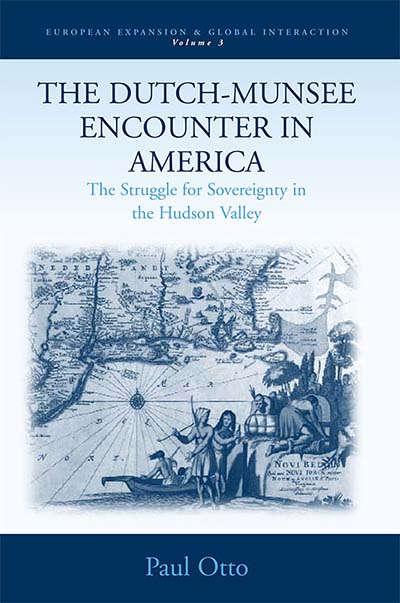
THE DUTCH-MUNSEE ENCOUNTER IN AMERICA
The Struggle for Sovereignty in the Hudson Valley
Paul Otto
| 248 pages, bibliog., index ISBN 978-1-57181-672-6 Hb $75.00/£45.50 Published ( 2006) Buy now and get 15% off listed price |
All chapters available for download - see below.
“Otto provides important insights in the cultural developments with the Munsee during this time. He also broadens his analysis in an Afterword by comparing the three phases of the Dutch experience in New Netherland with their colonization of The Cape Colony in South Africa. He finds many parallels, but the most striking was that after periods of peaceful trade and episodes of violent conflict, both aboriginal groups eventually lost their land and became marginalized…The rest of us will be better served by looking to Otto's book to help us understand the complexities of the relationship between the Dutch and the Munsees in the seventeenth-century." · Long Island Historical Journal
“…it offers a thoughtful investigation of understudied peoples and events, and on that count, it is wholly successful…With this useful book, Otto shows how historians of early America can both ‘face east from Indian Country’ and tell the story 'with the Dutch put in'". · H-Low-Countries
“[this book is] a sterling example of how the scholarship on New Netherlands has grown recently…[Otto’s] straightforward narrative provides an excellent chronology of events, causes, and consequences for both peoples in the region.” · Choice
“The book’s author is modest in arguing his case; yet running beneath his understated style and clear, direct prose is a bold and powerful argument about European-indigenous relations in the early modern era...Otto’s courage as a historian shines through [the text]. Not only does he demonstrate that his three-stage model of the Dutch-Munsee encounter applies to French and English frontiers elsewhere in colonial North America, but he also dedicates a fascinating 23 page afterword to the Dutch-Khoekhoe frontier in the seventeenth-century Cape Colony. That comparative drive makes this handsomely designed and thought-provoking work one that scholars and students of European overseas expansion and global interaction will especially appreciate.” · Itinerario
“…offers several valuable insights.” · The Journal of American History
"This is a first-rate discussion of native-European relations, which deals in a lucid way with the different layers of the encounter." · Wim Klooster, Clark University
"The Dutch-Munsee Encounter in America fills a major gap in scholarly studies of New Netherland. With keen judgment and perceptive analysis, Paul Otto examines European intrusion into the lower Hudson Valley and western Long Island and evaluates the changes it wrought on Indian and Dutch societies. This deeply-researched book is as nearly definitive - in the absence of Munsee sources - as it could be, and the comparative essay on South Africa is a valuable bonus." · Alden T. Vaughan, Professor Emeritus of History, Columbia University
Employing a frontier framework, this book traces intercultural relations in the lower Hudson River valley of early seventeenth-century New Netherland. It explores the interaction between the Dutch and the Munsee Indians and considers how they, and individuals within each group, interacted, focusing in particular on how the changing colonial landscape affected their cultural encounter and Munsee cultural development. At each stage of European colonization - first contact, trade, and settlement - the Munsees faced evolving and changing challenges.
Understanding culture in terms of worldview and societal structures, this volume identifies ways in which Munsee society changed in an effort to adjust to the new intercultural relations and looks at the ways the Munsees maintained aspects of their own culture and resisted any imposition of Dutch societal structures and sovereignty over them. In addition, the book includes a suggestive afterword in which the author applies his frontier framework to Dutch-indigenous relations in the Cape colony.
Paul Otto is Associate Professor of History at George Fox University in Newberg, Oregon where he teaches early American, Latin American, and southern African history. He earned a Ph.D. from Indiana University in 1995 and, as a Fulbright Fellow, undertook research in the Netherlands.
Series: Volume 3, European Expansion & Global Interaction
Download chapters from this title
Table of Contents (Free download)
Illustrations (Free download)
Preface (Free download)
Acknowledgments (Free download)
Notes_on_Text (Free download)
Introduction (Free download)
First Contact, 1524-1609
"Those natives of the country ... declare that when they saw [Europeans for the first time], they did not know what to make of them, and could not comprehend whether they came down from Heaven, or were of the Devil."— Adriaen van der Donck, Vertoogh van Nieu Nederlandt1The opening of the frontier was more than just the meeting of European and native individuals. It constituted nothing less than the meeting of two worlds, two systems of thought, two ways of organizing society, understanding reality, and making sense of human experience. Over the centuries, Native Americans and Europeans had developed unique cultural outlooks and patterns of living that reflected their historical experience, physical environment, and religious and cultural commitments. What would happen when members of two such groups met? Violence? Friendship? Congenial intercourse? Trade? Religious feasts and celebrations? And how would each side of this cultural divide perceive the meeting? If their worldviews had grown from such radically different experiences, surely they would understand the meeting with one another differently. And having once met, what would the frontier they created look like? What choices would they make? How would they resolve their cultural differences?
Price: $9
Download full chapter (PDF)
Trade, 1610-1623
"[The Indians'] trade consists mostly in peltries, which they measure by the hand or by the finger. ... In exchange for peltries they receive beads, with which they decorate their persons; knives, adzes, axes, chopping-knives, kettles and all sorts of iron work which they require for house-keeping."— Nicolaes van Wassenaer, Historisch Verhael1Just as word of Hudson's arrival must have spread among the Indians, so too did news of his discovery spread in Europe. Motivated by the ideals of material acquisition and driven by economic forces in Europe, Dutch merchants in Amsterdam wasted no time in dispatching trade expeditions after learning of the newly discovered lands and the valuable supply of furs in the Hudson River region. The Munsees, already engaged in trade with other native peoples throughout northeastern North America, welcomed the new source and availability of goods and provided a nexus through which Europeans would have access to Indian markets in the interior. From 1610 to 1623, a new stage of the frontier developed in which the Indians of the Hudson River and the surrounding region met and traded with a variety of Dutch captains, sailors, and traders.2 Contact was never extensive; the period was not marked by the immigration of European settlers, a demand for native land, or the imposition of Dutch rule. Nevertheless, contact through trade led to broad crosscultural interaction. What would happen when the two groups learned more of one another? Would violence again erupt as it had between the Munsees and Hudson's men?
Price: $9
Download full chapter (PDF)
Trade And Settlement, 1624-1638
"The colony began to advance bravely and to live in friendship with the natives." — Nicolaes van Wassenaer, Historisch Verhael1In December 1623, the Indians of the Hudson River welcomed Dutch traders as they had in previous years. These Dutchmen came aboard the ship Maeckereel and remained in New Netherland during the winter and summer, trading and bartering for furs. Nothing particularly unusual attended this trading expedition. Yet unlike previous voyages, this ship and crew came to New Netherland to establish a monopoly over the fur trade on behalf of the West India Company.2 After this point, relations between Europeans and Indians in New Netherland would take place within the framework of the West India Company's presumed control of a settlement colony.
Price: $9
Download full chapter (PDF)
Settlement Andwarfare, 1639-1647
"We have already stated that the cause of the population of New Netherland was the liberty to trade with the Indians. We shall now prove that it also is the cause of its ruin."— Anonymous, "Journal of New Netherland", 16471After 1638, changes in West India Company policy and the arrival of a new colonial administrator led to fresh developments in the Dutch- Munsee frontier. By altering its trade and immigration regulations, the West India Company encouraged population growth in New Netherland. Both itinerant and permanent immigrants arrived in the colony while trade with the Indians increased. Tensions between the Dutch settlers and the native inhabitants of New Netherland multiplied, including conflicts over land use, dishonest trading, abusive behavior, and even murder. While such problems could lead to increased violence, conflict could also be reduced through the accommodation and cooperation of Dutch and Indian leaders. When leaders from both sides sought to understand one another's legal and diplomatic protocol, the difficulties of the frontier could be smoothed over. By the same token, the actions of one side or another could easily tip the fragile balance. Factors on both sides, in fact, led to sustained violence in the First Dutch-Munsee War, commonly known as Governor Kieft's War.
Price: $9
Download full chapter (PDF)
Warfare And Diplomacy, 1648-1664
"Mr. Weyls ... recently had had in his house an Indian from Wiequaeskeck who had been a good friend of Van der Donck, and had taken care of his cows for some time ... his name was Joseph [and he] spoke English so well that he could understand him."— Director Stuyvesant to the Council, 16561Ultimately, the First Dutch-Munsee War changed little for the Munsee people in terms of lessening the pressure of European colonization. The Dutch may have learned to tread somewhat more lightly when it came to Indian affairs, but in the long run the war did little to slow the overall stream of European settlers to the region. During the next seventeen years, the colony's population recovered its prewar levels and eventually increased to upwards of eight thousand people by 1664. Europeans soon settled or added to the populations of Manhattan Island, Staten Island, and Pavonia. Furthermore, Dutch and English settlers founded new villages elsewhere along the Hudson River and on Long Island. While many still came to New Netherland as itinerant traders, the majority of colonists intended to remain in the colony permanently. Pursuing agriculture and domestic trades instead of bartering for furs, these settlers helped the colony mature and develop a stable economy.
Price: $9
Download full chapter (PDF)
Afterword
First Contact, Trade, and Settelment in The Cape Colony, 1487-1713
Price: $9
Download full chapter (PDF)
Index (Free download)
Sources (Free download)