New Titles Summer/Fall 10
(3.4Mb PDF file)

Anthropology 10/11
(3.3Mb PDF file)

Film and Media Studies 10
(2.5Mb PDF file)

International Studies 10
(3.1Mb PDF file)

History 2010
(2.0Mb PDF file)

Anthropology Texts for Teaching
(5.7Mb PDF file)


advanced search

Browse all titles by:
Author | Title | Series
Celebrating 16 Years of Independent Publishing Last updated: August 19th, 2010


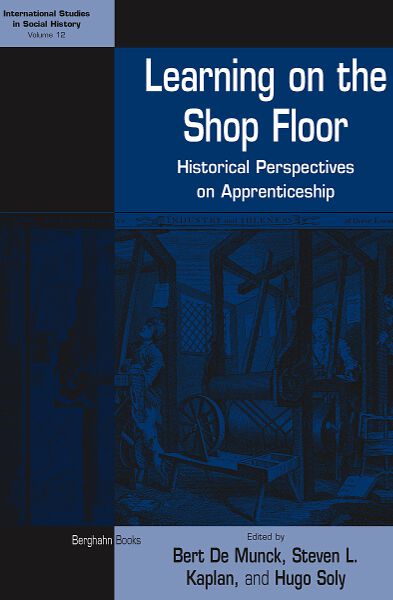
LEARNING ON THE SHOP FLOOR

Historical Perspectives on Apprenticeship

Edited by Bert de Munck, Steven L. Kaplan and Hugo Soly


242 pages, 4 figs, 14 tables, index
ISBN 978-1-84545-341-1 Hb $75.00/£37.50 Published (Winter 2007)
Buy now and get 15% off listed price
Hb 

Download this title All chapters available for download - see below.

(may not yet be available for newest titles)
 Google Book Search

Apprenticeship or vocational training is a subject of lively debate. Economic historians tend to see apprenticeship as a purely economic phenomenon, as an ‘incomplete contract’ in need of legal and institutional enforcement mechanisms. The contributors to this volume have adopted a broader perspective. They regard learning on the shop floor as a complex social and cultural process, to be situated in an ever-changing historical context. The results are surprising. The authors convincingly show that research on apprenticeship and learning on the shop floor is intimately associated with migration patterns, family economy and household strategies, gender perspectives, urban identities and general educational and pedagogical contexts.

Bert De Munck is Lecturer in the Department of History at the University of Antwerp, Belgium, where he teaches social and economic history of the early modern period, history and social theory, and European ethnology and heritage. His research focuses on the history of craft guilds, ‘social capital’ and vocational education.

Steven L. Kaplan is Professor of European History at Cornell University. He published Les ventres de Paris. Pouvoir et approvisionnement dans la France d’Ancien Régime (Fayard, 1988), Le meilleur pain du monde. Les boulangers de Paris au XVIIIe siècle (Fayard, 1996), La fin des corporations (Fayard, 2001) and (as editor, with Philippe Minard) La France, malade du corporatisme(2004).

Hugo Soly is Professor of Early Modern History and Director of the Centre for Historical Research into Urban Transformations at the Vrije Universiteit Brussel, Belgium. His writings focus on five major areas – urban development, poverty and poor relief, ‘deviant’ behaviour, industrialization, and craft guilds. Currently he is working on perceptions of work in pre-industrial Europe.

Series: Volume 12, International Studies in Social History


Download chapters from this title

Table of Contents (Free download)


List_of_Figures (Free download)


Preface (Free download)


'Learning on the Shop Floor' in Historical Perspective

Apprenticeship, which might be described very concisely as 'learning on the shop floor' or simply as 'learning by doing', is not a practice of bygone days. On the contrary, many new economic sectors have a growing need for highly skilled and specialized professionals with the flexibility to accommodate the rapidly changing needs of the labour market. This trend has affected educational systems as well. Not only is lifelong learning increasingly perceived as an absolute necessity, but in several countries two tracks are emerging: specialized modules and curricula at traditional schools on the one hand and shop-floor learning on the other. The process brings education and corporate industry closer together. While schools are under increasing pressure to meet the demands of trade and industry, companies arrange employee training internally. The authorities try to stipulate curricula and issue certificates upon course completion to ensure that training meets labour market demand. Moreover, the seals of quality issued matter to entrepreneurs and potential and current employees alike and thus function as cultural capital.

Price: $9

Download full chapter (PDF)


Apprentices, Servants and Other Workers

Apprenticeship in Japan

The word 'apprenticeship' induces images of teenage boys living and working under a master artisan, later to become journeymen and travel from place to place plying their skilled trade until they become master artisans themselves. This is primarily a pre-modern image associated with the small artisan workshop. In Japan, however, apprenticeship was not limited to artisan skills, the small artisan workshop, or teenage boys, even in the early modern context. The apprentice did not later become a journeyman and travel around the countryside plying his trade. Apprenticeship was a way of training managers in larger firms as well as skilled workers and artisans. Moreover, this system has continued to influence the way modern Japanese firms work as well as skilled artisans in craft industries. This study uses data from several early modern firms to show the role of apprenticeship in the early modern context. Secondary research and contemporary data are then used to show the continuing role of apprenticeship in modern Japan.

Price: $9

Download full chapter (PDF)


From School to Workshop

Pre-Training and Apprenticeship in Old Regime France

To the extent that we understand apprenticeship in Old Regime France, we understand it through the prism of the guild system. Guilds established regulations regarding apprenticeship and maintained a supervisory role in the training offered by their masters. A 1691 royal edict required apprentices to obtain notarized contracts for their training, signed by guild officers. Apprentices' families paid fees to the guild and its officials as well as any charges demanded by the child's master. In return, the apprentice acquired a recognized qualification vis-à-vis the corporation. Upon completion of the training period, the youth had acquired not only useful skills and professional contacts, but the capacity to become a master in turn one day. Apprenticeship was not a guarantee of entry; the finished apprentice still had to overcome major obstacles, including an entry fee, masterpiece, various ancillary fees and charges, and, often, quotas on the number of finished apprentices accepted each year. Still, he or she possessed an official qualification denied to those who had not undertaken a formal apprenticeship or who had done so in a different city. This privilege was even greater for Parisian apprentices, whose training was valid for guilds across the kingdom. Journeymen who lacked formal apprenticeship — or the superior qualification of being a master's son — could only hope to become masters by buying an expensive letter of mastership or marrying a master's widow.

Price: $9

Download full chapter (PDF)


Apprenticeship and Guild Control in the Netherlands, C.1450–1800

Apprenticeship at present seems to enjoy a higher reputation than ever before. In his recent survey of artisans in Europe from the late Middle Ages into the era of industrialization, James Farr has stated that apprenticeship was not only an initiation to a trade but an instrument of 'moral and political socialization' as well. Apprenticeship was one of the principal means to discipline labour and maintain a distinction between ranks in society and thus to uphold order and hierarchy. Guild regulations served to institutionalize this central role of apprenticeship for the preservation of the established social order. Steven Kaplan, in a pioneering case-study on apprenticeship in Paris in the eighteenth century, which formed the pièce de resistance of a special issue on this subject of the Revue d'histoire moderne et contemporaine, has claimed that apprenticeship was 'une des pierres angulaires du système de reproduction du monde des arts et métiers', which primarily served for the transmission of knowledge and skills but also contributed to the survival of the corporate system by acting as a vehicle of socialization.

Price: $9

Download full chapter (PDF)


Construction and Reproduction

The Training and Skills of Antwerp Cabinetmakers in the Sixteenth and Seventeenth Centuries

Apprenticeship in the Ancien Régime is included as a matter of course when studying the traditional trades, and rightly so: the apprenticeship system cannot be seen apart from the corporate organizational structures in which it existed. As the study of traditional trades moves forward, re-evaluations in that area will have important consequences for studies of apprenticeship — and a great deal has changed since the introduction of the term protoindustrialization. The key terms used to describe craft guilds have long had pejorative connotations: exclusivity, conservatism and heredity. Inevitably this has had a number of important consequences for the historical view of apprenticeship. Apprenticeship was approached primarily as an instrument in the hands of the masters, in the context of their control over the labour market and access to master status. Recently, however, other views of the trades have come to the fore: the realization of complex market strategies such as investment in quality and innovation and the resulting opportunities created in certain sectors and professions. On the European continent and in the Southern Netherlands in particular, remarkable cycles of product innovation and product differentiation have been observed. In the final decades of the sixteenth and the first half of the seventeenth centuries import substitution, expansion of ranges and the use of artistic creativity enabled many urban sectors (addressing problems related to access to foreign markets) to recreate a flourishing export industry.

Price: $9

Download full chapter (PDF)


Learning By Brewing

Apprenticeship and the English Brewing Industry in the Late Victorian and Early Edwardian Period

In the introduction to his wife's memoirs, Charles Flower, the Stratford-upon- Avon brewer and Shakespeare enthusiast, claimed that, when he first learned to brew in the middle of the nineteenth century, he literally began at the copper side. From there he 'went through the brewery under the direction of [his] father'. At this time, the firm brewed approximately three times a week and, according to Charles, that left him with much time for office work, among other tasks. Not just confined to the brewery that his father, Edward, had built in 1831, Charles collected cash from customers, kept the firm's account books and even did some of the brewery's sales work, otherwise known as travelling. Even more surprising, in October 1846, when Edward Flower left Stratford to visit relatives in America, the firm was left entirely in the hands of his sixteen-year-old son. Seemingly given little say in the matter, Charles claims the experience taught him 'the necessity of managing'. A year later, with his father back in charge of business affairs in Stratford, he was sent for approximately a month to stay with the Fordhams, other relatives in Hertfordshire and owners of the Ashwell Brewery, in order to study their methods of brewing and malting. While perhaps not having received the most systematic of educations, Charles Flower could proudly claim on the occasion of his retirement more than four decades later that he had 'worked in all areas of the brewery' and 'done a part of all the work'.

Price: $9

Download full chapter (PDF)


Silk Weaver and Purse Maker Apprentices in Eighteenth- and Nineteenth-Century Vienna

Over the last few decades, the perseverance and flexibility of preindustrial institutions and mentalities, of cultural and institutional frameworks during the process of modernization in the eighteenth and nineteenth centuries have become central themes in historical research. The study of preindustrial artisans provides key insights for an investigation into mobility and stability. The starting point of this chapter is that artisan trades should not be interpreted as some kind of fossilized relic. Rather, they should be understood as a flexible and ultimately very efficient means of regulating social mobility and dynamism.

This chapter deals with questions about duration and stability of an apprenticeship within Viennese artisan-workshops. Until now, these questions have not received much attention among historians. The regular training of artisans, which included their time as apprentices and as journeymen, was already institutionalized in the late Middle Ages and was in existence in nearly the same form until the twentieth century. The extreme importance of that training has been seen as one of the central characteristics of preindustrial artisan production. Contrary to the long-argued thesis of a continuous decline of a society and economy where the processes of production and reproduction were combined and apprentices as well as journeymen shared the households of their masters during the process of industrialization, this chapter will show that this system endured for a long time.

Price: $9

Download full chapter (PDF)


Social Mobility and Apprenticeship in Late Medieval Flanders

The last few decades have seen a dramatic increase in historical literature on apprenticeship and guilds in early modern Europe, but not for the late medieval period in Europe. Historians may have been daunted by the apparent lack of sources or the seemingly one-sided information in the normative sources. While these critics may be correct in their assessments of the economic and social realities of entrepreneurship, the guild statutes that have come down to us (although vague) can also provide indications of ideologies, cultural modes and social customs. A comparison of existing regulation with contemporary litigation in urban courts, surviving apprenticeship contracts, or scarce quantitative data about guild membership, moreover, sheds useful light on indicators of change as well as on some continuities.

Price: $9

Download full chapter (PDF)


Apprentices in the German and Austrian Crafts in Early Modern Times

Apprentices as Wage Earners?

Older studies of handicrafts history have generally focused on Guild ordinances containing articles of apprenticeship. These can indeed provide some important clues about social practices, but they tended to be merely normative overviews so they remain inadequate guides to actual practices. Educational sciences developed an early interest in the history of occupational education. They viewed guild training in the early modern period as integrated into an order of estates and governments, a static order where the requirements of tradition made any deviation from strictly observed norms impossible. According to Stratmann training was based on a fixed catalogue of behaviours set by custom, habit, law and religion and the imitatio process (learning through imitation) permitted no weakening of custom. In this view traditionalism led to a crisis in artisanal education in the late seventeenth century. Then, Enlightenment pedagogy (viewed from this humanistic perspective as the real source of occupational education in industrial society) brought occupational training into the light.

Price: $9

Download full chapter (PDF)


Reconsidering Apprenticeship

Afterthoughts

I propose these 'afterthoughts' not as a canonical conclusion — the elegant introduction does that job, as it were, pre-emptively — but as a critical and provocative homage to the excellent scholarship of this book. I question a number of approaches, challenge certain assumptions, (re)problematize some issues, seek elucidation of various points, venture connections and disconnections, and indicate areas where further research would be welcome: prolegomenon for a return ticket to the heat.

Price: $9

Download full chapter (PDF)


Index (Free download)


Contributors (Free download)


If you have any questions or comments about this site, please email us
All prices listed on this website are subject to change without notice.