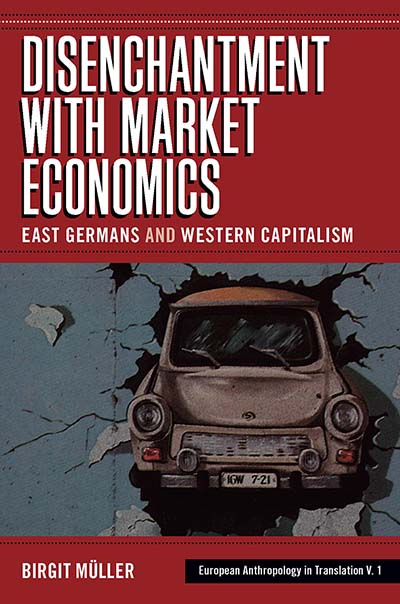
DISENCHANTMENT WITH MARKET ECONOMICSEast Germans and Western CapitalismBirgit Müller
The life-worlds and personal experiences of workers and employees in three enterprises in East Berlin at the moment of political and economic upheaval stand at the centre of the book. It sets out in 1989 at the moment of the fall of the Berlin Wall witnessing the confrontations with the market economy and examining the reinterpretations of the socialist past as the political and economic changes take place. Disenchantment with Market Economics captures a unique moment in history and unveils myths and promises of liberal market economy from the perspective of those who lived through the break down of the planned economy at their workplaces in East Berlin. While Western managers regarded the expansion of their businesses towards Eastern Europe as a civilising mission, the East German employees reacted with complex strategies of individual adaptation and resistance. Birgit Müller is a senior researcher in Social Anthropology at the Laboratoire de l'anthropologie des institutions et organisations sociales, LAIOS-CNRS in Paris. She has done extensive research in factories and on social and environmental movements in eastern and western Europe and Latin America. Her current focus is on power and ideology in the bio-tech controversies. Her publications include Political Power and Institutional Change in Post-Communist Eastern Europe (C.S.A., 1999). Series: Volume 1, European Anthropology in Translation Download chapters from this titleTable of Contents (Free download) Preface (Free download) Introduction (Free download) Part_1_Introduction (Free download) Ideology and Practice of the PlanThe transfer of private ownership of the means of production into 'people's property' (Volkseigentum) did away with profits on capital and the maximization of individual gain as the primary drives of the economy. Therefore, the market lost its function of allocating economic resources through competition among profit-oriented, legally autonomous subjects, acting at their own risk — in the roles of sellers and buyers of labour power, investors, producers, dealers and consumers (Rottenburg 1992: 242). To replace the market, the plan was introduced by means of which the appropriate products were supposed to be manufactured and distributed in the required amounts and at the right time. Download full chapter (PDF $9.00) Pact of Plan FulfilmentThe ideal 'socialist working person' is characterized by 'social responsibility and the highest sense of duty towards his party, his class and our people', declared Honecker in his speech given on the occasion of the twenty-fifth anniversary of the activist movement in 1973 (Honecker 1984: 69). Socialist morals demanded from the classconscious worker the will 'to be an active instrument', through which the transcendental will of the party and the objectives of socialism were realized (Gorz 1990: 64). The 'socialist worker' was supposed to strive for fulfilment of social responsibility and not for individual selfrealization and personal advantages. By overcoming alienation from work and its products, advocates of real existing socialist ideology claimed to have achieved consistency between the aims of society, enterprises and individuals (Rottenburg 1992: 242). Download full chapter (PDF $9.00) Socialism as PerformanceSocialist competition was the company philosophy of the planned economy. That is to say, it was not primarily about productivity, but rather about the cultural and political role of the workers inside and outside of the enterprise that granted the system its legitimacy. The worker (in GDR terminology Werktätige), as a member of the 'statesupporting class', was a central figure of the official ideology, and the worker's labour was ideologically embellished as 'a contribution towards the wellbeing of the people', and portrayed as 'a contribution in the struggle for peace'. Staff were not only to create goods of material value, but also to reproduce the values of socialism. Download full chapter (PDF $9.00) Party Rule in the EnterpriseThe political control of the economy by the party and the plan, which in turn received its direction from the central committee of the SED (Socialist Unity Party of Germany), constituted the key difference between market and planned economy. The 'ideological work' undertaken by the party organization of the enterprise might appear as a completely superfluous task when seen from the perspective of the market economy. However, production in the planned economy was not separate from the state, and non-economic considerations, such as political control, social redistribution, and military strategies, were inseparably bound with productive aims. The ideological monopoly of the Communist Party stipulated state property and state monopoly over the economy, which in turn required bureaucratic control and coordination and the abolition of the market (Kornai 1992: 360). Download full chapter (PDF $9.00) Part_2_Introduction (Free download) Privatization – Domination and PossessionIn the third part of this book, I will contrast the internal conflicts I was able to observe here over a two-year period with the privatization of the third enterprise by a multinational concern – 'from the outside', so to speak. The integration of the third enterprise into a concern that operated on a worldwide scale worked somewhat differently and was heavily shaped by global corporate management strategies and the influence of a strong workers' committee. The Treuhandanstalt's (trust fund's) concept of privatization allowed neither for the workers to share in the possession of the enterprise, nor for their participation in the privatization process. Its aim was the allocation of all property in the GDR to private legal entities. Download full chapter (PDF $9.00) Market DelusionThe high acceptance that the introduction of a market economy found at the beginning of 1990 among the workers was not only because of their consumer appetite, but also because of their need for moral renewal and transparency following the collapse of the 'deceitful' system of the planned economy. The pure market model, derived from the theoretical assumption of a self-regulating system of perfect competition, whereby competing producers satisfy the demand of independent consumers (Preston 1992: 61), received in the enterprises a popular interpretation. It was turned into a 'little tradition' (Tambiah 1970: 3–4), in other words, into a localized version of a large dominant tradition. This had a powerful moralizing dimension. Commercial transactions, the position of the employees in the enterprise and their chances in the job market were judged and justified using moral categories. Download full chapter (PDF $9.00) Worldviews at the Time of the WendeIn the time leading up to the Wende of autumn 1989, any promise for the future lay in the emphasis on common ground between East and West. With exhilaration, the cry of 'We are one people!' was to be heard in East and West. As the Wall came down, thousands of West and East Germans fell weeping into each other's arms. We watched these scenes of emotion between complete strangers on television, and hurried to be at the Wall ourselves. But, since then, that feeling of unity has been lost. You could almost think that it had never existed, and that the essentialising discourse of unity had never been this irresistible tide that had carried the German reunification along with it, against all the doubts and worries of the neighbouring countries. Download full chapter (PDF $9.00) Part_3_Introduction (Free download) Hochinauf's Mission in East GermanyThe expansion of the business into East Germany was supported by Western managers' conviction that, along with its economic and commercial goals, Hochinauf had a cultural, and even civilizing, mission to fulfil in the East. Against the irrationality and arbitrariness of the planned economy, as they perceived it, the managers laid down an enlightenment idea of man, based on economic rationalism, optimism and individualism. In their opinion, capitalism had clearly won the battle between the two systems. They therefore wanted to 'help the losers' make the leap into the market economy and create the basic cultural, legal and social conditions that this would require. Download full chapter (PDF $9.00) Two Careers in the Market EconomyIn this chapter I want to examine how two managers, with different professional trajectories that shaped their hopes and expectations towards the multinational corporation, enacted the corporate philosophy. This philosophy presented the new power relationships as being for the best of everyone. Was the staff convinced by it, did they endorse it, and was this philosophy therefore functioning like a hegemonic ideology in the Gramscian sense (Gramsci 1959: 344)? Download full chapter (PDF $9.00) Unification and IndividualizationIn February 1993 the industrial trade union IG Metall fought to keep the timetable for the alignment of wages in East and West Germany. Pfeiffer, the human resources director of Hochinauf was elected as the spokesperson of the national employers' association (Arbeitgeberverband). On the other side the trade union nominated Schwarz, the East Berlin chairman of the workers' council of Hochinauf. The two played a prominent part in the media. Hochinauf became a symbol of the differential treatment of East and West Germans, as employees doing the same work received different wages. Download full chapter (PDF $9.00) Index (Free download) Bibliography (Free download) Conclusion (Free download) |