Join our Email List




Series
Volume 12
War and Genocide
Email Newsletters
Sign up for our email newsletters to get customized updates on new Berghahn publications.
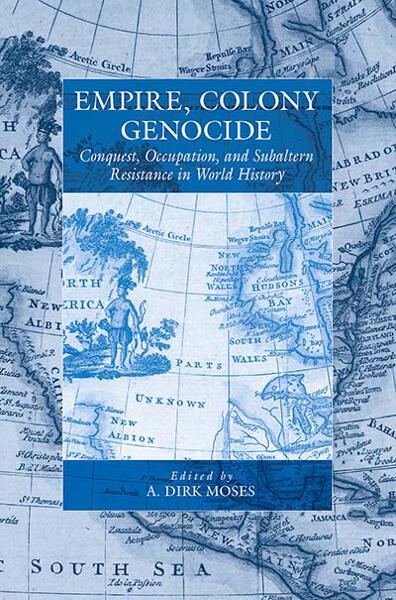
Empire, Colony, Genocide
Conquest, Occupation, and Subaltern Resistance in World History
Edited by A. Dirk Moses
502 pages, bibliog., index
ISBN 978-1-84545-452-4 $180.00/£138.00 / Hb / Published (June 2008)
ISBN 978-1-84545-719-8 $29.95/£23.95 / Pb / Published (December 2009)
eISBN 978-1-83695-603-7 eBook
Reviews
FIRST PRIZE IN THE CATEGORY OF NON-EUROPEAN HISTORY
Awarded for 2009 by H-Soz-und-Kult
With its depth of theoretical insight and the wealth of empirical material this volume sets new standards for the history of colonialism and genocide"
…an impressive achievement [to be used) as a core text for graduate and upper-- undergraduate courses in genocide studies…The book deserves to be read straight through; it maintains an admirable consistency of tone, purpose and scholarly quality through more than 450 pages. Specialists in the field will wish to add it to their collections immediately." · European History Quarterly
…much of the material in this book is thoughtful and thought provoking, particularly for those with academic or political interests in imperialism and colonization…[There are many] thought-provoking considerations that the probing contributions to Moses’ volume on genocide will raise among careful readers.” · H-Net Reviews
The essays in it establish the historical record of genocide in ways both verifiable and meaningful and thus, in a sense, permit future scholars to advance our ability to explain the ultimate political question of this or any time. This excellent volume certainly deserves the tribute of further scholarly and theoretical effort.” · Holocaust and Genocide Studies
The theoretical and empirical are linked in this stimulating volume in an exemplary manner.” · Zeitschrift für Genozidforschung
There is still so much to be understood and interpreted about the intersections of empire, colony and Genocide, and the pieces gathered here by Moses are successfully informative and thought-provoking.” · Journal of Australian Colonial History
…a fine body of work. The essays cannot examine every example of genocide, but collectively they represent a starting point for students, scholars and general readers. For this reason, I wholeheartedly recommend this book for high school and university courses alike.” · Canadian Journal of History/Annales canadiennes d’histoire
Moses has gathered an elite cohort of scholars with unrivalled expertise. Still, he makes no claim to comprehensiveness and I must follow his example. It is way beyond any review to do justice to the wealth of research and interpretive insight in all of these contributions. So let me say at the outset: the book is essential reading for anyone grappling with the deep and often intractable issues that confront us as historians of genocide.” · Borderlands e-journal
The essential problem of the book – its recurrent question as well as its potential pitfall – is the position of the Holocaust in relation to other acts of extermination…This creates a tension throughout the book; it also makes it worth debating and certainly makes it a remarkably useful text to inform further research and for teaching purposes.” · Journal of Global History
...the volume offers an unusually rich, deeply disturbing material.” · Peripherie
Empire, Colony, Genocide represents an important contribution to genocide studies. Taken individually or collectively, the contributors should be applauded for some thoughtful, methodologically sophisticated, and intellectually rigorous work ... What this volume provides, therefore, is stimulus to further analyze the social, economic, and cultural threads that fostered this complexity, and rationalized genocidal violence.” · Journal of Genocide Research
"Crossing broad temporal ranges and geographies, the collection represents a significant advance in genocide scholarship in its fusion of ostensibly unconnected episodes of mass violence, mass migrations, and nation building projects. It also represents a critical attempt to revisit the impact of murderous impulses in Western modernity as a structural logic with definable processes and actively pursued outcomes of domination and erasure of the colonised” · Australian Journal of Politics and History
In summary, this is a book that proposes a daring thesis, namely that genocide since antiquity has its origins in imperialism and colonialism.” · Journal of World History
The volume is disturbing and provocative reading. It raises fundamental methodological and conceptual notions related to genocide. It thereby positions genocide studies in their own right much independent of the hitherto largely dominant Holocaust studies, and situates the latter in a wider context. It is a context of a modern history of violence, which emerged in its still existing forms hand in hand with the industrial mode of production.” · New Routes, A Journal of Peace Research and Action
An immensely stimulating volume ... [that] meets the challenge to make this kind of mass violence ... a subject ... of global historical importance. It brings together in an innovative way the ‘crime without name’ as it is sometimes called ... with settler colonialism. This approach thus provides a common framework for fields of research that until then were thought to be disparate. Without relativising the genocide of the European Jews, which was in the minds of Lemkin and the UN Convention, new cross references are nevertheless being trialled." · H-Soz-u-Kult
This volume offers an important contribution to the discussion on methodological and conceptional foundations of the notion of genocide in that it identifies the latter more precisely and anchors it more firmly in historical epistemology than has been the case up to now in Genocide Studies… Second, this volume reflects new developments in Genocide Studies in its focus on ‘Genocide from Below’… Third, some contributions stand out because of their daring and unconventional approaches [which should be] an encouragement for others to abandon scholarly blinkers." · Sehepunkte
…a meticulously researched and deftly edited scholarly reference…strongly recommended to community library history collections and any non-specialist general reader with a strong interest in world history." · The Midwest Book Review
Description
In 1944, Raphael Lemkin coined the term “genocide” to describe a foreign occupation that destroyed or permanently crippled a subject population. In this tradition, Empire, Colony, Genocide embeds genocide in the epochal geopolitical transformations of the past 500 years: the European colonization of the globe, the rise and fall of the continental land empires, violent decolonization, and the formation of nation states. It thereby challenges the customary focus on twentieth-century mass crimes and shows that genocide and “ethnic cleansing” have been intrinsic to imperial expansion. The complexity of the colonial encounter is reflected in the contrast between the insurgent identities and genocidal strategies that subaltern peoples sometimes developed to expel the occupiers, and those local elites and creole groups that the occupiers sought to co-opt. Presenting case studies on the Americas, Australia, Africa, Asia, the Ottoman Empire, Imperial Russia, and the Nazi “Third Reich,” leading authorities examine the colonial dimension of the genocide concept as well as the imperial systems and discourses that enabled conquest. Empire, Colony, Genocide is a world history of genocide that highlights what Lemkin called “the role of the human group and its tribulations.”
A. Dirk Moses Dirk Moses is chair of global and colonial history at the European University Institute, Florence / University of Sydney. He has published widely on modern Germany and Comparative Genocide Studies. His publications include Genocide and Settler Society (Berghahn Books 2004) and German Intellectuals and the Nazi Past (CUP 2007)
Subject: Genocide HistoryColonial History
Contents
Of Related Interest...

The Massacre in History
National Socialist Extermination Policies
Contemporary German Perspectives and Controversies
War of Extermination
The German Military in World War II