Join our Email List
Series
Volume 3
Spektrum: Publications of the German Studies Association
See Related
History JournalsEmail Newsletters
Sign up for our email newsletters to get customized updates on new Berghahn publications.
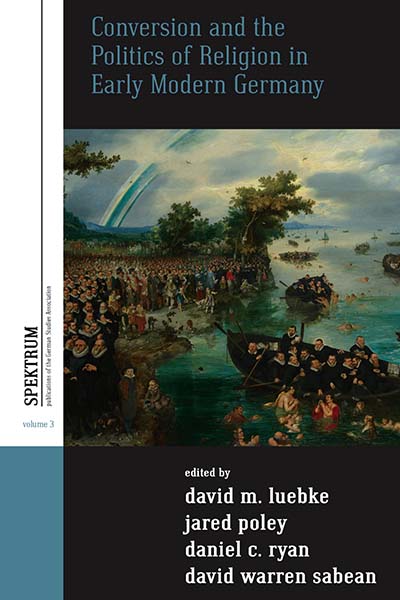
Conversion and the Politics of Religion in Early Modern Germany
Edited by David M. Luebke, Jared Poley, Daniel C. Ryan, and David Warren Sabean
216 pages, bibliog., index
ISBN 978-0-85745-375-4 $135.00/£104.00 / Hb / Published (May 2012)
eISBN 978-1-83695-770-6 eBook
Reviews
“The book is unusually coherent for a collection of essays…One of the strengths of this volume is the long chronological perspective it takes. The essays cover issues from the first half of the sixteenth century to the middle of the eighteenth century. This perspective allows the reader to trace German ideas about conversion and to connect them in a nuanced way with political developments. The volume thus provides a new perspective on the issue of confessionalization.” · American Historical Review
“This well-conceived essay collection provides not only an excellent survey of the meanings of conversion in early modern Germany but also important insights into the whole concept of ‘conversion’ in the pre-modern period and the light this sheds on such associated ideas as the ‘confessionalization’ paradigm. In his lucid introduction, David Luebke not only provides the reader-in-a-hurry with useful summaries of each of the subsequent essays, but also an outline sketch of the different meanings of the term ‘conversion’ during the period under review…The volume is brought to a close by a brief afterword and is provided with an excellent index which makes this essay collection a must for all those increasing number of scholars who are becoming interested in conversion and religious identity formation beyond only the pre-modern world.” · European History Quarterly
Description
The Protestant and Catholic Reformations thrust the nature of conversion into the center of debate and politicking over religion as authorities and subjects imbued religious confession with novel meanings during the early modern era. The volume offers insights into the historicity of the very concept of “conversion.” One widely accepted modern notion of the phenomenon simply expresses denominational change. Yet this concept had no bearing at the outset of the Reformation. Instead, a variety of processes, such as the consolidation of territories along confessional lines, attempts to ensure civic concord, and diplomatic quarrels helped to usher in new ideas about the nature of religious boundaries and, therefore, conversion. However conceptualized, religious change— conversion—had deep social and political implications for early modern German states and societies.
David M. Luebke is Professor of History at the University of Oregon. His publications include His Majesty’s Rebels: Factions, Communities, and Rural Revolt in the Black Forest (Cornell University Press 1997) and many articles, most recently “Confessions of the Dead: Interpreting Burial Practice in the Late Reformation” (Archiv für Reformationsgeschichte 101: 2010).
Jared Poley is Associate Professor of History at Georgia State University. He is the author of Decolonization in Germany: Weimar Narratives of Colonial Loss and Foreign Occupation (Peter Lang 2005).
Daniel C. Ryan is currently Visiting Assistant Professor at the College of Charleston. He was awarded his PhD in 2008 from the University of California, Los Angeles, with a study on conversion and peasant protest in Imperial Russia.
David Warren Sabean is the Henry J. Bruman Endowed Professor of German History at University of California, Los Angeles. He is the author of Property, Production, and Family in Neckarhausen, 1700-1870 (Cambridge University Press 1990) and Kinship in Neckarhausen, 1700-1870 (Cambridge University Press 1998). He recently edited, with Simon Teuscher and Jon Mathieu, Kinship in Europe: Approaches to Long-Term Development, 1300-1900 (Berghahn Books 2007).
Subject: History: Medieval/Early Modern
Area: Germany
Contents
Of Related Interest
Between Reform and Revolution
German Socialism and Communism from 1840 to 1990
Imperial Germany 1871-1918
Economy, Society, Culture and Politics
The East German State and the Catholic Church, 1945-1989