Join our Email List
Series
Volume 28
Forced Migration
Email Newsletters
Sign up for our email newsletters to get customized updates on new Berghahn publications.
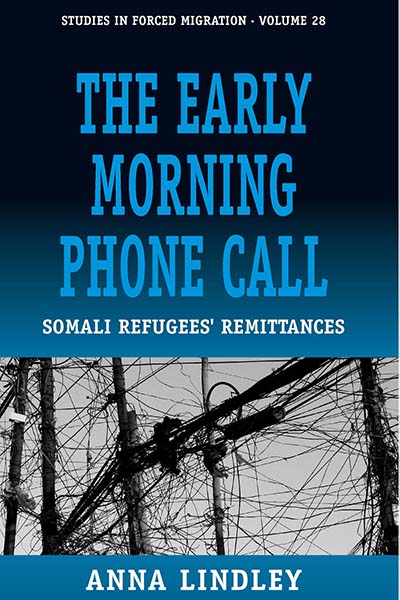
The Early Morning Phonecall
Somali Refugees' Remittances
Anna Lindley
192 pages, 18 illus., bibliog., index
ISBN 978-1-84545-644-3 $135.00/£104.00 / Hb / Published (August 2010)
eISBN 978-1-83695-725-6 eBook
Reviews
“In a nutshell, [this book] is a timely and productive intervention in the debates on migration, remittance refugees and development. The ethnographic narrative is rich… and provides an excellent counterpoint to the general understandings of the role of remittance in development.” · Review of African Political Economy
“…should be read by any academic or policy maker interested in migration, transnationalism, and financial remittances involving conflict settings such as Somalia. Besides, and for all students of social anthropology, it is a wonderful example of a multi-sited ethnography in George Marcus’ sense and shows how to study a phenomenon such as remittances in transnational space.” · Nordic Journal of Migration Research
“In sum, Lindley offers readers interested in understanding the transnational political and economic impact of remittances a solid multisited empirical study that provides a good starting point for future studies.” · American Anthropologist
“Her interdisciplinary research combines ethnographic and survey data from three different contexts in which remittances ramify: Hargeisa, Nairobi and London. Through this combination of qualitative and quantitative methodologies, statistics are brought to life by accounts of real lives and the social pressures and bonds involved in the remittance economy.” · The Journal of Modern African Studies
“Lindley’s book negotiates the complexities and captures the ambiguities that define life in the diaspora, the role of remittances, the rise of a transnational identity, and the realities of people living in Somalia and beyond. I would hope that [it] finds a large audience. Lindley’s style as well as her experience with and strong knowledge of the region make for an excellent study that should find a home in classes focused on migration, remittance practices, development, and African Studies.” · Anthropological Quarterly
"Anna Lindley's new book is a welcome addition to the study of transnational remittances and their critical role in the lives of ordinary residents of war-torn Somalia. This work counters popular images of Somalis as thieving pirates, unscrupulous money launderers and vicious war mongers, by showing how remittances allow ordinary and peaceful Somali families cope with extraordinarily difficult circumstances. Anna Lindley has done a great service to scholars of the Horn of Africa, reminding readers that the protracted crisis in Somalia and its global remittance industry defy simplistic, ‘knee jerk’ explanations." · Peter D. Little, Professor of Anthropology and Director, Development Studies Program, Emory University (author of Somalia: Economy without State)
“Migrant workers’ money transfers home are usually the stuff of World Bank statistics. Anna Lindley tells the human stories behind the data, and examines the relationships between people trying to survive the daily insecurity of a failed state and those who have escaped. Yet she never forgets the political economy of global inequality, which lies behind the heart-wrenching decisions that refugees and migrants have to make. This book is a remarkable combination of social analysis and story-telling, which should (but won’t) be read by everyone who ever fell for the headlines about asylum seekers as a threat.” · Stephen Castles, University of Sydney
“This is an interesting, humane, thoughtful and well-written account of Somali remittances, a topic that has been discussed to some extent but never in such a detailed way. It addresses current debates and policy interests in the field of migration-development very well. Lindley's data on remittances in conflict-affected areas is remarkably detailed and rich, while her multi-sited fieldwork approach provides an excellent insight into the complexities of engaging in transnational livelihoods for all those involved.” · Cindy Horst, Senior Researcher, International Peace Research Institute Oslo
Description
As migration from poverty-stricken and conflict-affected countries continues to hit the headlines, this book focuses on an important counter-flow: the money that people send home. Despite considerable research on the impact of migration and remittances in countries of origin - increasingly viewed as a source of development capital - still little is known about refugees’ remittances to conflict-affected countries because such funds are most often seen as a source of conflict finance. This book explores the dynamics, infrastructure, and far-reaching effects of remittances from the perspectives of people in the Somali regions and the diaspora. With conflict driving mass displacement, Somali society has become progressively transnational, its vigorous remittance economy reaching from the heart of the global North into wrecked cities, refugee camps, and remote rural areas. By ‘following the money’ the author opens a window on the everyday lives of people caught up in processes of conflict, migration, and development. The book demonstrates how, in the interstices of state disruption and globalisation, and in the shadow of violence and political uncertainty, life in the Somali regions goes on, subject to complex transnational forms of social, economic, and political innovation and change.
Anna Lindley is a Lecturer in Development Studies at the School of Oriental and African Studies, University of London. The study on which this book is based was carried out while working at the Centre on Migration, Policy and Society and the Refugee Studies Centre at Oxford University.
Subject: Refugee and Migration StudiesPeace and Conflict Studies
Area: Africa
Contents
Of Related Interest
The State and the Grassroots
Immigrant Transnational Organizations in Four Continents
Migration Control in the North-atlantic World
The Evolution of State Practices in Europe and the United States from the French Revolution to the Inter-War Period
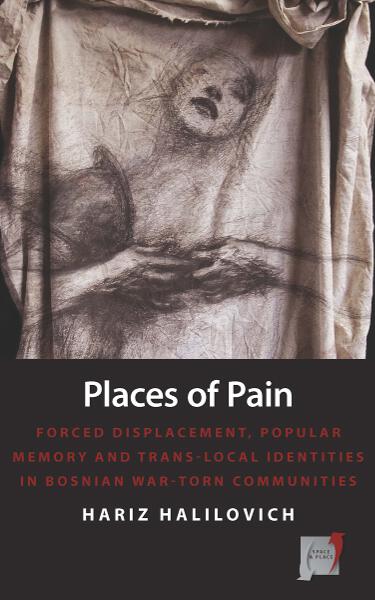
Places of Pain
Forced Displacement, Popular Memory and Trans-local Identities in Bosnian War-torn Communities