New Titles Summer/Fall 10
(3.4Mb PDF file)

Anthropology 10/11
(3.3Mb PDF file)

Film and Media Studies 10
(2.5Mb PDF file)

International Studies 10
(3.1Mb PDF file)

History 2010
(2.0Mb PDF file)

Anthropology Texts for Teaching
(5.7Mb PDF file)


advanced search

Browse all titles by:
Author | Title | Series
Celebrating 16 Years of Independent Publishing Last updated: August 19th, 2010


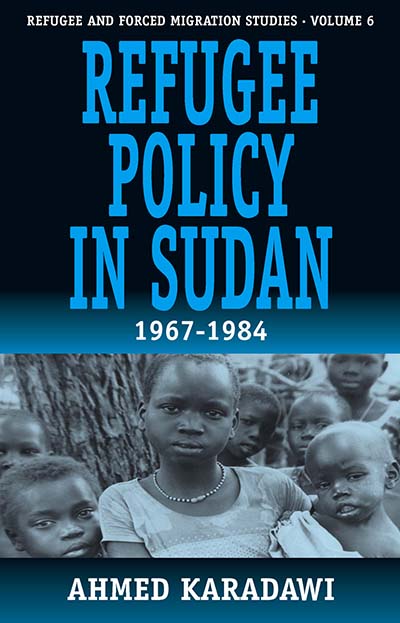
REFUGEE POLICY IN SUDAN 1967-1984

Ahmed Karadawi

Edited by Peter Woodward


256 pages, maps, bibliog., index
ISBN 978-1-57181-708-2 Hb $59.95/£40.00 Published ( 1999)
Buy now and get 15% off listed price
Hb 

Download this title All chapters available for download - see below.

(may not yet be available for newest titles)
 Google Book Search

"an excellent addition to what is becoming an increasingly recognized topical seriesof monographs"  · Dr. J. K. Rogge, United Nations Development Programme

"Unlike the author's untimely death, this book has come at an opportune time when the question of asylum seekers and refugees is being increasingly scrutinized."  · Journal of Refugee Studies

Based on the work of Ahmed Karadawi, Refugee Policy in Sudan discusses Sudanese government policy towards the refugee flows from Ethiopia into the Eastern Region of Sudan in theperiod 1967 to 1984, arguing that there were two underlying assumptions behind successive governments' policies: that refugees were considered a security threat and a socio-economic burden. In response,the policies incorporated the Organization of African Unity norms, which offered a platform to depoliticise the refugees, equally with the international conventions relating to refugees, which assured the externalization of responsibility and access to aid. This prescription, however, ignored the dynamism of the conflict that continued to generate refugees - and, as numbers accumulated in Sudan, the international aid regime did not act as a willing partner of the government. The consequences of a sizeable refugee population revealed a serious conflict of priorities, not only within the Sudanese government of the day, but also between the government and aid donors - thus, the objectives of the government policy were seriously undermined.

Peter Woodward received his Ph.D. on Condominium and Sudanese Nationalism from the University of Reading where he is currently Professor of Politics. He has written a number of books on Sudan and has worked in a Sudanese school as part of the Voluntary Service Overseas project.

Series: Volume 6, Forced Migration


Download chapters from this title

Table of Contents (Free download)


List_of_Maps (Free download)


List_of_Tables (Free download)


Foreword (Free download)


Preface (Free download)


Abbreviations (Free download)


Introduction (Free download)


Map-_Distribution_of_Refugees_in_Sudan (Free download)


Sudan, Its Eastern Region, and the Refugees

Since independence in 1956, successive governments of Sudan have been challenged by flows of refugees from the neighbouring countries of Zaire, Ethiopia, Uganda and Chad. By 1984 there were 700,000 refugees in the country compared to 35,000 in 1967. Problems have arisen not only because of the size of the influxes but also because of the complex political background against which these refugee movements have occurred. All these refugee situations result from domestic conflicts which are often prolonged and which inevitably bring political repercussions for neighbouring countries. Similarly, refugees arrive in a dynamic political and economic situation in the country of asylum itself. The conditions in the country of origin and the host context are equally important in understanding

Price: $9

Download full chapter (PDF)


The Emergence of a Centralised Refugee Policy during the Second Parliamentary Regime 1965-1969

This chapter discusses the process by which the governments of Sudan's second parliamentary regime ( June 1965 to May 1969) endeavoured to assume control over the refugees. The genesis of the refugee policy applied in 1967 dates back to 1965, particularly after the election of Prime Minister Mohammed Ahmad Mahjoub. The policy which evolved was necessarily centralised and institution-alised. Several factors came into play to shape it.

Price: $9

Download full chapter (PDF)


The Changing Nature of the Refugee Influxes 1970-1980

The policy towards refugees described in the last chapter was based on the principles of sovereignty and territorial integrity and consequently the condemnation of external intervention in the internal affairs of individual countries. Such a policy was severely tested after the changes in regimes in Sudan in May 1969 and in Ethiopia in September 1974. As before, the presence of opposition groups continued to threaten the security of each regime and created tension between the two countries. In the period from 1976 to 1978, the two regimes abandoned the norms established by the OAU. Instead, they relied on alliances with other states, military buildup, and public support for exiled opposition groups. As a result, Ethiopia witnessed an escalation in fighting between the regime and opposition groups. Military operations expanded to cover larger areas and larger sections of the population were affected. Consequently, the rate of exodus of refugees to Sudan was far greater than anything known before.

Price: $9

Download full chapter (PDF)


Competing Interests within the Sudanese Bureaucracy and Their Consequences for Refugee Policy

The change of policy to one which aimed at improving relations with Ethiopia left the Sudanese regime with the dilemma of how to deal with the refugee problem. It was evident at the time that neither the Eritrean nor other Ethiopian opposition groups were capable of achieving a decisive victory against the Ethiopian regime. Additionally, there was no way that Sudan could force Ethiopia to create a political atmosphere that would enable the refugees to return to their homes. Since it was not possible to force the contending parties to share responsibility, the refugees became a matter of internal policy for Sudan alone.

Price: $9

Download full chapter (PDF)


The Role and Limitations of Assistance to Refugees

UNHCR and COR, 1975-1978

As COR was coming into conflict with other government departments in its attempt to reconcile the need to contain the real or perceived threats posed by the refugees, and the need to guarantee the refugees' rights, its position was strengthened by its link with international donors, as represented by UNHCR. As argued in Chapter 4, COR's close association with UNHCR saved it more than once from being attached to the security organisations, or from being abolished altogether. Since the government was concerned not only to contain the security threat but also to minimise the socio-economic problems posed by the refugees, COR was able to maintain its position by arguing that it at least had a role to play in addressing the latter issue. COR, therefore, occupied a pivotal position as an intermediary between the Sudanese Government and UNHCR. Whilst attempting to guarantee the security of the refugees, in the face of opposing demands from Sudanese authorities, COR was also responsible for providing for their material needs. In the government's view, the task of alleviating the socio-economic problems caused by the refugees necessarily involved approaches to international donors: indeed, the government believed that the international community had an obligation to share the burden.

Price: $9

Download full chapter (PDF)


Refugees as an International Responsibility

The Sudanese Initiative of 1980 and Its Consequences

The last two chapters have argued that in their responses to the refugee phenomenon, both government authorities and UNHCR, from their different positions, adopted measures which ultimately contributed to a crisis situation. The government resorted to measures to force refugees out of areas where they had spontaneously settled; UNHCR failed to help the government or the refugees to find more constructive alternatives. It was COR that took the initial step of proposing that the responsibility for refugees should be shared with the international community and that the crisis situation in Sudan could only be remedied by massive international assistance. However, in spite of the strength of the arguments put forward by COR, the specific case of Sudan was overlooked internationally, as other African countries in a similar position simultaneously made their own financial demands on donors. In response to the situation in which it found itself, COR, with support from the government, formulated an international campaign to raise funds for refugees in the Sudan.

Price: $9

Download full chapter (PDF)


The Active Role of UNHCR in the Development of Refugee Policy

The Promotion of Voluntary Repatriation as an Option

After the exchanges between the Sudanese Government and external donors between 1980 and 1983, the government lost its ability to control refugee policy, or to direct its implementation. As the government successfully sought more assistance from foreign donors, the aid organisations, and in particular UNHCR, were more able to dominate government policy. After 1983, there were even some extreme cases of intervention by foreign organisations and governments to assist particular refugee groups and dissident political fronts directly. Examples of these extreme cases were the secret operations to help the Falasha (Ethiopian Jews) to leave Sudan, and the direct assistance given by some European NGOs to political fronts such as the TPLF, the ELF and the EPLF. However, without minimising the importance of these developments, this discussion is confined to the role of UNHCR, the main partner of the government in dealing with the consequences of the refugee influx. The role of COR declined, while UNHCR emerged as the more active agent, which imposed its own priorities, particularly with regard to settlement policy and its attempts to promote the repatriation of refugees to Ethiopia.

Price: $9

Download full chapter (PDF)


Conclusion

Sudan's refugee policy under successive governments had two major concerns: the threat to state security and the socio-economic burden caused by the refugees. The emphasis on the need to contain the threat to state security was maintained throughout the period under study, irrespective of whether a particular Sudanese regime attempted to contain the threat for the sake of stability or to use it to destabilise the regime in Ethiopia. After 1967, with the introduction of a policy which accepted the OAU norms for the treatment of refugees, the latter course of action became the exception rather than the rule. The Sudanese Government's adoption of the OAU norms was intentional, as they provided legitimacy for its attempts to suppress the political activities of the refugees and to contain any threat to the status quo. Under the influence of governments which, through their internal policies, had caused the exodus of their citizens, the OAU confirmed the link between refugees and the likelihood of threats to national and international security. Both Sudan and Ethiopia had encountered internal conflict which generated refugees, and each needed to contain the threat posed by their active oppositions in exile. In Sudan, as in Ethiopia, the OAU norms gave credence to what was originally an internal government policy to subdue opposition.

Price: $9

Download full chapter (PDF)


Index (Free download)


Bibliog (Free download)


Epilogue (Free download)


If you have any questions or comments about this site, please email us
All prices listed on this website are subject to change without notice.