Join our Email List
Series
Volume 12
EASA Series
See Related
Anthropology JournalsEmail Newsletters
Sign up for our email newsletters to get customized updates on new Berghahn publications.
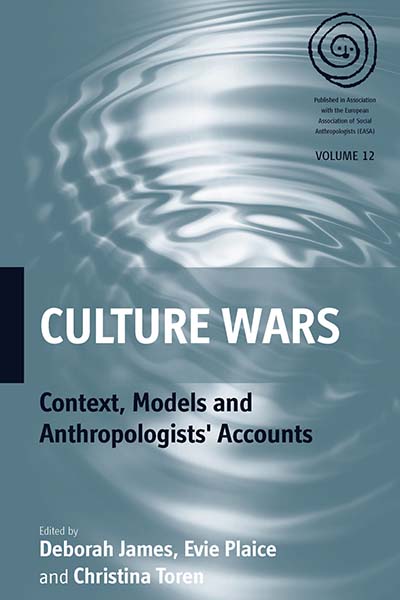
Culture Wars
Context, Models and Anthropologists' Accounts
Edited by Deborah James, Evelyn Plaice and Christina Toren
228 pages, bibliog., index
ISBN 978-1-84545-641-2 $135.00/£104.00 / Hb / Published (March 2010)
ISBN 978-0-85745-661-8 $34.95/£27.95 / Pb / Published (June 2012)
eISBN 978-1-83695-798-0 eBook
Reviews
"an important and very interesting contribution to, first of all, critical and reflexive anthropology…Every chapter offers fresh insights into a key area of critical anthropology. Undoubtedly, the volume is very well organized, thoroughly substantiated, and interestingly written. I believe that the reviewed collection of articles is a distinguished, very useful, and sometimes provocative reading for all scholars concerned with a critical approach to social science and especially to social anthropology" · Anthropos
Description
The relationship between anthropologists’ ethnographic investigations and the lived social worlds in which these originate is a fundamental issue for anthropology. Where some claim that only native voices may offer authentic accounts of culture and hence that ethnographers are only ever interpreters of it, others point out that anthropologists are, themselves, implanted within specific cultural contexts which generate particular kinds of theoretical discussions. The contributors to this volume reject the premise that ethnographer and informant occupy different and incommensurable “cultural worlds.” Instead they investigate the relationship between culture, context, and anthropologists’ models and accounts in new ways. In doing so, they offer fresh insights into this key area of anthropological research.
Deborah James is Professor of Anthropology at the London School of Economics. Her research interests, focused on South Africa, include migration, ethnomusicology, ethnicity, property relations and the politics of land reform. She is author of Songs of the Women Migrants: Performance and Identity in South Africa (Edinburgh University Press, 1999) and of Gaining Ground? “Rights” and “Property” in South African Land Reform (Routledge, 2007).
Evelyn Plaice is Associate Professor of Anthropology jointly appointed to the Faculty of Arts and the Faculty of Education at the University of New Brunswick, Canada. Her interests include land, identity and the ethnopolitics of land restitution, and the anthropology of education. She has conducted research in both South Africa and Canada and is the author of .The Native Game: Indian-Settler Relations in Central Labrador (ISER, 1990).
Christina Toren is Professor of Social Anthropology at the University of St Andrews. Her fieldwork areas are Fiji and the Pacific, and Melanesia, and her theoretical interests include exchange processes; spatio-temporality as a dimension of human being; sociality, kinship and ideas of the person; the analysis of ritual; epistemology; ontogeny as a historical process. Her books include Making Sense of Hierarchy: cognition as social process in Fiji (Athlone, 1990) and Mind, Materiality and History: Explorations in Fijian Ethnography (Routledge, 1999).
European Association of Social-Anthropologists (EASA)
Subject: Theory and MethodologyCultural Studies (General)
Contents
Of Related Interest

A Walk to the River in Amazonia
Ordinary Reality for the Mehinaku Indians
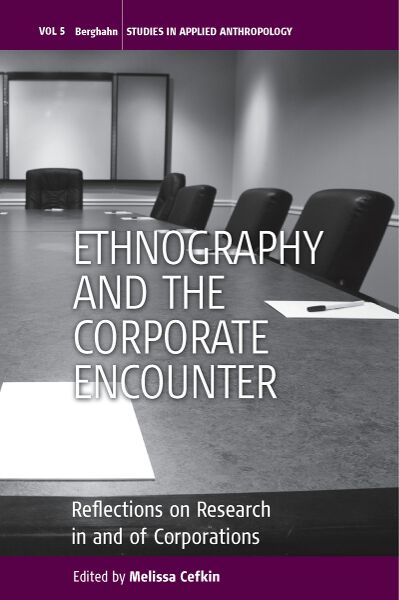
Ethnography and the Corporate Encounter
Reflections on Research in and of Corporations
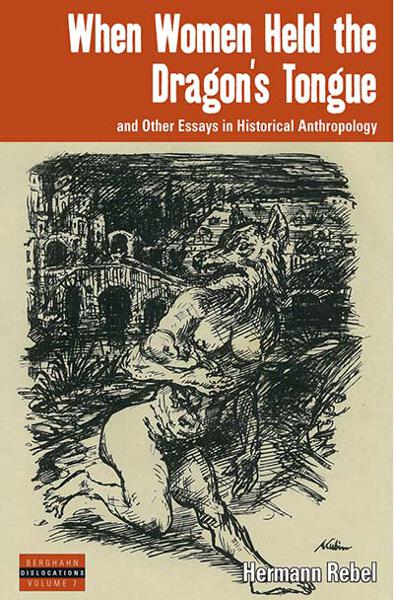
When Women Held the Dragon's Tongue
and Other Essays in Historical Anthropology