New Titles Summer/Fall 10
(3.4Mb PDF file)

Anthropology 10/11
(3.3Mb PDF file)

Film and Media Studies 10
(2.5Mb PDF file)

International Studies 10
(3.1Mb PDF file)

History 2010
(2.0Mb PDF file)

Anthropology Texts for Teaching
(5.7Mb PDF file)


advanced search

Browse all titles by:
Author | Title | Series
Celebrating 16 Years of Independent Publishing Last updated: August 19th, 2010


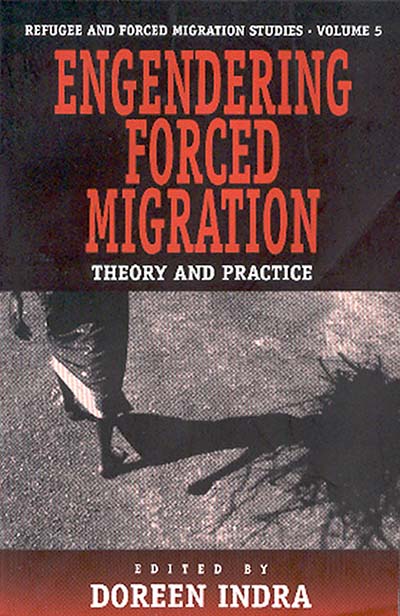
ENGENDERING FORCED MIGRATION

Theory and Practice

Edited by Doreen Indra


400 pages, bibliog., index
ISBN 978-1-57181-135-6 Pb $18.50/£12.95 Published ( 1998)
ISBN 978-1-57181-134-9 Hb $59.95/£45.00 Published ( 1998)
Buy now and get 15% off listed price
Pb 
Hb 

Download this title All chapters available for download - see below.

(may not yet be available for newest titles)
 Google Book Search

"Altogether, this volume has a great deal to offer any reader concerned with the global scenario of armed conflict, environmental stress, large-scale displacement, and the desperate search for security."   · Signs

At the turn of the new millenium, war, political oppression, desperate poverty, environmental degradation and disasters, and economic underdevelopment are sharply increasing the ranks of the world's twenty million forced migrants. In this volume, eighteen scholars provide a wide-ranging, interdisciplinary look beyond the statistics at the experiences of the women, men, girls, and boys who comprise this global flow, and at the highly gendered forces that frame and affect them. In theorizing gender and forced migration, these authors present a set of descriptively rich, gendered case studies drawn from around the world on topics ranging from international human rights, to the culture of aid, to the complex ways in which women and men envision displacement and resettlement.

Doreen Indra is Associate Professor of Anthropology at the University of Lethbridge, Alberta. Her most recent work has been on environmentally forced migrants in Bangladesh and the social construction and culture of disasters. She is the co-author of Continuous Journey: Social History of South Asians in Canada, co-editor and author of two volumes on refugees in Canada and is author of many academic journal articles in the field of forced migration.

Series: Volume 5, Forced Migration


Download chapters from this title

Table of Contents (Free download)


Acknowledgments (Free download)


Introduction (Free download)


Abbreviations (Free download)


Not a "Room of One's Own"

Introduction
This chapter introduces some challenges to the more thorough integration of gender into forced migration research and practice. There are many ways in which this might be accomplished, none of which can be exhaustive or definitive. What I have done is to take a broadly historical journey through several research discourses on gender that highlight what I see as a range of pertinent framing, representational, and revisioning challenges facing forced migration studies and practice today. This approach has in turn required me to read 'gender issues in forced migration' differently than some may anticipate. One could take a quite circumscribed, topically bounded route through the relevant material. But if I were to take this route, I would be accepting as given one of the central framing assumptions I want to challenge: that 'gender' is simply one topic or topical frame among many in forced migration.

Price: $9

Download full chapter (PDF)


Gendering Those Uprooted by 'Development'

Gender, Development, Refugees, and Resettlement

The Gendered Literature
Boserup long since pointed out that households or families are composed of individuals whose productive roles and ability to benefit from production are determined or at least strongly influenced by the structure of gendered relationships (1970). This has become at least a rhetorical commonplace among those who critique development projects, especially those that purport to serve agricultural populations, and the literature on the roles of women in agriculture and as wage earners and how these are affected by centralized planning is now vast (see for example, Adepoju and Oppong 1994; Afsar 1991; Ahmed 1984; Beneria 1982; Chilvers 1992; Creevey 1986; Dauber and Cain 1981; Davidson 1988; Dixon, 1980; Gladwin 1991; Guyer 1986b; Lele 1986; Mencher and Okongwu 1993; Moser 1989; Poats, Schmink, and Spring 1988; Savane 1986; Spring 1979; Staudt 1990; Tinker 1990).

Price: $9

Download full chapter (PDF)


Interview with Barbara Harrell-Bond

Q. Before becoming involved in refugee studies you had established yourself studying more conventional anthropological subjects in Sierra Leone. How did you come to do the field research on African forced migrants that was the basis for your book, Imposing Aid? A. Well, first of all, I have never been "established" as a "conventional anthropologist" in the sense of having a 'my' people approach, nor did I ever study "conventional" anthropological subjects! My first research was in fact in a housing estate in Oxford, Blackbird Leys. It was the last, largest, most 'progressive' housing estate built in Britain and was intended for working-class migrants. The housing shortage in Oxford was a consequence of the migration of workers from other parts of the United Kingdom as well as some from the Commonwealth who had come to Oxford to work in the motor [automobile] industry. So Blackbird Leys was built to house those people referred to as the 'overspill' population in Oxford. In fact, by the time the houses there got built, most people moving to Blackbird Leys had been born in Oxford, and most of those working in the motor industry had bought houses in villages around the city.

Price: $9

Download full chapter (PDF)


Girls and War Zones

Troubling Questions

Introduction

This is a paper I did not want to write because I would be happier if the data did not exist. Graburn (1987: 211)
The inception of this chapter dates to a day in 1990 when I was sitting in a hot and dusty town in Central Zambezia, Mozambique. The town had just been retaken by the Frelimo governmental forces after having been under rebel Renamo control for several years. Renamo was credited with the majority of human rights abuses during the war, and the Renamo commander in charge of this town had a particularly brutal reputation. During Renamo's occupancy, the town center had been destroyed, and a sea of small mud huts spread in all directions on the outskirts of the city ruins. I arrived shortly after the first Frelimo administrator. Disease and starvation were rampant; town leaders estimated that twenty-five people were dying each day. This was in part due to the fact that both Renamo and Frelimo used forced resettlement tactics to control the population, with the result that civilians were frequently denied access to farmlands. Virtually all trade routes had been destroyed by the war, and what resources did exist were often plundered by soldiers and armed bandits. The town's dirt runway allowed emergency cargo planes to land, so this town was the recipient of a one-week feeding program administered by several Western NGOs working with Mozambican emergency relief programs. The pilot of a cargo plane had given me boleia-a free ride.

Price: $9

Download full chapter (PDF)


Gendered Violence in War

Reflections on Transnationalist and Comparative Frameworks in Militarized Conflict Zones

This chapter addresses issues of forced migration that surface in the gendered violations of women in homes and households in war.1 I also explore the potential for comparative analysis of these issues across militarized conflict zones. From a comparative perspective, I argue that ideas and images of the home are often central to nationalist and protonationalist ideologies that inform these conflicts. In such cases, the home as an everyday, tangible and 'natural' conceptual unit is frequently mapped onto the intangible abstractions of nation and state. In this process, homes or households are then often rendered invisible in folk discourse. Nor are they considered relevant units of analysis in most studies of nationalism and war. One aim of this chapter, therefore, is to reveal key dimensions of the gendered nature of nationalism and war through an exploration of the violation of women, homes, and households in 'wartime' and the reflection or immanence of these practices in 'peacetime'. One of the most visible ongoing consequences of gendered violence in war is the massive movement of women and children from war zones. Gendered nationalist ideologies and the conflicts in which they are activated have direct implications for displacement and war, refugee-generating flight, and refugees' experiences thereafter.2

Price: $9

Download full chapter (PDF)


Gender Relief and Politics During the Afghan War

Women no longer have the right to work or attend school.... We want to set up a government based on the precepts of the holy Koran and the Prophet's recommendations…. The Book stipulates that women should not mix with men either at work or in school. If they want to study, they can do so at home under their husbands' supervision. Sayed Abdul Malek, Herat, Afghanistan
It was with horror that many people read these words in the Guardian Weekly (29 October 1995), for observers had hoped that the newest mujahedeen movement, the Taleban, then sweeping through western Afghanistan, would bring enlightenment, unity, and, finally, peace to the beleaguered country.1 This was not to be, for the appearance of the Taleban simply added one more player to the crowded field of warlords vying for power in Kabul, and initiated yet another rearrangement of alliances between old and bitter rivals.

Price: $9

Download full chapter (PDF)


Response to Cammack

Dr. Cammack's chapter raises some very difficult issues relating to religious fundamentalism, identity politics, the role of humanitarian agencies in complex emergencies, and the interface between the West and the Islamic world.

Central to her thesis is the assertion that the West has been willing to openly condemn the gender policies of the Taleban whereas they ignored the very similar policies of the mujahedeen. Her argument that this is due to the greater strategic interest which the US had in continuing cooperation with the mujahedeen has considerable validity. Certainly, while the US is rumored to be backing the Taleban because of its concerns about drugs and terrorism, its wish to recover Stinger missiles given to the mujahedeen, and its interest in the development of a pipeline to transport Central Asian gas and oil to the Indian Ocean, these do not weigh as heavily as the previous ambition to bring the Soviet Union to its knees.

Price: $9

Download full chapter (PDF)


Upsetting the Cart

Forced Migration and Gender Issues, the African Experience

Introduction
This chapter covers the root causes of forced migration in Africa 1 and the related international refugee regime. It also touches on the participation of females and children in wars; the unraveling of the state, social institutions, and structures; assistance programs and their reinforcement of male domination; resettlement and voluntary repatriation. Although internal displacees are discussed, refugees are my main focus. In Africa as elsewhere, males have often been the instigators of violent conflict, yet they are not necessarily the ones who suffer the most. The vulnerable members of society-children, women, the elderly, and the infirm-usually come out worst in these conflicts. This chapter shows that the situation usually does not improve during the course of flight, while in exile, on returning home, or during resettlement. I also show that gender inequality is a significant cause of forced migration and vice versa. Without a fundamental restructuring of society, making it more equitable and reducing levels of violence, particularly those directed at the weakest members, forced migration will continue.

Price: $9

Download full chapter (PDF)


Women Migrants of Kagera Region, Tanzania

The Need for Empowerment

The women who contributed to this study 1 were not refugees from political, religious, ethnic, or other persecution; they were forced to flee poverty and patriarchal custom.2 They migrated to accumulate the capital needed to set up independent households. Haya women are the most productive members of their society but paradoxically are the poorest. This study of four villages in Hayaland, the Kagera region of Tanzania, confirms a common tendency in rural Africa: women carry out approximately two-thirds of all work but earn only one-third of the aggregate cash income. Most of women's meager incomes are used to care for children, leaving little savings or capital accumulation. Women have, out of necessity, developed a work ethic and the skills to manage their meager resources. This chapter explores the main reasons why Haya women are disadvantaged and forced to migrate. The tenacity of these women when confronting such conditions illustrates their resourcefulness as decision-makers and underscores their potential in promoting regional development.

Price: $9

Download full chapter (PDF)


The Relevance of Gendered Approaches to Refugee Health

A Case Study in Hagadera, Kenya

Gender is increasingly recognized by social scientists as a significant vulnerability criterion in forced migration (Sapir 1993), and several international aid agencies have recently developed a gender policy (UNHCR 1995a). Before rushing blindly to establish a parallel fashion trend in refugee public health, it seems sensible for health professionals to reflect carefully on the relevance of gender as a public health risk factor in crisis situations. What is the evidence for gendered differences in health in crisis situations? Do women have specific health needs in these situations? Are the health staff of relief programs aware of gender issues and do they implement specific health interventions targeting women? What is the rationale for such differential intervention? What is the impact of such specific interventions? To shed some light on these questions, we did a review of a refugee health program in Kenya.

Price: $9

Download full chapter (PDF)


Post-Soviet Russian Migration from the New Independent States

Experiences of Women Migrants

Introduction
Issues related to post-Soviet migrations and to their gender dimensions are seriously underexplored in Russia.1 It is true that there are many signs that research on migration is on the upswing and that this new work will derive much strength from established academic traditions. Concerning migration studies, the major thing needed now is sufficient time for scholars to comprehend and digest those new migration patterns brought about by the collapse of the former Soviet Union. In contrast, research on gender relations remains in its infancy. To extend the metaphor, the study of the intersection of gender and ethnicity (including migration as an ethnically based issue) is at best embryonic (Kosmarskaya 1995: 153). In fact, I am unaware of any academic book or paper especially focused upon women migrants, save for a small one by Galina Vitkovskaya (1995). Official migration statistics collected by the Federal Migration Service (FMS) and other state bodies provide nothing more than the number of migrating males and females according to age groups.

Price: $9

Download full chapter (PDF)


A Space for Remembering

Home-Pedagogy and Exilic Latina Women's Identities

Why is it that in Chile we know more about the United States than this country knows about us? -Alicia, high school student 1 It is a shame-since our North American cousins have unspeakable interests in this regard-that we continue to live in Latin America without knowing each other. -Paulo Freire (1994)
Language is the main signifier of the historical self. We constantly name our autobiographical search that witnesses what is inscribed, remembered, or appears to make sense: the 'here' and 'there' in the space configuration of our positionality. Our utterances trace the ambiguities of a past. To remember anything nostalgically is to do so through the lens of one's present, at the same time projecting it as a sign into the future. The dilemma of exilic memories is that language is caught between the language that names what is already known and the language of 'difference', which tries to articulate experiences. In this way, the past often becomes woven in a poetic reencoding of metaphorical and metonymic logic of multiple representations, which acts "at the very edge of semantic availability" (Williams, cited in Rutherford 1990: 22). Likewise, the diasporic and displacement process of 'interpreting' and 'reading' identities is far from immune from the forces of conflict and tension in the dialectical operations that bring women's experiences to the frontline of displacement as a subject's history, to where "language is the site of history's enactment" (Scott 1992: 34).

Price: $9

Download full chapter (PDF)


Eritrean Canadian Refugee Households As Sites of Gender Renegotiation

Introduction
Forced migration and processes of resettlement and adaptation to new environments require exiles and refugees to come to terms with unfamiliar circumstances and demands, often by assuming new roles and renegotiating expectations, behaviors, and relationships that have operated in the past. Many of these new circumstances are lived most intensely within the context of the household and are frequently enacted along the lines of gender. Household and gender relations, therefore, offer important sites for understanding how exiles and refugees come to terms with their new situations. This chapter discusses some of these renegotiations by setting them in the case of the Eritrean-Canadian diaspora population. We consider such renegotiations in the context of altered situations for employment and education, of encounters with North American culture and the influence of nationalist ideologies. Our observations are based on over a decade of participant-observation with communities in several Canadian cities, as well as data from interviews, focus group discussions, written questionnaires, and discourse analysis of various written texts and public meetings.1

Price: $9

Download full chapter (PDF)


Negotiating Masculinity in the Reconstruction of Social Place

Eritrean and Ethiopian Refugees in the United States and Sweden

Introduction
This chapter explores the challenges to masculine identity experienced by a selected group of Ethiopian and Eritrean men in the United States and Sweden by virtue of being refugees.1 Their varied and situational responses provide a view of efforts to reconstruct a coherent identity as men, an identity that may provide positive meaning and dignity within a harsh reality of usually forced choices. As such, this chapter is a point of departure for understanding the gendered nature of these men's particular experience, of the refugee experience itself, and of the multiple layers and sites of relationships that shape the social reconstruction of masculine identity of these persons as men and as refugees. Longitudinal data highlight the long-term significance to these men of resisting perceived subordination and loss of respect, of exerting control, and of having experiences of power and choice when faced with the often confusing and risk-filled situations inherent in developing a sense of belonging in a new sociocultural context.

Price: $9

Download full chapter (PDF)


The Human Rights of Refugees with Special Reference to Muslim Refugee Women

Introduction
The situation facing refugees and other forced migrants is one of the most serious of this century of displacement. Today, we speak of 20 to 23 million refugees and of 24 to 25 million internally displaced persons. It is well known that women and children now represent 80 to 90 percent of these numbers ( Jack 1996: 11). Few, however, appreciate that the majority of these migrant women and children are Muslim. Not only are the human rights of most of these female Muslim refugees not guaranteed, the very violation of their rights has become a well-institutionalized dimension of war. All four main terms in the title of this chapter ("human rights," "refugees," "women," and "Muslim") have something in common: their conceptual ambiguity and inconsistent usage. This can lead to much practical confusion and to inadequate legal and physical protection for members of this large population. It is important to reflect on this association of terms and to analyze each one individually.

Price: $9

Download full chapter (PDF)


A Comparative Analysis of the Canadian, US, and Australian Directives on Gender Persecution and Refugee Status

Introduction
Like migrants themselves, ideas about migration diffuse across national borders. More often than not, these ideas concern how to keep migrants out-witness the European Community's Dublin Convention and the draft Memorandum of Understanding between Canada and the United States.1 A refreshing exception to this trend has been occurring of late, however. In March 1993, the Chair of Canada's Immigration and Refugee Board (IRB) released Guidelines on Women Refugee Claimants Fearing Gender-Related Persecution (Canada IRB 1993). In May 1995, the United States' Immigration and Naturalization Service (INS) issued Considerations for Asylum Officers Adjudicating Asylum Claims from Women (US INS 1995, hereafter "US Considerations"). A year later, in July 1996, the Australian Department of Immigration and Multicultural Affairs (DIMA) followed suit with "Guidelines on Gender Issues for Decision-makers" (Australia DIMA 1996, hereafter "Australian Guidelines"). In response to evolving jurisprudence from higher courts, the IRB revised the Canadian Guidelines (Canada IRB, hereafter "Canadian Guidelines") in November 1996, but the additions to the text were not major.

Price: $9

Download full chapter (PDF)


Women and Refugee Status

Beyond the Public/Private Dichotomy in UK Asylum Policy

Introduction

Both the structures of international law making and the content of the rules of international law privilege men; if women's interests are acknowledged at all they are marginalized. International law is a thoroughly gendered system. (Charlesworth et al. 1991: 614-5)
While the rules of international law are commonly assumed to be abstract, objective, and gender-neutral, feminist jurisprudence has emerged over the past decade as a systematic critique of the practice and profession of law, with its central theme that law is an inherently gendered system reinforcing male domination. It has been argued that the impact of 'neutral' laws is not always equal and that laws based on men's lives do not effectively incorporate women's experience: "Asking the 'woman question' means examining how the law fails to take into account the experiences and values that seem more typical of women than of men, for whatever reason, or how existing legal standards and concepts might disadvantage women" (Roach Anleu 1992; Romany 1993; Binion 1995). In this context, a feminist perspective, with its concern for gender as a central category of analysis and its commitment to equality between the sexes, provides a substantial challenge to international refugee law as it is institutionally understood, and asks fundamental questions about the processes by which human rights are defined, adjudicated, and enforced.

Price: $9

Download full chapter (PDF)


The Problem of Gender-Related Persecution

A Challenge of International Protection

Refugees leave their country because they fear serious violations of their basic human rights due to their civil or political status, or because of danger arising from external or internal aggression.1 Their states cannot or will not protect them. Under certain conditions, enlightened interpretation of the UN definition of a Convention refugee can also protect women who are persecuted simply because they are women by including them under one of five enumerated grounds of "membership in a particular social group" facing oppression by the state or its agents.2 In fact, the Supreme Court of Canada has defined a particular social group (among other criteria) to embrace those persons who share a fundamental, immutable characteristic from which disassociation is impossible.3 The Supreme Court of Canada has specifically identified gender and sexual orientation as grounds to claim international protection, both of which are analogous to the unalterable characteristics of race and nationality (ethnic origin). Application of the ejusdem generis principle in Canada challenges other states to follow, given that precious few states acknowledge an obligation to protect women because they are women. This chapter explores how the protection of refugee women because they are women came about in Canada; it invites anthropologists to participate in the effort to protect women from gender-based persecution.

Price: $9

Download full chapter (PDF)


Anthropologists As 'Expert Witnesses'

When I first saw Lisa Gilad's chapter, I was quite surprised to learn of the importance of my testimony (in the form of an affidavit) in shaping the fate of an 'Issa Somali woman applying for refugee status. Given the reported facts of the woman's case, I thought she would be in desperate straits, should she be returned against her will to Dire Dawa, Ethiopia. Anthropologists are not trained to reach conclusions on the basis of minimal, secondhand reports, and I was aware of several questions I would have liked to investigate if this were possible and if the case were not a matter of urgency, but I did not hesitate to respond. Was this an ethical compromise?

Price: $9

Download full chapter (PDF)


Index (Free download)


References (Free download)


Contributors (Free download)


If you have any questions or comments about this site, please email us
All prices listed on this website are subject to change without notice.