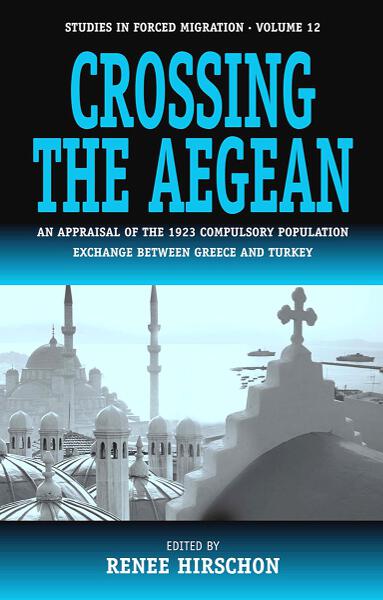
CROSSING THE AEGEAN
An Appraisal of the 1923 Compulsory Population Exchange between Greece and Turkey
Edited by Renée Hirschon
| 304 pages, bibliog., index ISBN 978-1-57181-562-0 Pb $27.95/£17.00 Published ( 2003) ISBN 978-1-57181-767-9 Hb $75.00/£47.00 Published ( 2003) Buy now and get 15% off listed price |
All chapters available for download - see below.
"This volume is a long overdue endeavour to tackle the thorny and delicate issue of the compulsory population exchange…The argumentative force of the volume lies in the careful analysis of the contradictory and ambiguous ramifications of the convention." -The Greek Review of Social Research
Following the defeat of the Greek Army in 1922 by nationalist Turkish forces, the 1923 Lausanne Convention specified the first internationally ratified compulsory population exchange. It proved to be a watershed in the eastern Mediterranean, having far-reaching ramifications both for the new Turkish Republic, and for Greece which hadto absorb over a million refugees. Known as the Asia Minor Catastrophe by the Greeks, it marked the establishment of the independent nation state for the Turks. The consequences of this event have received surprisingly little attention despite the considerable relevance for the contemporary situation in the Balkans. This volume addresses the challenge of writing history from both sides of the Aegean and provides, for the first time, a forum for multidisciplinary dialogue across national boundaries.
Renée Hirschon was educated at the universities of Cape Town, Chicago and Oxford. Intensive fieldwork among the Asia Minor refugees settled in Piraeus resulted in the monograph "Heirs of the Greek Catastrophe". She has been Senior Lecturer at Oxford Brookes University, and Professor of Social Anthropology at the University of the Aegean. She is currently Research Associate of the Refugee Studies Centre, Queen Elizabeth House, Senior Research Fellow and College Lecturer, St Peter's College, University of Oxford and Senior Member at St. Antony's College, University of Oxford.
Series: Volume 12, Forced Migration
Download chapters from this title
Table of Contents (Free download)
List_of_Figures (Free download)
List_of_Tables (Free download)
Contributors (Free download)
Notes_on_Terminology_and_Orthography (Free download)
Preface (Free download)
Acknowledgments (Free download)
Map_of_Greece_and_Turkey (Free download)
'Unmixing Peoples' in the Aegean Region
Renée Hirschon
The background to Lausanne
The 1923 compulsory population exchange between Greece and Turkey involved the movement of about 1.5 million people. It had profound long-term consequences, radically changed all aspects of life in the Aegean region and, though historically distant from the ever-increasing patterns of forced migration, undoubtedly has poignant contemporary relevance. Our assessments of this event and its aftermath, discussed below, must be grounded in an understanding of the historical context and, for this, we need to look at the specific coordinates of the region (Ottoman) and the period (early twentieth century and post-First World War). The period of the late nineteenth and early twentieth century was marked by the creation of modern nation-states. With the disintegration of the huge multiethnic Ottoman and Austro-Hungarian Empires, radical political and demographic changes occurred throughout the region of the Balkans and the Middle East. The Ottoman Empire had already begun to break up with the intensification of nationalist movements in Serbia, Bulgaria, and Greece all joining in the struggle to wrest territory from the empire. The Ottoman world was shrinking as bloody conflicts in the Balkans caused the mass displacement of its mixed populations. The ultimate exodus of much of its Muslim population and the unorganised influx of millions of destitute people into the Ottoman heartland resulted (McCarthy 1983a, 1995).
Price: $9
Download full chapter (PDF)
Consequences of the Lausanne Convention
An Overview
Renée Hirschon
My intention in this chapter is to present a synoptic picture of the effects of the population exchange for both Greece and Turkey, taking, as it were, an eagle's eye view over the Aegean. With limitations of space, I can only draw attention to the most outstanding features. The overall picture, based on chapters in this volume, is inevitably simplified and generalised. This summary indicates only the main outlines; each chapter with its special focus provides the detail to fill out the image.
Price: $9
Download full chapter (PDF)
Lausanne Revisited
Population Exchanges In International Law And Policy
Michael Barutciski
Introduction
From Biblical times to the end of the second millennium, the expulsion of populations has often been a strategy employed by belligerents to rid their territories of groups perceived to be a threat to effective political control. While the form of this practice has varied throughout history, the twentieth century is full of examples of premeditated mass displacement with the objective of con-solidating political power. The unmixing of populations in Europe, the Indian subcontinent and the Middle East are among the more prominent examples of this form of violence in the twentieth century. This practice is not a feature of warfare confined to undemocratic or non-Western parts of the world: for example, mass deportations of German nationals were openly discussed in the American and British parliaments at the end of the Second World War. As Prime Minister Churchill declared in the House of Commons on 15 December 1944: 'The transference of several millions of people would have to be effected from the East to the West or North, as well as the expulsion of the Germans - because that is what is proposed: the total expulsion of the Germans from the area to be acquired by Poland in the West and the North.'
Price: $9
Download full chapter (PDF)
The Consequences of the Exchange of Populations for Turkey
Çaglar Keyder
Introduction
The exchange of populations of 1923, together with the Armenian deaths and deportations during the First World War, can be argued to have constituted the most important factor in defining the new Turkish entity. In terms of the eventual effects on the Turkish nation-state, the two population expulsions were parallel in their impact, and together resulted in the formation of an ethnically 'cleansed' Turkish entity. As a result of these displacements, the Turkish Republic was founded on the basis of a relatively homogeneous population, or at least one in which such a claim of homogeneity did not risk much incredulity.
Price: $9
Download full chapter (PDF)
1922: Political Continuations and Realignments in the Greek State
Thanos Veremis
Introduction
The Greek state achieved its independence in 1830. The main themes of its development until 1922 included the consolidation of the new state's authority, the modernisation of state and public institutions, and the unification of territories inhabited by substantial Greek populations. It should be noted that the Greek state developed with remarkable speed and consistency, so that the two decades spanning 1860 to 1880 appear as something of a golden era of liberal democracy. In particular, Greek irredentism, encapsulated in the Megali Idea, the Great Idea, was a grand theme running through and beyond this period. It found its champion in the reformist politician, Eleftherios Venizelos, leader of the Liberal Party and Prime Minister over many years, who played a primary role in the events around the Lausanne negotiations.
Price: $9
Download full chapter (PDF)
Economic Consequences following Refugee Settlement in Greek Macedonia, 1923-1932
Elisabeth Kontogiorgi
Introduction
In the aftermath of the First World War and the failed Asia Minor campaign Greece received the largest influx of refugees in the Balkans: 1.2 million refugees - mostly women and children 1 - had to be integrated into an existing population of just five million. The arrival and settlement of so many refugees (equal to about one-quarter of the existing population) imposed heavy burdens on the national economy, both in the short term with the cost of initial relief,2 but more importantly in the longer term when the debts incurred for the settlement of the refugees would prove crippling; indeed, it has been argued that these debts contributed to the bankruptcy of the Greek state in 1932 (Ladas 1932: 635ff.). The influx of numerous refugees also raised serious political and social concerns; the dangers of social unrest and the spread of epidemics and radical political ideologies were all feasible. Furthermore, there was the risk of hostility between the newcomers and the native population. The fact that the refugees enjoyed full citizenship rights as soon as they arrived in Greece (according to the Lausanne Convention) and were entitled to be established in the large Muslim estates (according to the Geneva Protocol of 29/9/1923), which local landless farmers expected to be distributed to them, increased antagonism over the resources available, and caused tension between the two groups during the implementation of land reform and settlement.
Price: $9
Download full chapter (PDF)
Homogenising the Nation, Turkifying the Economy
The Turkish Experience Of Population Exchange Reconsidered
Ayhan Aktar
Introduction
Commenting in 1922 on the export of nationalism to Greek and Turkish societies, the British historian Arnold Toynbee noted that 'the inoculation of the East with nationalism has from the beginning brought in diminishing returns of happiness and prosperity' (1922: 18). The compulsory exchange of populations between Greece and Turkey demonstrates this point. The forced migration of well over one million Greeks and Turks not only increased chaos and despair among the migrants, but also profoundly changed the social and political texture of both countries. Concentrating mainly on Turkey, I argue that the exchange reduced the possibility of foreign intervention in her domestic affairs by homogenising the population along ethnic and religious lines, which in turn promoted the formation of a nation-state similar to western models. However, the exchange's effect on the economy of the new state was damaging, and necessitated many years of structural modification and readjustment.
Price: $9
Download full chapter (PDF)
The Story of Those Who Stayed
Lessons From Articles 1 And 2 Of The 1923 Convention
Baskin Oran
Introduction
Historical context of the 1923 exchange of populations The compulsory exchange of populations of 1923 between Greece and Turkey is a component part of the Lausanne Peace Conference, which took place at the end of the Turkish War of Independence (1919-22). That war concluded when the armies of the Greek occupation of Anatolia supported by the Allies at the end of the First World War were defeated in August 1922 by the Turks. The Convention and Protocol on the Exchange of Greek and Turkish Populations (hereinafter 'the Convention') is one of eighteen instruments created at the Lausanne Conference on Near Eastern Questions, 1922-23. Sixteen of these instruments, including the Lausanne Peace Treaty itself, were signed at the end of the Conference on 24 July 1923. The remaining two, the Convention and the Turkish-Greek Agreement on the Extradition of Civil Hostages and on the Exchange of War Prisoners, were signed on 30 January 1923, about two and a half months after the start of the Conference and about six months earlier than the other sixteen. The subject matter of these two instruments 'had nothing to do with the Peace Treaty' but had to be 'dealt with at the earliest possible time'.1 The Convention was thus a prerequisite for the Peace Treaty, as shown by its early signature.
Price: $9
Download full chapter (PDF)
Religion or Ethnicity
The Identity Issue Of The Minorities In Greece And Turkey
Alexis Alexandris
Introduction
At the Lausanne Conference, the international community allowed some relatively small minority groups in Greek Thrace, Istanbul and the islands of Imbros and Tenedos to escape the ensuing population exchange. These minorities were entitled to enjoy religious, educational and linguistic freedom, retained the right to administer their pious communal properties (vakifs) and were allowed to settle questions of family law and personal status in accordance with their customs.1 As worthy as these principles were, the Lausanne arrangements for minorities had serious practical flaws the consequences of which were to blight the minorities' lives for years to come. Firstly, the Treaty of Lausanne defined the minorities in religious terms and evaded addressing the issue of their ethno-national identity. Secondly, although the reciprocal character of the rights that were to be enjoyed by the minorities in Greece and Turkey and the preservation of numerical balance between the two minority populations created a sense of bilateralism, no effective multilateral mechanism for assuring the respect of these protection clauses was installed. As a result, the minorities could genuinely prosper only as long as Greek-Turkish relations were good, as in the 1930s and early 1950s. This essay addresses the impact that these issues have had on the Lausanne minorities, and concludes with an appraisal of what the future could hold for them in the post-Cold War era.2
Price: $9
Download full chapter (PDF)
Inter-war Town Planning and the Refugee Problem in Greece
Temporary 'Solutions' And Long-Term Dysfunctions
Alexandra Yerolympos
Introduction
In the quest for the optimum outcome of spatial arrangements, the task of the town planner involves unemotional, 'scientific' calculations and long-term provisioning. The populations involved in these plans are treated as abstract human categories, and a considerable length of time is necessary before the planning strategies result in specific schemes and programmes of action. However, in the context of 1920s Greece thousands of homeless refugees were urgently in need of shelter, and to them, with their lives and personal prospects at stake, time was of the essence. In such circumstances, arguments favouring speedy ad hoc decisions are not easily dismissed, but there is nevertheless a widely acknowledged need for well balanced and thoroughly researched programmes. I was well aware of this dilemma when examining the problems of refugee settlement during the inter-war period in Greece. As a result of eighty years' distance and hindsight, the critical questions of the time can now be approached more dispassionately, and, moreover, the consequences of the so-called solutions that were adopted are apparent for all to see.
Price: $9
Download full chapter (PDF)
When Greeks Meet Other Greeks
Settlement Policy Issues In The Contemporary Greek Context
Eftihia Voutira
Introduction
History, in E.H. Carr's felicitous phrase, is a continuous dialogue between the past and the present. In this chapter, I examine the legacy of the exchange of populations in contemporary Greece, beginning with an analysis of how a long-term memory of the 'successful' adaptation of the 1.2 million Asia Minor refugees was formed. I then examine how this interpretation of the interwar refugee experience has become a source of legitimacy and inspiration in formulating current state policies towards the new 'co-ethnic' immigrants from the Former Soviet Union (FSU). Finally I analyse the role this memory has played in social relations between the Soviet Greek newcomers and the members of the host Greek state.
Price: $9
Download full chapter (PDF)
Housing and the Architectural Expression of Asia Minor Greeks Before and After 1923
Vassilis Colonas
Introduction
When the relationship between the individual and the environment is fraught with contradictions and inadequacy, he becomes discontent and strives to transform it in his own image in order to satisfy his personal desires and dreams. The purpose of architecture is not merely to provide man with a roof over his head, but to allow him, through the type and form of residence that he chooses, to express both his cultural identity and his social and economic standing. Man needs an environment that will facilitate the creation of images. He needs neighbourhoods with their own individual character, with roads and passageways that lead somewhere, and with focal points that reflect a specific and appealing identity (Norberg-Schulz 1977: 431).
The most direct and fundamental consequence of the Lausanne Convention was a violent interruption in the continuity of human presence in space. More than just the dwellings of the hundreds of thousands of uprooted people were lost: also lost were the architectural expressions of identity and purpose that had been built into their communities, that had made them meaningful homes. Of the Christians forced out of Turkey to Greece, some took over properties left by the Muslims, but with a total influx of over one million refugees these could never be enough. Indeed, even with government provision of thousands of new, hastily built houses, many refugees were left no choice other than to erect makeshift lean-tos with whatever scrap material came to hand. In such circumstances, disorientated and trapped in poverty, the continuing manifestation of architectural expression that this paper uncovers is testament to the Asia Minor Greek community's resilience in the face of adversity.
Price: $9
Download full chapter (PDF)
Space, Place and Identity
Memory And Religion In Two Cappadocian Greek Settlements
Vasso Stelaku
Introduction
Two groups of Cappadocian refugees who came to Greece in 1924 as a result of the Exchange of Populations Convention are the subject of this chapter. It examines some ways by which these displaced people adapted their past cultural identity to the new environment in Greece.
With respect to space, time, culture and communication, the disruption involved in the uprooting of people usually gives rise to significant disorientation. The uprooted lose their homeland, power and symbols, which together provide indices of their identity. They leave 'everything' behind, including many components of their former identity, especially their spatial and environmental heritage. In essence, they lose their 'home', where home, to quote Scudder and Colson, 'refers to community in the widest sense, as well as to the surrounding landscape, especially where it is incorporated into origin myths, historical accounts, and religious symbolism' (1982: 270; cf. Downing 1996). As a consequence, they lose the feeling of belonging.
Price: $9
Download full chapter (PDF)
Lessons in Refugeehood
The Experience Of Forced Migrants In Turkey
Tolga Köker (in collaboration with Leylâ Keskiner*)
Introduction
Of the hundreds of thousands of Muslim refugees that Turkey received under the 1923 Convention this paper concentrates on those who came from Greek Macedonia to Muradiye and Menemen, two small towns near Izmir.1 Focusing on issues of identity, memory and adaptation, it draws lessons from their experiences, including their encounter with a new environment, their reception in Turkey, lost hopes about repatriation, and the reconstruction of their everyday life. The paper concludes by placing these experiences in the broader context of refugee studies.2
Much of the paper is based on the fieldwork of Leylâ Keskiner, who in June 1998 made repeated visits to the muhacirs (refugee) community in Muradiye and Menemen, interviewing individuals born before or immediately after the population exchange about their personal experiences, memories and what it meant to them to be muhacirs.
Price: $9
Download full chapter (PDF)
Muslim Cretans in Turkey
The Reformulation Of Ethnic Identity In An Aegean Community
Sophia Koufopoulou
Identity issues
The Lausanne Treaty has been a subject of inquiry in many and diverse disciplines, ranging from demography to international law, from economics to social and political geography.1 However, what much of this work has in common is its focus on the national and international, whereas relatively little research has been published examining the Treaty's consequences for individuals and communities.2 Relying on oral, genealogical and other data collected during extended fieldwork in the 1990s, I focus here on how the implementation of the Convention, the actual population exchange, affected the lives of the Muslim Cretans, a group that was forcibly relocated to the Turkish island of Cunda.
Various terms have been used to denote this group.3 In this chapter, I use the terms 'Muslim Cretans' and 'Kritiki' ('Cretans' in Greek). I use Muslim Cretans when discussing the situation in Crete before and during the exchange in order to distinguish between the Muslim and Christian inhabitants of that island; I use the term Kritiki in the post-exchange context, for that is how the current inhabitants of Cunda describe themselves when speaking Greek, the language in which interviews took place.
Price: $9
Download full chapter (PDF)
The Exchange of Populations in Turkish Literature
The Undertone Of Texts
Hercules Millas
In spite of the reciprocal aspect of the exchange of populations between Greece and Turkey, the event is reflected differently in the literary texts of the two countries. In this analysis, I concentrate on Turkish novels and short stories related to the forced exchange, with only occasional references to Greek literature in order to highlight the differences. Of those differences the most striking is the limited appearance of the event in Turkish literature. I maintain that this is mainly owing to political reasons. In addition, the way the two societies perceive themselves also plays a role. In Turkish literature the predominant sense is that of belonging to a strong and sovereign central state. This contrasts with Greek literature in which the sense of a motherland - closely associated with a family home, personal memories and the 'space' of a small local community - is more keenly expressed.
Price: $9
Download full chapter (PDF)
The Myth of Asia Minor in Greek Fiction
Peter Mackridge
For the political and intellectual leaders of Greece from the end of the War of Independence in 1829 until 1922, Asia Minor was Greece's other half. There had been a Greek presence in Asia Minor, with demographic fluctuations, since at least 1000 B.C., spanning the Ancient Greek, Roman, Byzantine and Ottoman periods, while, according to official Ottoman statistics, in 1910 Asia Minor counted among its inhabitants more than 1.7 million Orthodox Christians. The political and intellectual leaders of Greece considered these people to be Greeks. If we bear in mind that the total population of Greece in the same year numbered only 2.6 million, we realise the importance, even in purely demographic terms, of Asia Minor to Greece at that time.
The Treaty of Lausanne, however, placed a barrier between the western and eastern halves of the Greek world - a partition similar to that between India and Pakistan, or between East and West in the days of the Iron Curtain. Since then, Asia Minor has been a prohibited zone for the Greeks, a site of desire that has been physically unapproachable (or at least uninhabitable) and for that reason a space on which fantasies can be projected. Asia Minor before the coming of war in 1914 is both another place and another time, not only for those Greeks who have lived there, but also for those (especially their descendants) who have not. It has become a dream-world that can be imagined as the opposite of the waking world of the here-and-now, a semi-real, semi-imaginary landscape where it is possible to take the world and 'Re-mould it nearer to the Heart's Desire'.
Price: $9
Download full chapter (PDF)
Between Orientalism and Occidentalism
The Contribution Of Asia Minor Refugees To Greek Popular Song, And Its Reception
Stathis Gauntlett
Asia Minor refugees are widely credited with having first introduced into Greece the bouzouki, now the national instrument, and the internationally popular type of Greek song known as rebetika. Curiously, the refugees themselves and their descendants have been at pains to abjure these attributions as mischievous and offensive. This paper explores the cultural politics behind the fabrication and perpetuation of what are indeed false attributions. It finds at the core of the issue a contest over modern Greek cultural identity, one of whose principal arenas from the 1880s to the 1980s was Greek popular song. Although it is now celebrated as one of the most sophisticated achievements of modern Greek culture, popular song in Greece has regularly been declared to be in crisis, periodically of such gravity as to incur official censorship, not just of lyrics, but also, remarkably, of music.
Price: $9
Download full chapter (PDF)
References (Free download)
Appendix (Free download)
Index (Free download)