Join our Email List
Series
Volume 22
Monographs in German History
See Related
History JournalsEmail Newsletters
Sign up for our email newsletters to get customized updates on new Berghahn publications.
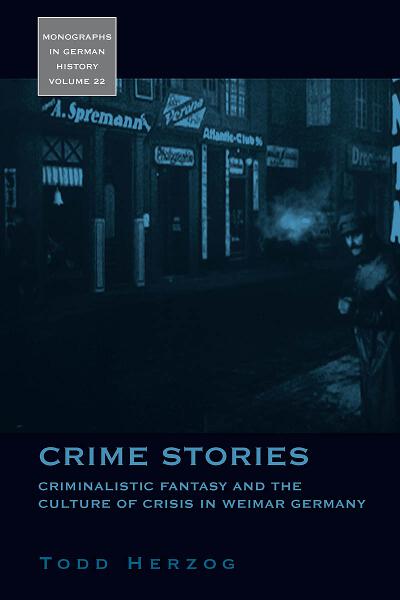
Crime Stories
Criminalistic Fantasy and the Culture of Crisis in Weimar Germany
Todd Herzog
182 pages, 15 illus., bibliog., index
ISBN 978-1-84545-439-5 $135.00/£104.00 / Hb / Published (April 2009)
eISBN 978-1-84545-905-5 eBook
Reviews
“Herzog’s book uses a wonderful array of texts, from films to crime fiction, and his arguments are provocative. While English, French, and US crime novelists placed detectives at the center of their tales, he reveals, their Weimar counterparts focused on the criminal.” · The Journal of Modern History
“Herzog’s arguments are insightful and persuasive. This seminal book is a valuable contribution to the interdisciplinary field of German Studies and should be incortporated in courses on the Weimar Republic.” · Focus on German Studies
“Convincingly argued, the book combines socio-historical, literary and media analyses for an astonishing and fascinating depiction of Weimar culture.” · European History Quarterly
Description
The Weimar Republic (1918–1933) was a crucial moment not only in German history but also in the history of both crime fiction and criminal science. This study approaches the period from a unique perspective - investigating the most notorious criminals of the time and the public’s reaction to their crimes. The author argues that the development of a new type of crime fiction during this period - which turned literary tradition on its head by focusing on the criminal and abandoning faith in the powers of the rational detective - is intricately related to new ways of understanding criminality among professionals in the fields of law, criminology, and police science. Considering Weimar Germany not only as a culture in crisis (the standard view in both popular and scholarly studies), but also as a culture of crisis, the author explores the ways in which crime and crisis became the foundation of the Republic’s self-definition. An interdisciplinary cultural studies project, this book insightfully combines history, sociology, literary studies, and film studies to investigate a topic that cuts across all of these disciplines.
Todd Herzog is an Associate Professor of German Studies at the University of Cincinnati. He is editor of A New Germany in a New Europe (Routledge 2001, with Sander Gilman) and Rebirth of a Culture: Jewish Identity and Jewish Writing in Germany and Austria Today (Berghahn Books, 2008, with Hillary Hope Herzog and Benjamin Lapp). He is currently working on A Critical Filmography of German Cinema to 1945.