New Titles Summer/Fall 10
(3.4Mb PDF file)

Anthropology 10/11
(3.3Mb PDF file)

Film and Media Studies 10
(2.5Mb PDF file)

International Studies 10
(3.1Mb PDF file)

History 2010
(2.0Mb PDF file)

Anthropology Texts for Teaching
(5.7Mb PDF file)


advanced search

Browse all titles by:
Author | Title | Series
Celebrating 16 Years of Independent Publishing Last updated: August 19th, 2010


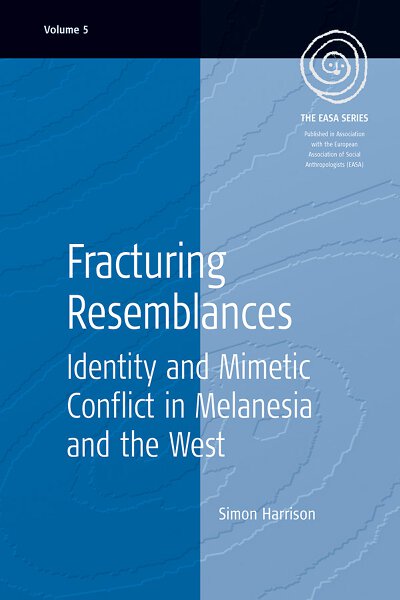
FRACTURING RESEMBLANCES

Identity and Mimetic Conflict in Melanesia and the West

Simon Harrison


192 pages, bibliog., index
ISBN 978-1-84545-097-7 Pb $22.50/£14.00 Published (Fall 2006)
ISBN 978-1-57181-680-1 Hb $75.00/£37.50 Published (Summer 2005)
Buy now and get 15% off listed price
Pb 
Hb 

Download this title All chapters available for download - see below.

(may not yet be available for newest titles)
 Google Book Search

"This book offers a counterintuitive and innovative approach to the politics of cultural difference and social order. The appeal of Harrison’s argument is enhanced because he shows that currently dominant approaches to the politics of identity and difference are likely to be misguided, but does not resort to a wrongheaded appeal to universalism that simply collapses difference."  ·  ANTHROPOLOGICAL FORUM

"I thoroughly enjoyed this book. It is clearly and convincingly written, covers a large number of fascinating and diverse ethnographic cases, and its central theoretical propositions are well worthy of consideration and debate."  ·  American Anthropologist

Western societies draw crucially on concepts of the 'individual' in constructing their images of the ethnic group and nation and define these in terms of difference. This study explores the implications of these constructs for Western understanding of social order and ethnic conflicts. Comparing them with the forms of cultural identity characteristic of Melanesia as they have developed since pre-colonial times, the author arrives at a surprising conclusion: he argues that these kinds of identities are more properly and adequately viewed as forms of disguised or denied resemblance, and that it is these covert commonalities that give rise to, and prolong, social divisions and conflicts between groups.

Simon Harrison is Reader in Social Anthropology at the University of Ulster, and has carried out ethnographic fieldwork among the people of Avatip in Papua New Guinea. He has published extensively on Melanesian warfare, ethnopsychology, cultural identity, and indigenous forms of intellectual property.

Related Link: European Association of Social-Anthropologists (EASA)

Series: Volume 5, EASA Series


Download chapters from this title

Table of Contents (Free download)


Acknowledgments (Free download)


Introduction (Free download)


Proprietary Identities

The standard view [of imitation], derived from Plato's mimesis via Aristotle's Poetics, has always excluded one essential human behavior from the types subject to imitation — namely, desire and, more fundamentally still, appropriation. If one individual imitates another when the latter appropriates some object, the result cannot fail to be rivalry or conflict ... In human beings, the process rapidly tends toward interminable revenge, which should be de.ned in mimetic or imitative terms.

Price: $9

Download full chapter (PDF)


A Phenomenology of Trademark Ownership

Trademarks and Magical Theft
As one can see, there have been societies in which honouring the same gods, or respecting the same religious symbols, could constitute a violently conflictual and divisive relationship in some circumstances. This may seem odd from a Durkheimian perspective, in which such symbols always appear as expressions — perhaps, indeed, paramount expressions — of social solidarity and moral consensus.

Price: $9

Download full chapter (PDF)


Mimesis and Identity

Difference as Superiority
In the Introduction, I referred to a key leitmotif in contemporary social science: namely, the conception of social identities as relational phenomena, constructed through acts of division. According to this view, an identity is never in some sense self-suficient, but is always linked to an Other — real or imagined, overt or covert — against which it is defined. This Other, so central to the constitution of the Self, may, for instance, comprise images of an exoticised East (Said 1978) or representations of the 'primitive' against which the West has counterposed itself historically as 'civilised' (Fabian 1983; Kuper 1988). It may be one's own community imagined at an earlier period in history, as Hastrup has shown for contemporary Icelanders (1995: 107-17). To Atatürk and his fellow Turkish modernisers, the Ottoman past which they sought to disown as backward had a similar signi.cance (Yoruk 1997).

Price: $9

Download full chapter (PDF)


Difference as Denied Resemblance

Orientalisms and the Other: Difference as Inferiority
Penrose observes how nationalist discourses often employ what he calls the 'foil of other': '[N]ationalist rhetoric frequently asserts the existence of a nation by documenting what it is not ... [F]or example, Canadians can assert that they are not loud and brash like the Americans; Bretagnes can insist that they are untouched by French snobbery; and Sami can argue that Finnish regimentation and reserve are alien to them' (1993: 33; see also p. 32).

Price: $9

Download full chapter (PDF)


Property, Personhood and the Objectification of Culture

Introduction
In a seminal argument, Handler shows how nationalism is connected intimately to Western conceptions of personhood: specifically, to an ideology which, following Macpherson (1962), he calls 'possessive individualism'. This ideology represents persons as bounded, unique and autonomous entities that define themselves through the things they create and own. A 'nation' is, in effect, an imagined individual of precisely this sort writ large. The proof that a people are a nation is conceived to lie, above all, in their visible possession of a distinctive 'culture' of their own creation, demonstrating their national identity (Handler 1988: 192). Ethnic and national differences, then, are purported contrasts between such conceptually objectified cultural repertoires, and between the social groups which identify with them or are identified with them by others.

Price: $9

Download full chapter (PDF)


Cultural Piracy and Cultural Pollution

Introduction
In the previous chapter, I have tried to outline two complementary ways in which cultural identity can be conceived by social actors. In one, 'cultures' are understood as discrete entities attached to social groups as exclusive legacies, thereby differentiating these groups from one another. In another, culture is a transactional resource intended for circulation between social groups, and groups are thereby connected to one another principally by networks of cultural commonalities and resemblances.

Price: $9

Download full chapter (PDF)


Cultural Boundaries, Cultural Ownership

Every property is an extension of personality; property is that which obeys our wills, that in which our egos express, and externally realize, themselves. This expression occurs, earliest and most completely, in regard to our body, which thus is our first and most unconditional possession. (Simmel 1950: 344)
Introduction
The discourses of cultural piracy and pollution, I suggest, are best viewed as twin aspects of a single model which seems often to underlie contemporary claims concerning cultural identity. This implicit folk theory of cultural identity might be briefly summed up in the following way. First, cultural practices and symbols are in certain respects things (they are 'objectified', as Handler (1988: 14-16) puts it), and can in principle be transmitted, circulated, accumulated and so forth, much like objects. As we shall see, many cultural symbols are objects or, more precisely, practices relating to them: objects such as sacred sites, antiquities, museum objects and, indeed, national territories and ethnic homelands themselves.

Price: $9

Download full chapter (PDF)


Power and the Negotiation of Identity

Introduction: Two Patterns of Internal Conflict
An important question concerns the ways in which these representations of cultural appropriation and cultural pollution serve the interests of power, in particular the interests of élites. These are the social actors who characteristically play the leading roles in nationalist movements and in the construction of national identities (Antonnen 2000; Bauman 1992; Conversi 1997: 257; Jacobson-Widding 1983a: 24; Nederveen Pieterse 1996: 31; Sharp 1996: 93; Smith 1986: 178; Verderey 1990: 94).

Price: $9

Download full chapter (PDF)


Identity as a Scarce Resource

Self-definition does not occur in a vacuum, but in a world already defined. As such it invariably fragments the larger identity space of which its subjects were previously a part. (Friedman 1992: 837)
Cultural Boundaries and Social Boundaries: Élites and Social Exclusion
My argument raises the problem of identifying the situations in which social groups and actors employ particular kinds of cultural boundary discourses. It is important to discover why, for instance, communities may be preoccupied with perceptions of cultural pollution in some circumstances or in relation to certain kinds of cultural Others, and why they sometimes mobilise themselves collectively through discourses of cultural appropriation instead (or employ both sorts of discursive imagery together, or perhaps even some other kinds).

Price: $9

Download full chapter (PDF)


The Politics of Alikeness

Each tongue hoards the resources of consciousness, the world-picture of the clan. Using a simile still deeply entrenched in the language-awareness of Chinese, a language builds a wall around the 'middle kingdom' of the group's identity. It is secret towards the outsider and inventive of its own world ... There have been so many thousands of human tongues, there still are, because there have been, particularly in the archaic stages of social history, so many distinct groups intent on keeping from one another the inherited, singular springs of their identity ... [I]n this sense also there is in every action of translation — and specially where it succeeds — a touch of treason. Hoarded dreams, patents of life are being taken across the frontier. (Steiner 1975: 232-33; see also p. 284)

Price: $9

Download full chapter (PDF)


Conclusion

Cultural Constructions of 'Cultural Identity'

I have sought in this book to explore a way of thinking which I have called proprietary identity — a form of thought in which people represent their social identities and conceive of similarities and differences among themselves by means of symbols, and understand these symbols to be forms of property. In referring to these modes of symbolism as proprietary, I mean to suggest that they have two basic features.

Price: $9

Download full chapter (PDF)


Bibliog (Free download)


If you have any questions or comments about this site, please email us
All prices listed on this website are subject to change without notice.