Join our Email List
See Related
History JournalsEmail Newsletters
Sign up for our email newsletters to get customized updates on new Berghahn publications.
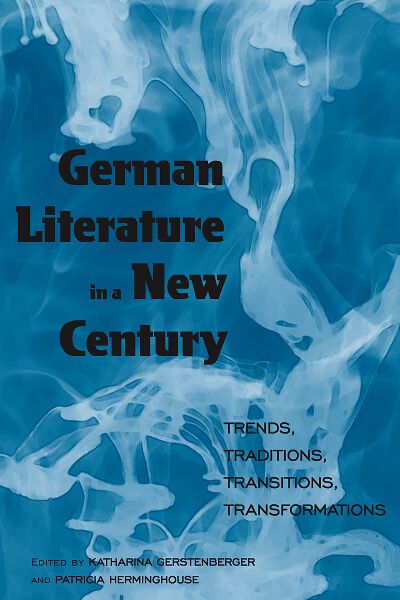
German Literature in a New Century
Trends, Traditions, Transitions, Transformations
Edited by Katharina Gerstenberger and Patricia Herminghouse
272 pages, bibliog., index
ISBN 978-1-84545-547-7 $135.00/£104.00 / Hb / Published (October 2008)
ISBN 978-0-85745-168-2 $34.95/£27.95 / Pb / Published (September 2011)
eISBN 978-1-84545-866-9 eBook
Reviews
“This book contains many thoughtful essays on contemporary German literary culture, with an interesting mixture of chapters focusing on analyses of individual authors as well as the consumption and marketing of literature…Read as a whole, the book provides a refreshing variety of perspectives on ;key questions of contemporary cultural and literary trends in Germany.” · Modern Language Review
“The great majority of these essays are well-written and well-researched…they provide an abundance of pertinent information, including an extensive index, which makes this book altogether a very valuable resource for further investigations.” · German Studies Review
“This outstanding collection of insightful and thought-provoking articles marks a significant advancement of scholarship on contemporary literature. While contributions (remarkable for their consistently high quality) are valuable on their, all benefit from being read in conjunction with the others.” · German Studies Review
“Taken as a whole, this is an important contribution to scholarship on contemporary German-language literature. Its emphasis on younger authors, on literary marketing, and on female and Turkish-German authors confirms that literature continues to provide an important forum for discussions of German identity, but that in the new century the contours of that identity are rapidly changing.” · Monatshefte
Description
While the first decade after the fall of the Berlin wall was marked by the challenges of unification and the often difficult process of reconciling East and West German experiences, many Germans expected that the “new century” would achieve “normalization.” The essays in this volume take a closer look at Germany’s new normalcy and argue for a more nuanced picture that considers the ruptures as well as the continuities. Germany’s new generation of writers is more diverse than ever before, and their texts often not only speak of a Germany that is multicultural but also take a more playful attitude toward notions of identity. Written with an eye toward similar and dissimilar developments and traditions on both sides of the Atlantic, this volume balances overviews of significant trends in present-day cultural life with illustrative analyses of individual writers and texts.
Katharina Gerstenberger is Professor of German and Head of German Studies at the University of Cincinnati. She earned her PhD from Cornell University in 1993. She is the author of Truth to Tell: German Women’s Autobiographies and Turn-of-the-Century Culture (2000). She also publishes on contemporary literature and identity.
Patricia Herminghouse is the Karl F. and Bertha A. Fuchs Professor emerita of German Studies at the University of Rochester. She has written widely on nineteenth- and twentieth-century German literature, the social contexts of women’s writing, German identity, and German émigrés in nineteenth-century America.