Join our Email List




Series
Volume 14
Fertility, Reproduction and Sexuality: Social and Cultural Perspectives
See Related
Anthropology JournalsEmail Newsletters
Sign up for our email newsletters to get customized updates on new Berghahn publications.
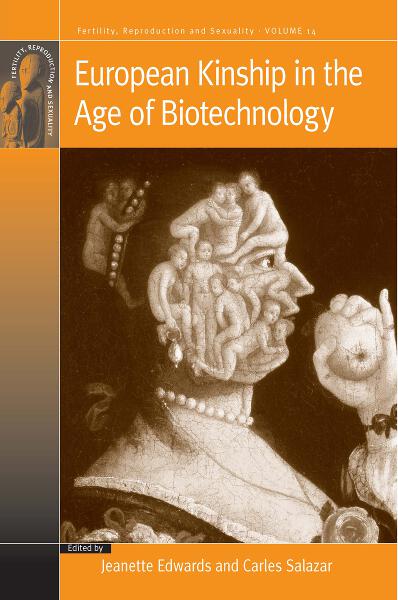
European Kinship in the Age of Biotechnology
Edited by Jeanette Edwards and Carles Salazar
232 pages, bibliog., index
ISBN 978-1-84545-573-6 $135.00/£104.00 / Hb / Published (March 2009)
ISBN 978-0-85745-365-5 $34.95/£27.95 / Pb / Published (June 2012)
eISBN 978-1-80758-998-1 eBook
Reviews
This superb anthology extends the emphasis on technology that has become such a prominent feature of much recent anthropological work on kinship…In this richly ethnographic text, the most familiar problems produce the most unusual answers…Each chapter brilliantly combines kinship as a matrix with kinship as a tool, using ethnographic examples that leap off the page.” · Journal of Anthropological Research
Description
Interest in the study of kinship, a key area of anthropological enquiry, has recently reemerged. Dubbed ‘the new kinship’, this interest was stimulated by the ‘new genetics’ and revived interest in kinship and family patterns. This volume investigates the impact of biotechnology on contemporary understandings of kinship, of family and ‘belonging’ in a variety of European settings and reveals similarities and differences in how kinship is conceived. What constitutes kinship for different publics? How significant are biogenetic links? What does family resemblance tell us? Why is genetically modified food an issue? Are ‘genes’ and ‘blood’ interchangeable? It has been argued that the recent prominence of genetic science and genetic technologies has resulted in a ‘geneticization’ of social life; the ethnographic examples presented here do show shifts occurring in notions of ‘nature’ and of what is ‘natural’. But, they also illustrate the complexity of contemporary kinship thinking in Europe and the continued interconnectedness of biological and sociological understandings of relatedness and the relationship between nature and nurture.
Jeanette Edwards is Professor of Social Anthropology at Manchester University. She has published widely on the implications of new reproductive technologies for kinship both ethnographically and theoretically. She is author of Born and Bred: Idioms of Kinship and New Reproductive Technologies in England (Oxford University Press, 2000), co-author of Technologies of Procreation: Kinship in the Age of Assisted Conception (Routledge 2nd ed., 1999) and co-editor of Recasting Anthropological Knowledge: Inspiration and Social Science (Cambridge University Press 2011). She directed the European-funded project ‘Public Understanding of Genetics: a Cross- Cultural and Ethnographic Study of the “new genetics” and social identity’.
Carles Salazar is Lecturer in Social Anthropology at the University of Lleida. He received his PhD from the University of Cambridge and has carried out ethnographic fieldwork in Ireland and Catalonia (Spain). His publications include A Sentimental Economy (1996, Berghahn) and Anthropology and Sexual Morality (2006, Berghahn) and a number of articles on kinship, sexuality, reproduction and Irish ethnography.
Subject: Medical Anthropology
Area: Europe
Contents
Of Related Interest...
Thai in Vitro
Gender, Culture and Assisted Reproduction

Militant Lactivism?
Attachment Parenting and Intensive Motherhood in the UK and France
Managing Reproductive Life
Cross-Cultural Themes in Fertility and Sexuality