Join our Email List
Series
Volume 4
Film Europa
Email Newsletters
Sign up for our email newsletters to get customized updates on new Berghahn publications.
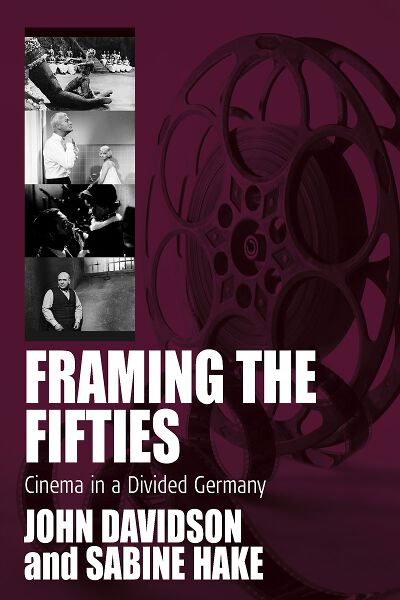
Framing the Fifties
Cinema in a Divided Germany
Edited by John Davidson and Sabine Hake
260 pages, bibliog., filmog., index
ISBN 978-1-84545-204-9 $135.00/£104.00 / Hb / Published (July 2007)
ISBN 978-1-84545-536-1 $19.95/£15.95 / Pb / Published (December 2008)
eISBN 978-1-80758-857-1 eBook
Reviews
“This collection of essays on the cultural history of post-World War II Berlin is a fine and coherent example of the conference-inspired anthology…The sheer number of subjects…in this slim volume is impressive and enlightening, and each essay has an excellent bibliography to point the reader in the direction of further literature. As an ensemble, the essays in the volume work well together, to the point that many refer to each other.” · German Studies Review
“These essays are for the most part interesting and persuasive and are an important step in reclaiming what Hake in her introduction calls the ‘last terra incognito of German film studies’.” · German Studies Review
“This very attractive collection invites the reader to study the larger project of German cinematic postwar reconstruction and identity formation with a number of excellent essays. The volume appears remarkably coherent, insofar as all 14 contributions are well-researched and well-written investigations… Undoubtedly, Framing the Fifties will trigger further and much-needed research to reintroduce complexity into a field of study that has long suffered from discursive impoverishment. Davidson and Hake have put together a fine volume that will find its grateful readers.” · Journal of Contemporary History
Description
The demise of the New German Cinema and the return of popular cinema since the 1990s have led to a renewed interest in the postwar years and the complicated relationship between East and West German cinema in particular. A survey of the 1950s, as offered here for the first time, is therefore long overdue. Moving beyond the contempt for "Papa's Kino" and the nostalgia for the fifties found in much of the existing literature, this anthology explores new uncharted territories, traces hidden connections, discovers unknown treasures, and challenges conventional interpretations. Informed by cultural studies, gender studies, and the study of popular cinema, this anthology offers a more complete account by focusing on popular genres, famous stars, and dominant practices, by taking into account the complicated relationships between East vs. West German, German vs. European, and European vs. American cinemas; and by paying close attention to the economic and political conditions of film production and reception during this little-known period of German film history.
John Davidson is Director of the Program of Film Studies and Associate Professor of Germanic Languages and Literatures at the Ohio State University. His Deterritorializing the New German Cinema appeared in 1999, and he has published numerous articles on German film as well as political discourses and literary figures in cinema more generally. He serves on the editorial board of Studies in European Cinema (UK) and is currently working on a book project investigating cinema, labor, and mobility in twentieth-century Germany.
Sabine Hake is the Texas Chair of German Literature and Culture in the Department of Germanic Studies at the University of Texas at Austin. She is the author of four books: German National Cinema (2002), Popular Cinema of the Third Reich (2001), The Cinema's Third Machine: German Writings on Film 1907-1933 (1993), Passions and Deceptions: The Early Films of Ernst Lubitsch (1992), as well as numerous articles on German film and Weimar culture. Her current book project deals with urban architecture and mass utopia in Weimar Berlin.
Subject: Film and Television StudiesHistory: 20th Century to Present
Area: Germany
Contents
Of Related Interest
From Self-fulfilment to Survival of the Fittest
Work in European Cinema from the 1960s to the Present
DEFA
East German Cinema 1946-1992

International Adventures
German Popular Cinema and European Co-Productions in the 1960s