Join our Email List
Series
Volume 7
Studies in German History
See Related
History JournalsEmail Newsletters
Sign up for our email newsletters to get customized updates on new Berghahn publications.
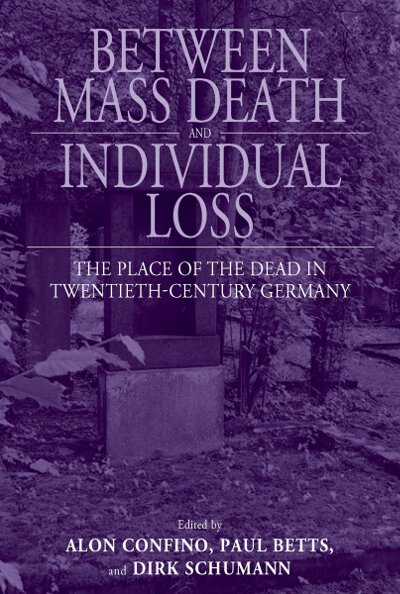
Between Mass Death and Individual Loss
The Place of the Dead in Twentieth-Century Germany
Edited by Alon Confino, Paul Betts and Dirk Schumann
Published in Association with the German Historical Institute, Washington, D. C.
344 pages, bibliog., index
ISBN 978-1-84545-397-8 $135.00/£104.00 / Hb / Published (July 2008)
ISBN 978-0-85745-169-9 $34.95/£27.95 / Pb / Published (September 2011)
eISBN 978-1-83695-899-4 eBook
Reviews
“Understood as a starting point for further inquiries into practices of mourning, burial and grief, this volume deserves broad attention, not least because it succeeds in embedding its case studies within a broad cultural, social and political history.” • European History Quarterly
“Taken together, this volume is a welcome departure from the usual literature on memory and trauma which ignores what came before the war and treats what happened after only in relation to the Holocaust. This excellent volume enables us to look at the history of death as a whole beyond the break of 1945 and to see influences and continuities throughout the last century. The volume delivers on the promise of the introduction to open up new avenues for research and raise new questions and should be a welcome addition to the library of every scholar of modern Germany.” • German Politics & Society
“[The volume] offers a significant contribution to theories of death and memory work in German Studies. [It] is clearly organized using theme-based sections, which lead the reader through material culture as well as psychological investigation; the essays are well-researched and cogently written.” • German Studies Review
“Taken together, the volume provides more than the sum of its individual contributions and actually succeeds in offering new perspectives on a hitherto neglected topic. Several essays demonstrate persuasively the myriad ways in which the ghosts of the dead haunted the living in twentieth-century Germany…for anybody interested in the social and cultural history of death in Germany, this volume will be an indispensable starting point.” • German History
Description
Recent years have witnessed growing scholarly interest in the history of death. Increasing academic attention toward death as a historical subject in its own right is very much linked to its pre-eminent place in 20th-century history, and Germany, predictably, occupies a special place in these inquiries. This collection of essays explores how German mourning changed over the 20th century in different contexts, with a particular view to how death was linked to larger issues of social order and cultural self-understanding. It contributes to a history of death in 20th-century Germany that does not begin and end with the Third Reich.
Alon Confino is Professor of History at the University of Virginia. He has written substantially on nationhood, memory, and historical method. His new book is Foundational Pasts: An Essay in Holocaust Interpretation (CUP, 2011).
Paul Betts is Professor of European History at the University of Sussex. He is the author of The Authority of Everyday Objects: A Cultural History of West German Industrial Design (Berkeley, 2004) and Within Walls: Private Life in the German Democratic Republic (Oxford, 2010). He was Joint Editor of the journal German History, 2004-2009.
Dirk Schumann is Professor of Modern and Contemporary History at Georg-August University, Göttingen. His most recent books include Raising Citizens in the "Century of the Child“: The United States and German Central Europe in Comparative Perspective (Berghahn, 2010, edited), Political Violence in the Weimar Republic, 1918–1933: Fight for the Streets and Fear of Civil War (Berghahn, 2009).
Subject: History: 20th Century to PresentCultural Studies (General)Sociology
Area: Germany
Contents
Of Related Interest

Transactions, Transgressions, Transformation
American Culture in Western Europe and Japan

Protest in Hitler's “National Community”
Popular Unrest and the Nazi Response

The Inverted Mirror
Mythologizing the Enemy in France and Germany, 1898-1914