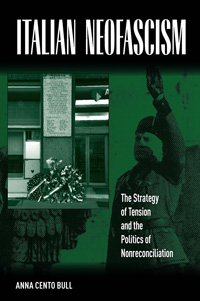
ITALIAN NEOFASCISM
The Strategy of Tension and the Politics of Nonreconciliation
Anna Cento Bull
| 208 pages, bibliog., index ISBN 978-1-84545-335-0 Hb $70.00/£35.00 Published (Winter 2007) Buy now and get 15% off listed price |
All chapters available for download - see below.
During the Cold War Italy witnessed the existence of an anomalous version of a civil conflict, defined as a 'creeping' or a 'low-intensity' civil war. Political violence escalated, including bomb attacks against civilians, starting with a massacre in Milan, on 12 December 1969, and culminating with the massacre in Bologna, on 2 August 1980. Making use of the literature on national reconciliation and narrative psychology theory, this book examines the fight over the 'judicial' and the 'historical' truth in Italy today, through a contrasting analysis of judicial findings and the 'narratives of victimhood' prevalent among representatives of both the post- and the neo-fascist right.
Anna Cento Bull is Professor of Italian History and Politics at the University of Bath. Her publications include Social Identities and Political Cultures in Italy (Oxford: Berghahn, 2000); The Lega Nord and The Northern Question in Italian Politics (London: Palgrave, 2001) (with M. Gilbert) and Speaking Out and Silencing: Culture, Society and Politics in Italy in the 1970s. (Legenda: Oxford, 2005) (edited jointly with A. Giorgio).
Download chapters from this title
Table of Contents (Free download)
Abbreviations (Free download)
Preface (Free download)
Acknowlegments (Free download)
Introduction
This book compares and contrasts the narratives put forward by the Italian radical and postfascist right, through its political representatives, intellectuals and protagonists, with the judicial findings on — and the mainstream interpretations of — the political violence perpetrated in the 1960s and 1970s, with specific reference to terrorist bombing massacres collectively known as stragismo. The book examines the evidence concerning the role of Italian neofascism in stragismo, as established by successive judicial investigations and trials, and then analyses the reconstructions of these same events made by the right. As this work will show, the contrast between the two could not be greater.
Price: $9
Download full chapter (PDF)
Part_I_Introduction (Free download)
The Role of Italian Neofascism in Stragismo and the Strategy of Tension
Introduction
As we saw in the Introduction to Part I, the evidence amassed in successive judicial trials has in many instances not proved sufficient to secure the conviction of individual suspected culprits, all of them members or sympathisers of neofascist groups. Despite these obvious setbacks in terms of securing clear-cut verdicts on the role of individuals, successive judicial trials have uncovered a wealth of data on the activities of various neofascist organisations. Much of the evidence unearthed in the investigations was judged incontrovertible even by the Courts which finally reached 'not guilty' verdicts. In this section, the most relevant judicial findings will be analysed and assessed; only those which were endorsed by the Supreme Court will be used in order to reconstruct the role played by Italian neofascism (or at least by some of its segments) in both stragismo and the Strategy of Tension.
Price: $9
Download full chapter (PDF)
The Role of the Armed Forces and Intelligence Structures
Introduction: connivances and depistaggi
As stated in the Introduction, investigations and trials on the massacres were repeatedly obstructed by cover-ups and false leads (depistaggi), on the part of certain sections of the armed forces, the Carabinieri and the intelligence services. The measures adopted ranged from falsifying or concealing important information, to deliberately preventing crucial new witnesses from testifying to the magistrates and even to assisting suspected perpetrators escape abroad. In this section we will examine the most emblematic of these cover-ups, as brought to light by the investigations of Judges Salvini and Lombardi, as well as by the trial concerning the 1972 Peteano attack.
Price: $9
Download full chapter (PDF)
Interpretations of the Strategy of Tension in Accordance with Judicial Findings
Introduction
There are almost as many interpretations of the Strategy of Tension as there are scholars, journalists, magistrates and politicians who have commented on these events. This chapter looks at the principal explanations given by people who, in view of their formal role, whether institutional, professional or associational, have directly contributed to the discovery of the recent findings underpinning judicial investigations, as discussed in the previous two chapters, or have acquired specific and detailed knowledge of such findings.
Price: $9
Download full chapter (PDF)
Part_I_Conclusion (Free download)
Part_II_Introduction (Free download)
Narratives of Victimhood: The Right's Reconstructions and Interpretations of Stragismo
Introduction
What is meant by reconciliation and how is it achieved? While conflict resolution implies the formal termination of the armed struggle and/or other acts of violence, reconciliation requires a much deeper process, 'through which the parties in conflict form new relations of peaceful existence based on mutual trust and acceptance, cooperation, and consideration of each other's needs' (Bar-Tal 2000a: 355; 2000b). According to Bar-Tal, three key changes must occur within each group involved in the conflict in order to achieve reconciliation, concerning three sets of beliefs: 'beliefs about societal goals', 'beliefs about the adversary group' and 'beliefs about the ingroup'.
Price: $9
Download full chapter (PDF)
The Self-narratives of Extreme-right Protagonists of the Political Conflict
Introduction
As far as the protagonists of right-wing violence are concerned, the sources tend to be scarce, particularly when compared to those available in relation to exmembers of extreme-left paramilitary organisations. They are also of a different nature compared to the reconstructions put forward by representatives and sympathisers of Alleanza Nazionale and discussed in the previous chapter. First, many of these sources take the form of political memoirs, biographies and autobiographies written by individuals who were convicted or suspected perpetrators of political violence, including acts of stragismo. They also consist of interviews granted to journalists and to the author.
Price: $9
Download full chapter (PDF)
Part_II_Conclusion (Free download)
Conclusion
The preceding chapters raised various questions as regards a possible process of national reconciliation, with reference to the violent conflict that took place from the late 1960s onwards. Does Italy need such a process? Is truth telling a necessary part of this process? Can a self-critical reassessment of the past by the different parties to the conflict contribute to less conflictual political relations? The literature on postconflict reconciliation is fairly unanimous on the need for truth telling and for more balanced and self-critical reconstructions of the past in order to achieve long-lasting peace and stability. However, there are dissenting voices on this issue.
Price: $9
Download full chapter (PDF)
Index (Free download)
Bibliog (Free download)