Join our Email List
See Related
Cultural studies JournalsEmail Newsletters
Sign up for our email newsletters to get customized updates on new Berghahn publications.
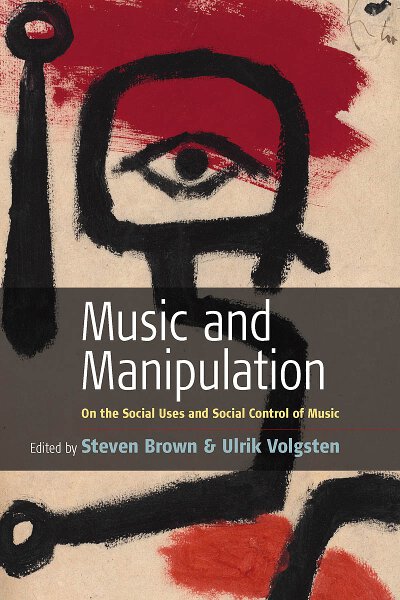
Music and Manipulation
On the Social Uses and Social Control of Music
Edited by Steven Brown and Ulrik Volgsten
400 pages, bibliog., index
ISBN 978-1-57181-489-0 $150.00/£115.00 / Hb / Published (December 2005)
ISBN 978-1-84545-098-4 $29.95/£23.95 / Pb / Published (December 2005)
eISBN 978-0-85745-714-1 eBook
Reviews
“This valuable and timely book provides an overview of various theoretical approaches to the uses and meaning of music, particularly in view of its capacity to influence people…In all, several important issues are raised in chapters of this book, and are also addressed, either in the same chapter or in one by another author.” · Musicae Scientiae
“…a valuable addition/complement to the musicological literature thanks to the critically examined current debates about the uses and consequences of music. [In addition, the book offers] many concise overviews of present research on music and manipulation. As such it is suitable for graduate students but also more generally for people working in the media and music industry.” · Swedish Journal of Musicology
“…a timely book that…sets a standard for a new field of study and therefore deserves to be read widely…[the volume’s] contributions contain fascinating material for further study.” · International Institute for Asian Studies Newsletter
“Steven Brown and Ulrik Volgsten haveput together a valuable collection of essays on a consistently interesting theme. The book constitutes an important resource for the future development of this theme.” · Music Perception
“…fascinating and challenging…this book, illustrates the diversity, the depth and the potential of the field of the sociology of music. As much as these texts enlighten, they also highlight the vastness of the research yet to be conducted. However, this book is far more than just a compilation of papers presented at a conference, they are relevant discussions to anybody who turns on the radio, purchases or downloads a record or even sings a lullaby.” · Leonardo Digital Reviews
Description
Since the beginning of human civilization, music has been used as a device to control social behavior, where it has operated as much to promote solidarity within groups as hostility between competing groups. Music is an emotive manipulator that influences attitude, motivation and behavior at many levels and in many contexts. This volume is the first to address the social ramifications of music’s behaviorally manipulative effects, its morally questionable uses and control mechanisms, and its economic and artistic regulation through commercialization, thus highlighting not only music’s diverse uses at the social level but also the ever-fragile relationship between aesthetics and morality.
Steven Brown is a researcher in cognitive neuroscience in the Department of Psychology at Simon Fraser University in Vancouver, Canada. He received his doctorate at Columbia University in New York, and has done research at the Pasteur Institute in Paris, the Karolinska Institute in Stockholm, and the University of Texas Health Science Center in San Antonio. His research deals with the neural basis of human communication, including the arts.
Ulrik Volgsten is a research fellow in the Department of Culture, Aesthetics and Media at Göteborg University in Sweden. He received his doctorate in the Department of Musicology at Stockholm University, and has published papers on both musical and philosophical topics. Volgsten's multidisciplinary research mainly focuses on human communication in different media.
Subject: Cultural Studies (General)SociologyAnthropology (General)
Contents
Of Related Interest

Performing Place, Practising Memories
Aboriginal Australians, Hippies and the State

Anyone
The Cosmopolitan Subject of Anthropology

Growing Artefacts, Displaying Relationships
Yams, Art and Technology amongst the Nyamikum Abelam of Papua New Guinea