New Titles Summer/Fall 10
(3.4Mb PDF file)

Anthropology 10/11
(3.3Mb PDF file)

Film and Media Studies 10
(2.5Mb PDF file)

International Studies 10
(3.1Mb PDF file)

History 2010
(2.0Mb PDF file)

Anthropology Texts for Teaching
(5.7Mb PDF file)


advanced search

Browse all titles by:
Author | Title | Series
Celebrating 16 Years of Independent Publishing Last updated: August 19th, 2010


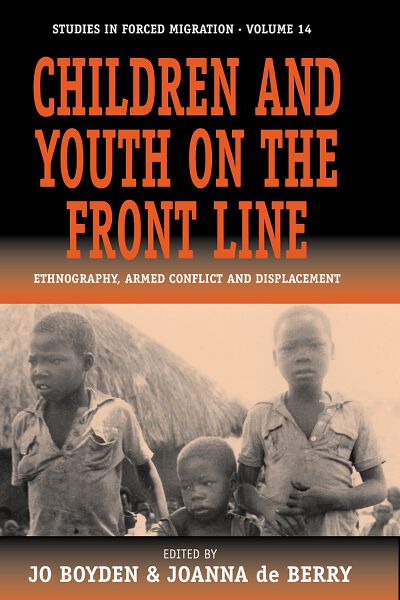
CHILDREN AND YOUTH ON THE FRONT LINE

Ethnography, Armed Conflict and Displacement

Edited by Jo Boyden and Joanna de Berry


288 pages, bibliog.
ISBN 978-1-84545-034-2 Pb $27.95/£15.00 Published (Autumn 2005)
ISBN 978-1-57181-883-6 Hb $75.00/£50.00 Published ( 2004)
Buy now and get 15% off listed price
Pb 
Hb 

Download this title All chapters available for download - see below.

(may not yet be available for newest titles)
 Google Book Search

"This deeply disturbing but brilliant collection will be a challenge to a burgeoning literature on children in war situations ... [especially] to those who wish to make a black and white distinction between children and adults."
Children, Youth and Environments

War leads not just to widespread death but also to extensive displacement, overwhelming fear, and economic devastation. It weakens social ties, threatens household survival and undermines the family's capacity to care for its most vulnerable members. Every year it kills and maims countless numbers of young people, undermines thousands of others psychologically and deprives many of the economic, educational, health and social opportunities which most of us consider essential for children's effective growth and well being.

Based on detailed ethnographic description and on young people's own accounts, this volume provides insights into children's experiences as both survivors and perpetrators of violence. It focuses on girls who have been exposed to sexual exploitation and abuse, children who head households or are separated from their families, displaced children and young former combatants who are attempting to adjust to their changed circumstances following the cessation of conflict. In this sense, the volume bears witness to the grim effects of warfare and displacement on the young.

Nevertheless, despite the abundant evidence of suffering, it maintains that children are not the passive victims of conflict but engage actively with the conditions of war, an outlook that challenges orthodox research perspectives that rely heavily on medicalized notions of 'victim' and 'trauma.'

Jo Boyden is a senior research officer at the Refugee Studies Centre, Queen Elizabeth House, University of Oxford.

Joanna de Berry trained in anthropology at Cambridge University and the London School of Economics and Political Science.

Series: Volume 14, Forced Migration


Download chapters from this title

Acknowlegments (Free download)


Acronyms (Free download)


Introduction (Free download)


Separated Children

Care And Support In Context

It is currently estimated that approximately one in every three-hundred children around the world is displaced by war and political violence (Machel 2000). This amounts to at least twenty million children, approximately one million of whom have been separated from their families (Djeddah n.d.). In Rwanda alone, by the end of 1994, more than 100,000 children had become orphaned or had lost contact with their parents as a direct result of the war (Machel 1996). The numbers in other countries are equally high: it is estimated that by 1992 the war in Mozambique had left nearly 200,000 separated children, and in 1995, a UNICEF study found that 20 percent of Angolan children had been separated from their parents and relatives as a result of the country's long-standing civil war (Garbarino et al. 1991). Moreover, recent UNHCR estimates indicate that at any one time, there may be up to 100,000 separated children in Western Europe alone (UNHCR 2001). Today large numbers of children around the world continue to be displaced from their families and communities as a result of armed conflict. Difficulties with definitions and with data collection have meant that the problem is probably larger than these statistics indicate.

Price: $9

Download full chapter (PDF)


Cultural Disruption and the Care of Infants in Post-war Mozambique

This chapter aims to describe the ways in which prolonged and multiple exposure to civil war and drought in the Gorongosa district of Sofala Province, Central Mozambique, influenced not only the psychological wellbeing of affected populations but also the wider stability and integration of families and communities. Quite apart from the destitution and profound discontinuities within the social order created by such exposure, it became increasingly difficult to perform the ceremonies and rituals that had long regulated life from birth (madzawde) to death (ntsanganiko) (Igreja 2003). In this way, armed conflict deprived the people of Gorongosa of vital social and cultural resources that had previously marked out their collective identity and given meaning to their existence. The loss of such resources had particular consequences for the survival and wellbeing of infants, since historically it was through observation of the rite of madzawde that the physical, psychological and emotional development of the child in the first two years of life was regulated. Other trends observed through the research included an increase in domestic and community violence, marital instability, infant malnutrition and sexual abuse - all of which pose an added threat to infant survival. According to annual surveys, rates of infant morbidity and mortality.

Price: $9

Download full chapter (PDF)


The Sexual Vulnerability of Adolescent Girls during Civil War in Teso, Uganda

Between 1987 and 1992 the Teso region of north-east Uganda was in the grips of civil war. An insurgent group called the Uganda People's Army (UPA) fought against the forces of the newly established government of Uganda, the National Resistance Army (NRA). The UPA had widespread support amongst the civilian population in Teso, and in seeking to curb the insurgency the NRA tried to cut off links between the militants and the local people. They did this by moving rural communities out of their homes and placing them in settlement camps, which were guarded by barracks of army soldiers. Land outside the camps was considered a freefire zone and anyone found there was assumed to be hostile to the government and killed. Government troops scoured the area looking for UPA bush camps to attack.

Price: $9

Download full chapter (PDF)


A Neglected Perspective

Adolescent Girls' Experiences Of The Kosovo Conflict Of 1999

After nearly a decade of non-violent opposition to repression by the Serbian administration, an armed wing of the Albanian Kosovar liberation movement was formed. With both ethnic groups claimharging right to Kosovo's territory and administration, Kosovo was plunged into violence. Severe clashes and a summer-long offensive in 1998 between the two factions resulted in the deaths of over 2,000 people from both communities, prompting intervention by international actors. In March 1999, after negotiations for peace broke down, NATO intervened and began strategic bombing raids on Serbian targets. Serbian offensives in Kosovo subsequently intensified, leading eventually to thousands of Albanian Kosovars fleeing into Albania, Montenegro and Macedonia as refugees. This chapter focuses on the experiences of adolescent girls who lived through this conflict both as civilians within Kosovo and as refugees in Albania. Humanitarian agencies and scholars often give priority to 'children'.

Price: $9

Download full chapter (PDF)


The Use of Patriarchal Imagery in the Civil War in Mozambique and its Implications for the Reintegration of Child Soldiers

An Ethnographically-based Concept of 'Child' Definitions and understandings of childhood in the West, which inform the concepts used by development agencies, are essentially age based. They assume that a child is someone under the age of 18, and is vulnerable, dependant and innocent. Implicit in this definition is the assumption that all those below 18 share these characteristics. Hence, the label 'child soldier' is applied to anyone under the age of 18 who bears arms. In the rural and urban areas of Manica province, Mozambique, where this research was carried out, the study sample indicated that almost half of both the RENAMO and FRELIMO fighters were younger than eighteen at the time of recruitment, and therefore were technically child soldiers (Schafer 1999: 123). But the research also suggests that the concept of 'child' soldier in the sense in which it is commonly understood, with the implications of childhood vulnerability and innocence, is not useful or accurate in this particular context. Amongst the Shona, the main ethnic group of Manica province, a distinction is made between the activities of a child and the activities of an adolescent. In Manica, labour migration was considered part of the process of entering manhood,2 beginning as early as age 12. The majority of the young RENAMO rural recruits had already spent some time living away from their family. (They generally went to nearby Zimbabwe for work at this age, and further afield to South Africa once they had more experience.) Thus, they were not really considered children by their communities in the sense in which the term is understood in the West.3 The fact that young men are involved in economic processes makes them, in the eyes of that society, potentially legitimate perpetrators of violence even though they are not yet 18 years of age.

Price: $9

Download full chapter (PDF)


Girls with Guns

Narrating the Experience of War of FRELIMO's 'Female Detachment'

Just as Africa is a continent on which youth constitute a demographic category of tremendous and increasing importance, because of the troubling number of military conflicts in Africa today it is also a continent on which a large percentage of the world's 'children at war' are to be found.2 Children at war and, particularly, 'child soldiers', feature prominently in international media coverage of Africa, especially when journalists wish to portray a chaotic continent plunging headlong into anarchy. Even if such media accounts and images often sensationalise and exoticise Africa, they not only play on the anxieties and suspicions of their readership, but also echo the ambivalence of many Africans toward the liminal category of youth. If we are to deepen our understanding of the broader issue of youth in Africa, we must better understand the place of Africa's youth in war.

Price: $9

Download full chapter (PDF)


Children, Impunity and Justice

Some Dilemmas from Northern Uganda

The use of children as soldiers is a growing phenomenon that has become a focus of advocacy and programme intervention by both human rights and humanitarian non-governmental organisations. Such interventions fall broadly into two strands. The first involves efforts to keep children out of conflict. This is exemplified by campaigning for an optional protocol to the UN Convention on the Rights of the Child to raise the minimum age of recruitment or participation in hostilities to 18 years. The second involves direct intervention to provide assistance to former child soldiers. Many of these programmes emphasise the psychosocial needs of children perceived to be victims of war. The aim is commonly to help children deal with the experience of being soldiers and to reunite them with their families or reintegrate them with the communities they are perceived to have been separated from by becoming fighters.

Price: $9

Download full chapter (PDF)


Children in the Grey Spaces Between War and Peace

The Uncertain Truth of Memory Acts

Already a fictitious past occupies a place in our memories, the place of another, a past of which we know nothing with certainty - not even that it is false. (Jorge Luis Borges: The Circular Ruins)
This chapter grows out of a need to make sense of truth and reconciliation in the aftermath of civil wars. These are armed struggles which make brother indistinguishable from stranger, family from a state of conflict. Such wars, marked by extermination and exodus which do not end with political treaties, both reveal and define the disquieting space in which we continue to live. I am particularly concerned with the ways in which acts of routine violence, practised on and by children between declared periods of war and peace, are treated within society. The following analysis examines the shifting narratives of children in the wake of armed conflict. By asking how children reconcile remembrance with forgetting, one also uncovers what is impossible to keep in conscious awareness.

Price: $9

Download full chapter (PDF)


Beyond Struggle and Aid

Children's Identities in a Palestinian Refugee Camp in Jordan

Conflict and displacement tend to encourage a discourse of monolithic and bounded identities. This may be especially true in the case of the young. As children's lives and bodies become objects for both political debate and humanitarian intervention, so the most immediate, most apparently pertinent or most expedient characteristic is taken up and stressed as singularly important. Young Hutu refugees in Tanzania, Bhutanese children in Nepal and Palestinians in Jordan are rendered as little more than that. The rhetoric of political leaders and of international humanitarian agencies engaged with refugee children tends to give scant consideration to difference between individuals within the same group. Thus, the age, gender, social class, personal history, religious faith, political views, and so on, of individual children are rendered irrelevant within discourses which suggest that a single dimension - be it ethnicity, nationality or the simple fact of being a refugee - overwhelmingly determines their experiences, values and aspirations. Inevitably, prevalent views about the universality of childhood itself also militate against the contemplation of difference (Archard 1990; Boyden 1997; Jenks 1996; Woodhead 1997).

Price: $9

Download full chapter (PDF)


Researching Young People's Experiences of War

Participatory Methods and the Trauma Discourse in Angola

Young people's experiences of armed conflict and displacement have formed a focus of research within the discipline of psychology for many decades. Psychologists and psychiatrists have conventionally studied the effects that these experiences have on children's emotional wellbeing, as well as the factors that mediate these effects: for example, the presence of a caregiver, or the age and personality of the child. A dominant trend in such research has been to take vulnerability rather than resilience as a starting point, based on assumptions about the difficulties which children and young people have in coping with the distressing experiences of armed conflict (Cairns 1996). Such assumptions are derived from popular conceptualisations of childhood in the West, where children are frequently regarded as vulnerable, passive beings who need to be protected and cared for, rather than as active members of their communities (Hwang et al. 1996).

Price: $9

Download full chapter (PDF)


Fluid Research Fields

Studying Excombatant Youth in the Aftermath of the Liberian Civil War

The architecture of this work is rooted in the temporal. Every human must be considered from the standpoint of time. (Frantz Fanon: Black Skin, White Masks)
Methodology is a rather neglected topic in studies of under-age combatants. Research in this field generally employs a quantitative approach and is based on short-term fieldwork in which encounters with respondents are often limited to one, or at most a few, and interviews are generally carried out with a tape recorder. Moreover, research is often done from within aid organisations. These approaches normally yield responses in victim modes and tend to conceal many important aspects of lived experience (see, for example, Brett and McCallin 1996; Fleischman and Whitman 1994; Goodwin-Gill and Cohn 1994). That is to say, respondents display what I term 'victimcy', expressing their individual agency by representing themselves as powerless victims (Utas forthcoming). This is a strategy that may also be employed by refugees and internally displaced people. 'Victim' responses often form the raw material for standardised and collectivised discourses of, for instance, survivors of war or repressive regimes (see, for example, Jackson 2002; Tiljander Dahlström 2001; Handelman 1997). Victimcy is a tactical manipulation, in part, aimed at presenting an image in line with cultural ideals. However, victimcy is also a political response to real security threats, as well as an economic strategy in relation to humanitarian aid projects, and as such is an obstacle to research. Hence, it is essential to find alternative modes of data collection.

Price: $9

Download full chapter (PDF)


Anthropology Under Fire

Ethics, Researchers and Children in War

As one of the most horrifying and momentous experiences known to humankind, war is of major theoretical and empirical interest to many scholars in the social sciences. International relations, economics, sociology and political science have been at the forefront of research in this field. Anthropologists, however, have tended to neglect the topic of war. In so far as the normal condition of human society is taken to be one of order, stability and equilibrium, anthropology tends to regard armed conflict as an atypical and calamitous state that, as such, merits little theoretical or empirical scrutiny. This outlook can be attributed in part to the influence of Marcel Mauss, whose theory of gift exchange promoted the idea that human interaction is founded on mutual interest and peaceful transaction. It has, however, been criticised in recent decades by those who suggest that it exaggerates both the accord and consistency of societies at peace and the anarchy of war (Allen 1989; Colson 1989; Davis 1992; Nordstrom 1997; Reynolds-White 1998). The critics stress instead the order that prevails within the disorder of war. They highlight the morality that persists in an immoral context and the culturally encoded meanings that structure and regulate individual and collective experience even in communities exposed to extreme violence and discord. They understand armed conflict not as a societal aberration, but as growing out of either a specific form of social organisation or a specific cultural phase. Some call for greater attention to conflict, or for the development of what John Davis has termed 'the anthropology of suffering'.

Price: $9

Download full chapter (PDF)


'Where Wings Take Dream'

On Children in the Work of War and the War of Work

Many shifts occur in the nature of war and the character of childhood. The patterns of change in both require vigilance and critical attention. With regard to war, forms that have been established to define and confine conflict easily fall away; thus the twentieth century witnessed a proliferation of 'nontraditional' wars. With regard to shifts in the conceptions of childhood, a similar level of vigilance is called for as fixed ideas of childhood can obscure children's experiences. Such an idealised view was expressed by G. W. Bush, the forty-third president of the United States, when, talking about the importance of families, he said, 'families is [sic] where our nation takes hope, where wings take dream' (quoted by Mitchell 2000). Children depend on an ethical attitude that is the basis of sociality and, where conflict erodes it (as it always does), they become targets and participants in war.

Price: $9

Download full chapter (PDF)


Contributors (Free download)


Index (Free download)


If you have any questions or comments about this site, please email us
All prices listed on this website are subject to change without notice.