New Titles Summer/Fall 10
(3.4Mb PDF file)

Anthropology 10/11
(3.3Mb PDF file)

Film and Media Studies 10
(2.5Mb PDF file)

International Studies 10
(3.1Mb PDF file)

History 2010
(2.0Mb PDF file)

Anthropology Texts for Teaching
(5.7Mb PDF file)


advanced search

Browse all titles by:
Author | Title | Series
Celebrating 16 Years of Independent Publishing Last updated: August 19th, 2010


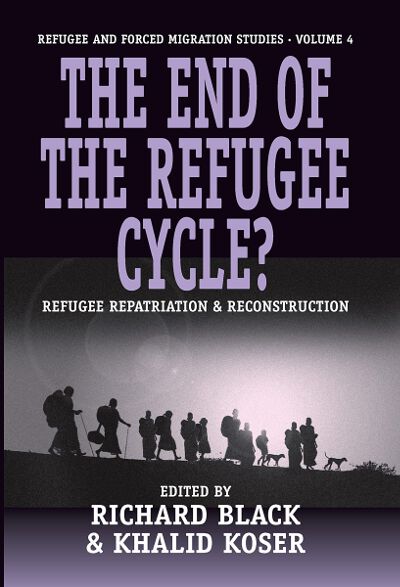
THE END OF THE REFUGEE CYCLE?

Refugee Repatriation and Reconstruction

Edited by Richard Black and Khalid Koser


256 pages, 3 maps, 11 tables, 3 diagrams, glossary, bibliog., index
ISBN 978-1-57181-715-0 Pb $22.50/£14.50 Published ( 1999)
ISBN 978-1-57181-987-1 Hb $59.95/£45.00 Published ( 1998)
Buy now and get 15% off listed price
Pb 
Hb 

Download this title All chapters available for download - see below.

(may not yet be available for newest titles)
 Google Book Search

Chosen by The Humanitarian Times as one of the Top Ten Titles on Humanitarian Issues of 1998

"Up-to-date material. Fills a fundamental gap in the literature which has tended to be based on pedagogical reasoning rather than actual field research."  · Population Index

At the start of the 1990s, there was great optimism that the end of the Cold War might also mean the end of the "refugee cycle" - both a breaking of the cycle of violence, persecution and flight, and the completion of the cycle for those able to return to their homes. The 1990s, it was hoped, would become the "decade of repatriation." However, although over nine million refugees were repatriated worldwide between 1991 and 1995, there are reasons to believe that it will not necessarily be a durable solution for refugees. It certainly has become clear that "the end of the refugee cycle" has been much more complex, and ultimately more elusive, than expected. The changing constructions and realities of refugee repatriation provide the backdrop for this book which presents new empirical research on examples of refugee repatriation and reconstruction. Apart from providing up-to-date material, it also fills a more fundamental gap in the literature which has tended to be based on pedagogical reasoning rather than actual field research. Adopting a global perspective, this volume draws together conclusions from highly varied experiences of refugee repatriation and defines repatriation and reconstruction as part of a wider and interrelated refugee cycle of displacement, exile and return. The contributions come from authors with a wealth of relevant practical and academic experience, spanning the continents of Africa, Asia, Central America, and Europe.

Richard Black is Lecturer in Human Geography at the School of African and Asian Studies, University of Sussex, where he moved in 1995 from King's College, London.

Khalid Koser is Research Fellow in the School of African and Asian Studies, University of Sussex and was previously Research Fellow in the Migration Research Unit at University College, London.

Series: Volume 4, Forced Migration


Download chapters from this title

Table of Contents (Free download)


List_of_Tables_and_Figures (Free download)


Acknowlegements (Free download)


Abbreviations (Free download)


The End of the Refugee Cycle?

At the beginning of the 1990s there was great optimism that the end of the Cold War might also result in the end of the global 'refugee cycle'. Cold War analyses of refugee displacements often highlighted the 'escape' from communism as the principal motive for refugee movements in the North. They tended to explain refugee-generating conflicts in the South in terms of wars conducted by proxy by the two superpowers (Suhrke and Zolberg 1989). In reality, though, the global refugee population increased substantially immediately after the end of the Cold War, from about 14.9 million in 1990 to 17.2 million in 1991 (UNHCR 1995a). The collapse of the former Soviet Union was a particularly significant event, which led to a wave of ethnic conflicts in the former Republics. As many as two million refugees have fled conflicts in Nagorno-Karabakh, Georgia, Moldova, Tajikistan and in the Russian Caucasus (Codagnone 1997). In the South, it became clear that many of the conflicts which perhaps started as proxy wars had taken on their own momentum, and refugees continued to flee Angola and Afghanistan, for example. In addition, new conflicts have emerged in the new geopolitical environment (Sword 1992). Up to two million people were displaced by the war in the former Yugoslavia, and perhaps one million from Liberia. New battle lines have been drawn between local protagonists and a range of international sponsors.

Price: $9

Download full chapter (PDF)


Researching Repatriation And Reconstruction

Who Is Researching What And Why?

In various parts of the world, and throughout the twentieth century, the transition from conflict to peace has led to the repatriation of exiles to their countries of origin (Coles 1985). Over recent decades, increases in the world's refugee and asylum-seeking populations have led to an increase in the number of people going back to their countries of origin at the end of war and conflict.1 The visibility of such moves is also growing. The laws of migration are such that every outward movement generates a back flow and there is research which suggests that this might be proportional, varying with flows of different magnitude and under different circumstances. This logic means that increases in returns from coercive war-related migration will also be associated with earlier increases in outward movements.

Price: $9

Download full chapter (PDF)


Revisiting a 'Repatriation Success'

The Case of Cambodia

In various parts of the world, and throughout the twentieth century, the transition from conflict to peace has led to the repatriation of exiles to their countries of origin (Coles 1985). Over recent decades, increases in the world's refugee and asylum-seeking populations have led to an increase in the number of people going back to their countries of origin at the end of war and conflict.1 The visibility of such moves is also growing. The laws of migration are such that every outward movement generates a back flow and there is research which suggests that this might be proportional, varying with flows of different magnitude and under different circumstances. This logic means that increases in returns from coercive war-related migration will also be associated with earlier increases in outward movements.

Price: $9

Download full chapter (PDF)


Repatriation and Reconstruction

The Case of Afghanistan

When Soviet troops invaded Afghanistan in December 1979, they set in motion a major exodus of refugees. By 1983, an estimated three million refugees had fled to Pakistan, increasing to some 3.27 million over the following seven years. A further 2.9 million had taken refuge in Iran by 1991. The refugees in Pakistan were accommodated in camps along the length of the border. They were provided with tents and some household equipment and had free access to food, health centres and schools in the camps. They were also permitted to seek employment within Pakistan, subject to certain restrictions. Most were engaged in daily labouring or pursued trading activities of various kinds. Most of the refugees in Iran, in contrast, were 'integrated' within Iranian society, and permitted to work in designated menial occupations. They were responsible for finding their own housing but had free access to health and education services and were also entitled to food and other subsidies on the same basis as Iranians. One element of the refugee population in Iran constructed their own mud villages close to the Afghan border. These so-called 'spontaneous' settlements were provided with health and education facilities by the Office of the United Nations High Commissioner for Refugees (UNHCR).

Price: $9

Download full chapter (PDF)


Contradictions and Control in Repatriation

Negotiations For The Return Of 500,000 Eritrean Refugees

During the longest standing armed conflict in Africa - the Eritrean struggle for liberation from Ethiopia - over one-quarter of Eritrea's population became refugees. The majority, as many as 500,000 people, sought asylum in Sudan, where some have now been for up to thirty years (Kibreab 1996a, Kibreab 1996b). In May 1991, after thirty years of trench warfare, Eritrea achieved liberation from Ethiopia. Although there is acknowledgement of food and humanitarian aid supplied during the war to nongovernment-controlled areas through the Sudan-based Cross-Border Operation, there is a clear and pervasive sense within Eritrea that Eritrea had to and did win its independence alone, without help from any nation or international body. In April 1993 an official referendum was held with over 99 percent of eligible Eritreans affirming their wish for Eritrea to be an independent nation. Until the referendum the Eritrean People's Liberation Front (EPLF) was the Provisional Government of Eritrea (PGE). The issue of the return of the refugees from Sudan to Eritrea quickly became a salient issue for PGE, for the United Nations High Commissioner for Refugees (UNHCR), and for international donors.

Price: $9

Download full chapter (PDF)


Repatriation from South Africa to Mozambique - Undermining Durable Solutions?

Explanations for the promotion of 'voluntary repatriation' as the preferred solution to the refugee cycle in the 1980s and 1990s tend to be sought in the field of international relations. Is it a reactive solution to problems within the international organisations? Harrell-Bond (1989) argues that it may be cheaper than long-term protection in the host countries. Allen and Turton (1996) view it as a 'pragmatic' response by the international community to avoid giving serious consideration to the other two 'durable' solutions and to reduce the likelihood of manipulation by host governments hungry for international assistance. They also imply that it goes hand in glove with the 'new realism' of 'militarised humanitarianism' (Allen and Turton 1996: 3). The increasing salience of national identities in the vacuum left by the end of the Cold War and its concomitant 'western'/'communist' ideologies is no doubt a further component. It is perhaps in this latter sense that the current High Commissioner for Refugees herself believes that 'properly planned and funded repatriation can help bring national and regional stability' (UNHCR 1994d). There is little room in these explanations to examine the motivations and practices of the refugees themselves, despite the gesture towards refugee agency implicit in the use of the qualifier 'voluntary'. Nor is much attention paid to the impact of the local socioeconomic and political context on the actual implementation of this policy. In this chapter I examine the Voluntary Repatriation Programme of Mozambicans from South Africa, a remarkably unsuccessful component of an operation which a UNHCR publication proudly described as 'the largest such program ever undertaken by UNHCR in Africa' (Dixon-Fyle 1994: 24).

Price: $9

Download full chapter (PDF)


Repatriation from the European Union to Bosnia-Herzegovina

The Role of Information

In December 1996, the UN High Commissioner for Refugees, Sadako Ogata, announced that requisite conditions had been satisfied to end the 'temporary protection' of Bosnian refugees, setting the stage for 1997 to be the year of repatriation from the European Union. According to UNHCR, at the end of 1996 there were 835,000 Bosnian refugees in twenty-five host countries in Europe without a 'durable solution', of whom it was projected that around 200,000 would return in 1997 (UN 1996). Half of these returnees were expected to come from Germany alone (UNHCR 1997b). While the vast majority of returns to Bosnia-Herzegovina were expected to be spontaneous, 1997 saw an increased effort amongst most EU member states, and by UNHCR itself, to initiate assisted return programmes and to facilitate and/or encourage Bosnian repatriation.

Price: $9

Download full chapter (PDF)


The Point of No Return

The Politics of the Swiss Tamil Repatriation Agreement

This chapter is about Tamil asylum migration during the years of the Sri Lankan conflict between 1983 and 1995, and attempts by the Swiss authorities to return failed asylum seekers to Sri Lanka. The focus is on the country of asylum, rather than on the country of return and aims to do three things. First, to explain why the Swiss authorities went through the arduous exercise of negotiating a return scheme aimed solely at failed Sri Lankan asylum seekers. Second, to describe the political and social consequences of the return scheme for the Swiss Sri Lankan population. And lastly, to explore alternative approaches to return which could have the potential to promote voluntariness, fairness and sustainability. Part of the rationale for a chapter of this kind is based on an assessment that in order to understand fully the implications of a return scheme it is as important to examine the situation in the country of asylum, from where people are going to be repatriated, as it is important to examine the conditions to which they are going to be returned. Repatriation is enormously complex, raising issues about reintegration and development, international law and human rights, security and justice, developed world-developing world relations and much more besides. This discussion touches on that complexity by arguing that examinations of return should scrutinise closely the reasons that lie behind governments' decisions to pursue return schemes, and analyse with care the effects and implications of return arrangements on the entire asylum population - not just those targeted for return but also those exempted.

Price: $9

Download full chapter (PDF)


The 'Self' in Self-Repatriation

Closing Down Mugunga Camp, Eastern Zaire

In mid-November 1996, after two years in exile, half a million refugees left eastern Zaire to return to Rwanda. Though sudden in some respects, this mass exodus in reverse followed a series of coordinated manoeuvres involving the strategic deployment of troops and aid. The return was planned and forecast, yet many questions surrounding the 'liberation' of the refugees remained, among them the thorny issue of whether the return had been voluntary. In view of the subtle changes that appeared in the international discourse at the time - in which terms like 'organised repatriation' and 'self-repatriation' came to be used - it is necessary to probe the mechanism that triggered the repatriation. Had refugees returned voluntarily or because of international collusion, or because of an extraordinary coincidence of extraordinary events?

Price: $9

Download full chapter (PDF)


From 'Refugee' to 'Repatriate'

Russian Repatriation Discourse in the Making

When the Soviet Union collapsed in 1991, Russia and the other newly independent states had no legislative or institutional framework for monitoring or managing large migrational flows, still less 'forced' migrations and refugee streams. During the Soviet period 'immigration' into the USSR had been virtually nonexistent and migration between constituent members of the Union ('interrepublican migration') was treated largely as an issue of rational economic planning.1 In the post-Soviet period, however, Russia has found it necessary to develop rapidly legislative and executive structures to manage a range of population movements. More than one hundred migrational flows have been identified in the post-Soviet space, ranging from the organised and planned withdrawal of Russian military personnel from Eastern Europe and some of the Newly Independent States to the flight from ethnic and military conflict in many former republics (Tajikistan, Uzbekistan, Moldova, Armenia, Azerbaijan and Georgia) and within the Russian Federation itself (North Osetia, Chechnia). UNHCR estimates that there are currently nine million displaced people on the territory of the former Soviet Union.

Price: $9

Download full chapter (PDF)


Why Angolan Soldiers Worry about Demobilisation and Reintegration

In the immediate postwar period, the vast majority of people migrating, resettling and reconstructing civil society are civilians. Yet demobilising soldiers and reintegrating them into civil society are key steps, and sometimes necessary preconditions, in the processes of demilitarisation and postwar social reconstruction. In Angola, the failure to demobilise after the 1991 Bicesse Accord facilitated the return to war in 1992. Demobilisation in Angola entails merging two armies and then sending around 70,000 soldiers back into civil society. As of November 1997, this process was still far behind the schedule predicted when the Lusaka Protocol was signed. Who are these soldiers, and what is their future in civilian life? Why do they worry about demobilisation? This chapter presents data collected by the authors in a survey of 500 soldiers (250 from each side) from both armies in April 1995. It discusses the social profiles of these soldiers, their postwar expectations, and some of the problems in fulfilling these expectations.

Price: $9

Download full chapter (PDF)


Repatriation and Everyday Forms of State Formation in Guatemala

The return of Guatemalan refugees from Mexico after more than ten years in exile is one of the cases that contributed to the designation of the 1990s as the 'decade of voluntary repatriation'. This repatriation exercise is an example of the contemporary concerns to promote the process of repatriation and to 'push' refugee assistance back across the border in order to prevent the further production of refugees. The lasting aim was to contribute to the formation of a modern, democratic state. The process of how repatriation links up with the (re-) formation of states has rarely been examined. The present chapter focuses on this process by drawing upon a more general debate on state formation. The process of repatriation in Guatemala is demonstrated to have increased the presence of the 'state' in the former areas of conflict, but at the same time to have enhanced the possibility of new conflicts. After presenting an analytical framework for the study of state formation, the chapter articulates the relationship between repatriation and state formation by focusing on three issues, namely: the arrival and forms of intervention of 'waves' of relief and development agencies; the conflicts over access to land and other resources which are related to the recategorisation of the social landscape, and finally the arrival, capacities and strategies of repatriates and returnees who regard themselves as a social force of modernisation.

Price: $9

Download full chapter (PDF)


Examining the Discourse of Repatriation

Towards a More Proactive Theory of Return Migration

In the study of repatriation, the lion's share of attention has been placed on examining either the decision to repatriate (particularly identifying the factors that go into electing to return and determining whether such decisions are voluntary), or the actual repatriation movement from the country of exile to the country of origin. While such areas of enquiry are obviously valid, there has been a virtual neglect of the later stages of repatriation, in which returnees attempt to establish themselves socially, economically and politically in their areas of return. Failing critically to consider these later stages can lead to the erroneous conclusion that with physical repatriation comes the end of the migration or displacement cycle. In fact the end of the process may still be years away for some returnee populations. As scholars and practitioners attempting to understand this process from the point of view of the repatriates, we need to question our assumptions about the meanings we give to concepts of 'return', 'home' and 'place' while at the same time reassessing the terms we use to describe postrepatriation life. In this chapter I argue that our understanding of the sociocultural and economic processes in which returnees become involved following repatriation is handicapped by our use of biased and inappropriate terminology. Lacking precise conceptual tools for examining what returnees do once they get down from the trucks that brought them back to their country of origin, aid providers are largely shooting in the dark when they try to develop assistance packages or to evaluate repatriation operations. Social scientists, who use misleading terminology borrowed largely from the international aid regime, its subdiscipline disaster management, and outdated migration theories, also fail to appreciate the lessons that returnees can teach them about culture change, the construction of communities, and the multiple meanings of, and connections between, notions of identity, culture, home and geographical place.

Price: $9

Download full chapter (PDF)


Contributors (Free download)


Bibliog_and_Index (Free download)


If you have any questions or comments about this site, please email us
All prices listed on this website are subject to change without notice.