Join our Email List
Series
Volume 9
Film Europa
Email Newsletters
Sign up for our email newsletters to get customized updates on new Berghahn publications.
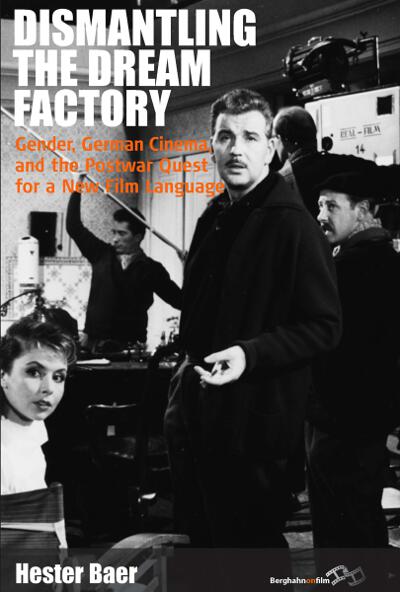
Dismantling the Dream Factory
Gender, German Cinema, and the Postwar Quest for a New Film Language
Hester Baer
318 pages, 22 illus., bibliog., index
ISBN 978-1-84545-605-4 $135.00/£104.00 / Hb / Published (September 2009)
ISBN 978-0-85745-617-5 $19.95/£15.95 / Pb / Published (February 2012)
eISBN 978-1-83695-707-2 eBook
Reviews
“…[a] fascinating study…[that] makes a major contribution to a burgeoning field dedicated to the investigation of what was once dismissed.” · Monatshefte
“...makes a significant and original contribution, is well researched as well as written, and would lend itself conveniently to the teaching of any of these films…[It] bring[s] to bear theories from Anglo-American film studies as well as German cultural studies and history. The result is a felicitous mixture of theory, cultural-historical context, and informed film readings.” · Jaimey Fisher, University of California, Davis
Description
The history of postwar German cinema has most often been told as a story of failure, a failure paradoxically epitomized by the remarkable popularity of film throughout the late 1940s and 1950s. Through the analysis of 10 representative films, Hester Baer reassesses this period, looking in particular at how the attempt to ‘dismantle the dream factory’ of Nazi entertainment cinema resulted in a new cinematic language which developed as a result of the changing audience demographic. In an era when female viewers comprised 70 per cent of cinema audiences a ‘women’s cinema’ emerged, which sought to appeal to female spectators through its genres, star choices, stories and formal conventions. In addition to analyzing the formal language and narrative content of these films, Baer uses a wide array of other sources to reconstruct the original context of their reception, including promotional and publicity materials, film programs, censorship documents, reviews and spreads in fan magazines. This book presents a new take on an essential period, which saw the rebirth of German cinema after its thorough delegitimization under the Nazi regime.
Hester Baer is Associate Professor of Germanic Studies at the University of Maryland, College Park. She has published widely on postwar and contemporary German cinema, women's literature, and feminism.
Subject: Film and Television StudiesGender Studies and Sexuality
Area: Germany
Contents
Of Related Interest
Framing the Fifties
Cinema in a Divided Germany

Masculinities in Polish, Czech and Slovak Cinema
Black Peters and Men of Marble