Join our Email List
Series
Volume 2
Anthropology of Media
Email Newsletters
Sign up for our email newsletters to get customized updates on new Berghahn publications.
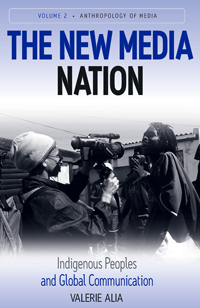
The New Media Nation
Indigenous Peoples and Global Communication
Valerie Alia
300 pages, 39 illus., bibliog., index
ISBN 978-1-84545-420-3 $135.00/£104.00 / Hb / Published (January 2010)
ISBN 978-0-85745-606-9 $34.95/£27.95 / Pb / Published (February 2012)
eISBN 978-1-80758-589-1 eBook
Reviews
“In sum, New Media Nationoffers scholars of minorities, of digital media and of globalizing indigeneities the opportunity to understand how the practices of producing meanings through discourses of resistance contribute over time to the development and re-invigoration of alternative discourses often thought to have been dissolved by the spread of ‘mass media’. By engaging in micro-analyses of specific cultural discourses and their elaboration in specific emergent media situations, Alia alerts her readers to the importance of the complexity of the local.” • Discourse & Communication
“…a scholar with extensive knowledge of indigenous life in the Canadian North, has compiled a valuable and timely compendium on how Native societies from the Arctic to Australia use new media technologies to reinforce local cultures and establish global connections…Highly recommended.” • Choice
“There is a lot of fascinating material in this book and it is striking that, the internet notwithstanding, radio remains central to indigenous media activity… Alia provides a very useful chronology which, although it starts in 11,000 BC, concentrates on developments in the last 100 years. There is also a filmography of indigenous films and videos.” • British Journal of Canadian Studies
“Alia should be commended for revealing a world of indigenous media use. This wide-ranging study lays a foundation for the study of how indigenous people use new media technologies, and future researchers of indigenous media use will want to use this book as a starting point.” • Anthropos
“Alia has crafted an accessible book for many audiences. It is easy to read; includes critical theory that is relevant, applicable and understandable; and flows through the many points of entry for indigenous people into the new media nation…The book is scholarly, yet it also reveals the depth and span of networks created by the new media nation that can be enhanced through awareness. The New Media Nation is brave and hopeful. As a document of the many instances of indigenous media, it captures events, experiences and testimony. It is also innately reflective of a network of global resistance, linking many indigenous groups’ affirmation of identity through the new media.” • The International Journal of Communication
Description
Around the planet, Indigenous people are using old and new technologies to amplify their voices and broadcast information to a global audience. This is the first portrait of a powerful international movement that looks both inward and outward, helping to preserve ancient languages and cultures while communicating across cultural, political, and geographical boundaries. Based on more than twenty years of research, observation, and work experience in Indigenous journalism, film, music, and visual art, this volume includes specialized studies of Inuit in the circumpolar north, and First Nations peoples in the Yukon and southern Canada and the United States.
Valerie Alia was an award-winning independent scholar, writer, and Professor Emerita, based in Toronto, Canada. She was Senior Associate of the Scott Polar Research Institute, Cambridge University, Distinguished Professor of Canadian Culture at Western Washington University, and Running Stream Professor of Ethics and Identity at Leeds Metropolitan University. She was also a television and radio broadcaster, newspaper and magazine writer and arts reviewer in the US and Canada. Her books include: Un/Covering the North: News, Media and Aboriginal People; Media Ethics and Social Change; Media and Ethnic Minorities; and Names and Nunavut: Culture and Identity in Arctic Canada. She was a founding member of the International Arctic Social Sciences Association and founded the sub-discipline of political onomastics, the politics of naming.
Listen to Valerie Alia talk about New Media Nation in an interview on Public Eye Radio, British Columbia's only weekly radio show covering politics in Canada's westernmost province, hosted Sunday mornings on CFAX 1070 by award-winning investigative journalist Sean Holman.
Subject: Media StudiesAnthropology (General)
Area: North America
Contents
Of Related Interest
Exploring Gypsiness
Power, Exchange and Interdependence in a Transylvanian Village
News as Culture
Journalistic Practices and the Remaking of Indian Leadership Traditions
Theorising Media and Practice