New Titles Summer/Fall 10
(3.4Mb PDF file)

Anthropology 10/11
(3.3Mb PDF file)

Film and Media Studies 10
(2.5Mb PDF file)

International Studies 10
(3.1Mb PDF file)

History 2010
(2.0Mb PDF file)

Anthropology Texts for Teaching
(5.7Mb PDF file)


advanced search

Browse all titles by:
Author | Title | Series
Celebrating 16 Years of Independent Publishing Last updated: August 19th, 2010


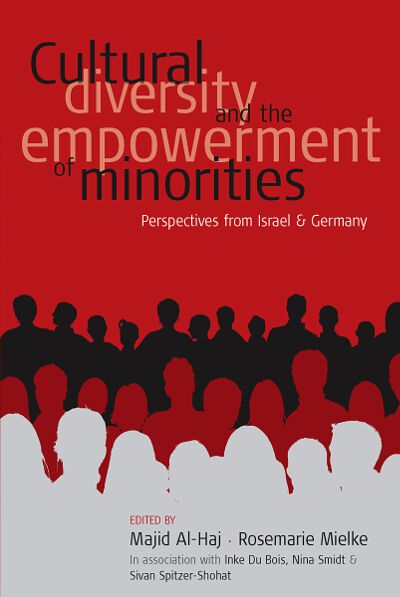
CULTURAL DIVERSITY AND THE EMPOWERMENT OF MINORITIES

Perspectives from Israel and Germany

Edited by Majid Al-Haj and Rosemarie Mielke
In association with Inke DuBois, Nina Smidt and Sivan Spitzer-Shoat


304 pages, bibliog., index
ISBN 978-1-84545-195-0 Hb $90.00/£45.00 Published (Winter 2007)
Buy now and get 15% off listed price
Hb 

Download this title All chapters available for download - see below.

(may not yet be available for newest titles)
 Google Book Search

"...this volume makes a valuable contribution to our understanding of the various dynamics and manifestations of conflict underlying majority-minority relations in Israel and Germany. Furthermore, the book makes a unique contribution in its application of democracy education as a means of empowering minorities and alleviating tensions. For these reasons, the book will likely appeal to both policymakers and scholars alike in its reference to a wide range of issues such as education, immigration, and gender issues."  ·  H-German

Conflicts between different racial, ethnic, national and other social groups are becoming more and more salient. One of the main sources of these internal conflicts is social and economic inequality, in particular the increasing disparities between majority and minority groups. Even societies that had been successful in dealing with external conflicts and making the transition from war to peace have realized that this does not automatically resolve internal conflicts. On the contrary, the resolution of external conflicts may even sharpen the internal ones. This volume, a joint publication of the University of Haifa and the International Center for Graduate Studies (ICGS) at the University of Hamburg, addresses questions of how to deal with internal issues of social inequality and cultural diversity and, at the same time, how to build a shared civility among their different national, ethnic, religious and social groups.

Majid Al-Haj is Head of the Center for Multiculturalism and Educational Research at the University of Haifa and lectures at the Department of Sociology at the University of Haifa. He has published extensively on the social and political structure of the Palestinians in Israel, Palestinian refugees, Russian immigrants in Israel, and freedom of expression. His books include Social Arab Local Government in Israel, co-authored with Henry Rosenfeld (Westview Press, 1990); Education, Empowerment and Control: The Case of the Arabs in Israel (SUNY Press, 1995), Sociology of War and Peace in Israel in a Changing Era (co-editor with Uri Ben Elezer- Haifa University Press , 2003) and Immigration and Ethnic Formation in a Deeply Divided Society: The Case of the 1990s Immigrants from the Former Soviet Union in Israel ( Brill, 2004).

Rosemarie Mielke is Professor for Educational Psychology at the University of Hamburg. She has published books on attitude and behavior and self related concepts like control, self-monitoring, self-efficacy and social identity. Her present research projects deal with strategies to cope with "negative" social identity, the influence of (minority/majority) group membership on self-evaluation and achievement behavior and the relationship between self-concept, values and the ethics of biogenetics.


Download chapters from this title

Table of Contents (Free download)


List_of_Figures_and_Tables (Free download)


Preface (Free download)


Introduction: Education, Multiculturalism, And Empowerment Of Minorities

An Overview

With the beginning of the new millennium, internal conflicts have become more and more salient. This trend is the result of the resurgence of ethnicity, the flourishing of local and individual identities, the increasing competition between groups over scarce resources and the rising awareness of national, ethnic, racial, and social groups of their right to be different. Societies that had been successful in dealing with external conflicts and making a transition from war to peace have realized that this does not automatically resolve internal conflicts. On the contrary, the resolution of external conflicts may even sharpen internal ones. In addition, societies that are heavily based on immigration realize that the "melting pot" strategy has failed and that the recognition of diversity is a basic condition for bridging the gap between the cleavages and divisions that make up societies.

Price: $9

Download full chapter (PDF)


Stories Of Struggle

Transnational Advocacy And Democracy Education

The terms "Democracy" and "Democracy Education" have been so overused that many are embarrassed to appear to be doing the same, and would prefer an alternative terminology. Others, such as the UNESCO Institute of Education (UIE), have sought to stimulate a debate around the meaning of "Democracy Education" by means of a series of consultative workshops on the topic between the years 2001 and 2004; and have, as I shall argue in this paper, contributed to giving it sharper contours. The decision about which participants were to be invited as well as the geographical location of the meetings inevitably shaped the process. The papers presented by the participants and the recorded discussion will form the basis for the present article. As I reread the material it seemed that two concepts played a decisive role in shaping an emerging consensus about the meaning of "Democracy Education": gender struggle and postcolonialism. The proposed models for educating teachers in the subject will be discussed and, finally, something will be said about the consultative process as a whole.

Price: $9

Download full chapter (PDF)


What's Going On Between Members Of Majorities?

Contributions From Social Psychology

Categorizing people and judging them according to the main characteristics of the group to which they belong is a very fast process. Most of the time, people are unaware of the judgments implicit in their behavior toward other people. The behavior is based on an intuitive process which stays unconscious as long as a person does not explicitly reflect upon it. According to social psychological intergroup theories the characteristics of the relationship between groups and the belonging to one group are strong determinants for the maintenance of judgments in favor of one's own group members and to the disadvantage of outgroup members. Even without hostility and hatred, which may explicitly strengthen the mutual rejection, the automatic processes based in the characteristics of the intergroup structure are fundamental for prejudice and discrimination.

Price: $9

Download full chapter (PDF)


Talking At Cross-Purposes

Misunderstanding In Intercultural Communication

Cross-talk is a phenomenon which routinely occurs in everyday talk both among members of the same culture and language community and members of different cultures. However, when misunderstanding occurs between members of different cultures, who also speak different native languages, the damage done by misunderstandings is often considerable and its negative effects on personal relationships can last for a long time. But what do we mean when we talk about "misunderstanding," can it be prevented, and, if so, how would one go about it? These are some of the questions I want to tackle in this paper. However, before attempting to give an answer to these questions, I will first of all explain what "misunderstanding" is, and give a brief introduction to some of the most important theoretical approaches to the complex phenomenon of misunderstanding. I will then, by way of illustration, describe a project on misunderstanding that I have been conducting at the University of Hamburg for a number of years. Finally, I will outline some ways and means of developing intercultural competence as an antidote to intercultural misunderstanding.

Price: $9

Download full chapter (PDF)


A Curriculum Between Conflict And Peace

The Teaching Of History In Jewish And Arab Schools In Israel

Pluralistic societies increasingly face the need to deal with internal issues of social inequality and cultural diversity, while simultaneously building a shared civility among their various national, ethnic, religious, and social groups. These challenges have led to the rise of multiculturalism both as an indicator for social structure and as a concept (see e.g., Banks 1981, 1989; Lynch 1986; Kymlicka 1995; McLaren 1995; Sleeter 1996; Giroux 1997; Wieviorka 1998). The school system is considered a foremost means for the promotion of multiculturalism and the deepening of intercultural relations. Accordingly, multicultural education has become one of the main subjects that pluralistic societies attempt to introduce for the new generation (Sleeter 1991, 1996). But is the education system capable of propelling social change and affecting the wider society? Or is it merely a reflection of the power relationships that exist in the wider society?

Price: $9

Download full chapter (PDF)


The Evolving Arab Reception Of The Holocaust And Palestinian Textbooks

A Contribution To Democracy And Peace Education?

In August 2001, the , one of the most widely circulated German daily newspaper supplements, blasted a headline on its front page that read: "Germany is financing anti-Jewish ['judenfeindliche'] schoolbooks for Palestinians." The uproar this news item caused can be easily imagined, especially as the article went on to elaborate that it was German taxes that were financing the anti-Semitic textbooks that would prepare children to become martyrs in the "Holy War" against Israel. Already in the previous year, when the first, newly devised Palestinian textbooks went into use, there had been an outcry in Israel, and even Mrs Hillary Clinton, in her bid to secure a seat in the U.S. Senate, felt prompted to go out of her way to stress that these books were not acceptable and appealed to the then First Lady of the Palestinian autonomous territories, Mrs Suha Tawil, to do something about the situation. I have quoted these examples to demonstrate that the issue of Palestinian textbook revision has made waves far beyond the local or regional arena and has warranted international involvement.

Price: $9

Download full chapter (PDF)


Police-Minority Relations In A Multicultural Society

The Israeli Case

Israel is defined as a deeply divided society and the strained relations between Jews and Arabs is considered to be the worst cleavage. The severity of the division is reflected in the tense relations between the police and Arab citizens, which climaxed in the week-long disturbances during the month of October, in 2000, and resulted in the death of twelve Arab citizens (as well as another Palestinian resident from the occupied territories).1 The tense relationship between Arab citizens and the police is historically rooted and was earlier manifested in the Israeli Arab narrative in events such as "Yom Al-Ard" ("Land Day") when violent clashes took place between the police and Arab citizens during the protests.2 A historical review ascertains that political factors are prominent in explaining the tense relationship between Arab citizens and the police in Israel. Factors contributing to the tension with the police are: (a) Arabs in Israel are part of the Palestinian nation and Israel has long been in conflict with the Palestinians, a fact which has led the Jewish majority to affiliate Israeli Arabs with the enemy and perceive them as having "dual loyalty"; (b) Israel defines itself first and foremost as a Jewish state; this definition has intensified the political marginalization, feelings of discrimination and regime deligitimization among the Arab minority in Israel (Smooha 1993, Rouhana 1997; Hasisi and Pedahzur 2000; Ghanem 2001; Or Committee 2003; Hasisi 2005).

Price: $9

Download full chapter (PDF)


On The Central Role Of "Threat Perception" In Mediating The Influence Of Socioeconomic Factors On Xenophobic Attitudes

Democratic government depends on more than formal institutions. It relies greatly on democratic political culture with the commitment of citizens to democratic values (Almond and Verba 1963). The willingness to protect minority rights in general and the willingness to accept and appreciate minorities both socially and culturally is one such democratic value. Yet xenophobia toward minorities is quite common in Western and other democracies. In Western Europe, there is recent evidence of the expansion of negative attitudes to outgroups such as ethnic minorities, religious minorities, and labor migrants (e.g., Boehnke, Hagan, and Hefler 1998).

Price: $9

Download full chapter (PDF)


A Multimedia Lexicon As A Tool For Increasing Societal Tolerance

Beneath the veneer of Israel's mainstream culture lie numerous groups whose world views, beliefs, desires, and lifestyles are far removed from those shared by the majority of Israelis. In effect, Israeli society is a variegated gallery of subcultures differentiated by patterns of taste, tradition, and behavioral conditioning. This is evinced, among other things, by their language, clothing, food, housing, entertainment, music, and education. Moreover, they are distinguished by economic criteria, such as income, profession, savings, and property, as well as by demographics (country of origin, family size, geographic distribution, and education). They differ in their political, religious, and ideological outlook, their self-image, the degree of exposure to outside influences, and their impact on other groups in Israeli society.

Price: $9

Download full chapter (PDF)


When Gender Differences Surpass Cultural Differences in Personal Satisfaction with Body Shape in Israeli College Students

How we perceive and experience our bodies is a significant component of the way we relate to ourselves (Mahler and McDevitt 1982; Hutchinson 1994). A central component of personal self-evaluation and self-acceptance is one's satisfaction (or dissatisfaction) with one's body. Body image is a subjective and complex set of perceptions of and attitudes to the size, shape, aesthetics, and experience of one's own body (Cash and Pruzinsky 1990; Thompson 1996) produced by inter- and intrapersonal dynamics. It is not to be confused with the actual physical body or with an outsider's impression of it (Cash and Pruzinsky 1990; Hutchinson 1994).

Price: $9

Download full chapter (PDF)


Postcolonial Feminism, The Politics Of Identification, and The Liberal Bargain

In 1988, Deniz Kandiyoti introduced the term , to explain how women living under patriarchy strategize in order to maximize security and optimize their life options. She showed that women's responses to male dominance vary widely, according to the objective opportunities available under each particular variant of patriarchy. Such responses range from eager collaboration, whereby women act as devout guardians of patriarchal mores and values, through skillful maneuvering to make gains while avoiding overt conflict, to different levels of passive and active resistance. Kandiyoti thus sought to distinguish among different degrees and forms of patriarchal oppression, on the one hand, and to convey the complex positioning of women with respect to power/disempowerment, on the other. She argued that within the system that by and large works against women, some of them stand to benefit from the unequal gender arrangements, depending on their stage in the life cycle or on their particular familial status. Such women are more likely to strike a bargain with patriarchy than to resist it. This was identified as a major source of women's acquiescence and accommodation to existing gender orders.

Price: $9

Download full chapter (PDF)


Acculturation Attitudes And Bilingual Classrooms In Germany

The Portuguese-German Example

The cohabitation of different cultures in the same geographical location originated with the discoveries of the fifteenth and sixteenth centuries and boomed in the twentieth century, mainly due to what nowadays is called globalization. Indeed, it was precisely in the fifteenth and sixteenth centuries that the Portuguese started to leave their country to settle somewhere else in the world, leading to one of the biggest diasporas in history, spreading across the five continents. Since the end of World War II, these migratory movements have increased within Europe, while trans-oceanic mobility has decreased. One of the most popular destinations of Portuguese emigrants has been Germany, especially since 1964, when the first agreements were signed with Portugal in order to supplement the labor force and contribute to the reconstruction of the country. Almost forty years have passed since then and the question arises of how Portuguese immigrants and the host community coexist in Germany.

Price: $9

Download full chapter (PDF)


"Not Always Proud To Be American"

The Reconstruction Of National Identity By Americans Residing In Germany

On July 4, 2004, some 150 Americans celebrated Independence Day in Hamburg, Germany. As at many July 4th events in the United States, the organizers had prepared a barbeque and the tables were decorated in the national colors of red, white, and blue; the children played baseball; and the adults had soft drinks and beer. Yet, a significant difference struck the observer: usually, an abundance of national flags swinging and swaying can be seen wherever one looks on this day. Here, however, the American flag was hidden under a big, beige-colored wooden umbrella. The hiding of the national flag is deeply symbolic of the change in American expatriates' national identity. This controversial change in what it means to identify as an American abroad is the theme of this paper.

Price: $9

Download full chapter (PDF)


Oral Mistake Corrections In Second-Language Classrooms

Second-language classrooms have been an area in which many analyses have taken place. Some of the early observational studies in second-language classrooms examined teachers' responses to students' errors/mistakes and most of them show the sorts of questions teachers ask about the issue: which errors/mistakes to treat, exactly when, and exactly how. Research on how teachers treat their students' errors show that teachers have a wide variety of techniques for the treatment of errors, but more important than this is the complexity of the decision teachers must take in order to correct an error.

Price: $9

Download full chapter (PDF)


Intercultural Competence In Management Consultancies In Germany

Does It Exist?

It is the contention of the author that the need exists to measure and develop the intercultural competence of management consultants working at management consultancies, e.g. A.T. Kearney, Deloitte, Ernst & Young, McKinsey, PricewaterhouseCoopers, etc. Since it is the responsibility and task of management consultants to strategically define and implement how large corporations operate and function within a global, and therefore intercultural context, it is critical to examine and gage the levels of intercultural competence within these individuals.

Price: $9

Download full chapter (PDF)


Index (Free download)


Contributors (Free download)


If you have any questions or comments about this site, please email us
All prices listed on this website are subject to change without notice.