Join our Email List
See Related
History JournalsEmail Newsletters
Sign up for our email newsletters to get customized updates on new Berghahn publications.
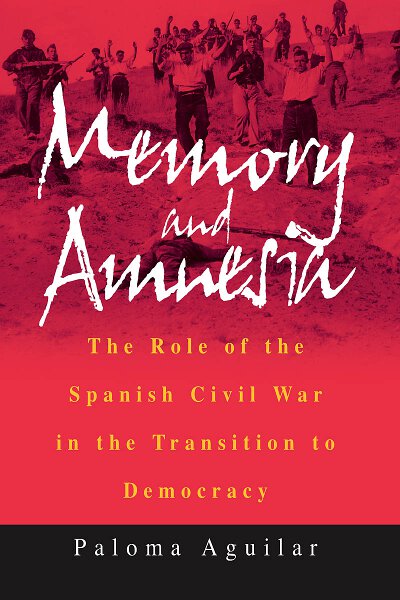
Memory and Amnesia
The Role of the Spanish Civil War in the Transition to Democracy
Paloma Aguilar
Translated from the Spanish by Mark Gordon Oakley
356 pages, 16 tables, 10 graphs, bibliog., index
ISBN 978-1-57181-757-0 $135.00/£104.00 / Hb / Published (August 2002)
ISBN 978-1-57181-496-8 $34.95/£27.95 / Pb / Published (August 2002)
eISBN 978-1-78238-485-4 eBook
Reviews
“…this excellent history of the Spanish desire for reconciliation is a major contribution to the study of both the Transition and memory.” • Journal of Modern History
“This book… is one of the most important research studies written recently about the Spanish transition to democracy… [It] will be of treat use for historians, researchers of cultural studies (Aguilar used cinema and art sources), political scientists and policy makers engaged in the transition process from non-democratic regimes.” • Democratization
“This methodologically exemplary study makes an essential contribution to research on historical memory in Spain, the most important issue within the country's contemporary history.” • Stanley Payne, University of Wisconsin-Madison
“Paloma Aguilar has made an important, meticulous and impartial contribution to a crucial aspect of our contemporary memory.” • Víctor Pérez-Díaz, Complutense University of Madrid
“Paloma Aguilar's detailed and composed study of the historical memory of the Spanish Civil War is a work of considerable importance. In addition to its scientific interest, it offers an exciting read.” • Paul Preston, London School of Economics
“…a very convincing analysis.” • Historische Zeitschrift
“The translation into English of a book written by a contemporary Spanish historian is an unusual publishing event. [This] work…is richly deserving of this tribute…this excellent history of the Spanish desire for reconciliation is a major contribution to the study of both the Transition and memory.” • Modern History
Description
Using a rich variety of sources such as official newsreels, school textbooks, the work of contemporary historians, memoirs, official documents, legislation, and monuments, this book explores how the historical memory of the Spanish Civil War (1936-1939) influenced the transition to democracy in Spain after Franco's death in 1975. The author traces the development of official discourse on the War throughout the Franco period and describes the régime's attempts to achieve political legitimacy. Although there was no universal consensus regarding the events of the Civil War, general agreement did exist concerning the main lesson which should be drawn from it: never again should Spaniards become embroiled in a fratricidal conflict.
Paloma Aguilar is Professor of Political Science at the Universidad Nacional de Educación a Distancia (Madrid, Spain) and Doctor Member of the Juan March Institute (Madrid, Spain).
Subject: History: 20th Century to PresentMemory Studies
Area: Europe
Contents
Of Related Interest