 Get New Issue Alerts
Browse Archive
 PDF issue available for purchase
 Print issue available for purchase
- Vol 5 Issue 1
- Vol 4 Issue 2
- Vol 4 Issue 1
- Vol 3 Issue 2
- Vol 3 Issue 1
- Vol 2 Issue 2
- Vol 2 Issue 1
- Vol 1 Issue 2
- Vol 1 Issue 1
Turba
The Journal for Global Practices in Live Arts Curation
ISSN: 2693-0129 (print) • ISSN: 2693-0137 (online) • 2 issues per year
Volume 2 Issue 2
Get 35% discount when you checkout 3 or more PDF articles.
Editorial
Liberating Curation
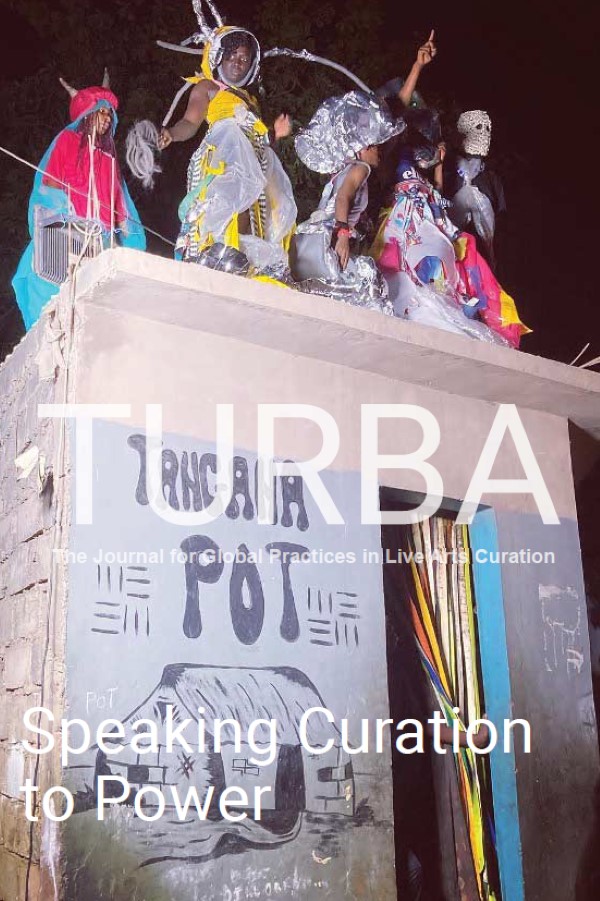
In recent decades we have experienced a resurgence of authoritarianism in previously democratic societies that have given way, once again, to populist movements, and in so many corners of the world that have been affected by social revolutions. The freedoms of progressive-minded people, live artists and curators are increasingly constrained not only by practicalities and aesthetics but also by political meddling and institutional censorship. A consequence of their convictions and positions of resistance is that their personal safety has been threatened. These are conditions that have been dire realities for curators living in many countries. Within the pages of this issue, they offer differing visions for imagining a radical curatorship in the face of tyranny by designing and defining innovative strategies that break down traditional ways of being and doing. And they model themselves as artivist community organizers and socio-political reformers.
Re/visiting
Revisiting “Collective Walks / Spaces of Contestation; Empowering Platforms, Raising a Non-Army in Thailand
In the summer of 2023, I received a surprising proposition from
New Research
Breaking the Refugee Mold Through Curation; Beyond Mystery and Authority; To Repeat also Means Getting Ahead; Curatorial Crisis On Display
The refugee experience is exacerbated by hostile receiving environments, out of which have developed an essentialized refugee imaginary. Media reporting has evidently been rife with documentation of anti-immigration political rhetoric and prejudice toward refugees. In this article we employ a framework of migrant-directed artistic programming to examine the experiences of refugees hosted in Malawi, United Kingdom, and India as curated in their visual, literary, and performance artworks. We interrogate context, meaning, and practice for the annual Tumaini Festival at Dzaleka Refugee Camp, Malawi; Refugee Week Festival, United Kingdom; and the recently published collection of artistic works from India Why did I become an illegal migrant? Tamil refugee students and youth on citizenship. Our examination pays particular attention to the dynamics and interplay of refugees’ individual and collective agency and the paternalistic oversight of their host communities. The distinct and overlapping experiences of refugees in the three countries echo the salience of the resulting power relations in society. This article highlights the agency and tactful resistance of refugees across communities in three different countries. Using thoughtfully curated artwork and related experiences, the refugee communities highlighted in this article begin to remold the layperson's understanding of the refugee experience. Our article contributes to the growing body of literature on refugee experiences and underscores the importance of elevating the voices and perspectives of marginalized migrant communities.
Following the author's experience of the performance SÅLE at the 2022 Ultima Oslo Contemporary Music Festival in Norway, this article argues that the concept of curating as deployed in contemporary music must be expanded beyond an understanding of the authorial individual carried over from the figure of the composer. Using Aneta
This article questions the potential of pre-enactment to embody prototypical counter- strategic forms in artistic and curatorial practices, within the European context, in light of a resurgence of authoritarianism, political populism, and the presence of various conflicts, migratory phenomena, and environmental crises. Pre-enactment has been characterized, for example, in certain works of the duo Hofmann & Lindholm, the Public Movement and Interrobang collectives, and the director Milo Rau. According to Friederike Oberkrome and Verena Straub in the introduction to their book (2019), pre-enactment is the invention of hypothetical scenarios, speculations on possible futures, and the experimentation of fictitious times and spaces order in to act on the present. This article approaches pre-enactment from the perspective of performative action-exercises based on three examples: Training for the Future (2019–) by Jonas Staal and Florian Malzacher, la facultad (2021–) by Myriam Lefkowitz and Catalina Insignares, and The Truth Commission (2013–) by Chokri Ben Chikha and his company Action Zoo Humain.
Festivals and their arrangements illuminate aspirational, economic, and aesthetic questions of societies and their citizens. However, to what extent do festivals reflect or represent the crucial concerns of the community they are a part of? This article addresses negotiations in the curatorial process of various festivals, while unraveling the layers of identity formation maneuvered through historical dance narratives. It addresses concerns about how festivals or cultural events become “sites” of curation that can speak to power. The attempt is to define the politics of curation and the need for “curation as a strategy of critique” for the existing presentation of “national” culture and its performance (display) in India. Considering the massive expansion of festivals in artistic arenas, national marketplaces, the international cultural industries, and scholarly programs in festival studies, this article tries to map out the historical context of the dance (performance) festival culture that exists in India.
Interviews and Conversations
Falling Skies; Curating and Creating Social Experiments; Silence (RE)Sounds
Juma and Epona met in autumn 2022. At the time Epona, along with Nara Virgens and Melmun Bajarchuu, was curating an event1 on the topic of sustainability in transnational cooperation in performing arts, to which Juma was invited as a guest speaker. Since then, they have continued their conversation and exchanged their perspectives. A recurring topic in their conversation is the question of decentralizing power dynamics in the global performing arts scene, on the backdrop of climate change and unequal distribution of resources. As an Indigenous artist and activist from Pindorama (colonially known as Brazil), Juma's perspective is informed not only through her locality within a global performing arts scene but by the knowledge they carry and the challenges they are facing stemming from her (human and non-human) Indigenous coexistence. Based in Berlin, Epona works in the performing arts field as a producer and curator and has gained varied experience in transnational cooperation in recent years. Her critical approach has been informed by her Lebanese heritage within European contexts and by being a mother to her daughter.
Vantage Points
Essays, Critical Perspectives, Field Notes, and a Manual
A distinctive trait of the Chilean art scene, its insular condition came about as a consequence of the 1973 coup d’état, which interrupted foreign relations for a long time. The situation is only now being reversed, with local artistic production still being restricted to a homegrown market and audiences. Within this national circuit of the arts, almost entirely centered in the city of Santiago, artistic work is mostly limited to the activity of graduates and faculty from metropolitan universities, such as the Universidad de Chile and the Universidad Católica. The trend is now being reversed thanks to recent social events, primarily the 2019 uprisings or the increased market value of lithium, which put Chile back at the center of the global geopolitical agenda. In addition, a shift in media attention toward the art of indigenous peoples, which peaked in 2022, with examples such as the Venice Biennale, has allowed artists like Cecilia Vicuña, active since the seventies, to enter the so-called star system of art.
Book Reviews
Acciari, Monia & Philipp Rhensius, eds. 2023. Politics of Curatorship: Collective and Affective Interventions. Bern, Switzerland: Norient Books.
Voegelin, Salomé. 2023. Uncurating Sound: Knowledge with Voice and Hands. London: Bloomsbury Academic.