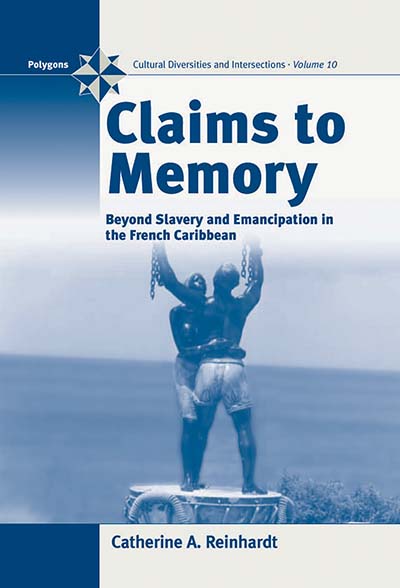
CLAIMS TO MEMORY
Beyond Slavery and Emancipation in the French Caribbean
Catherine Reinhardt
| 216 pages, 34 b/w photos, bibliog., index ISBN 978-1-84545-412-8 Pb $27.95/£15.00 Published (Winter 2007) ISBN 978-1-84545-079-3 Hb $70.00/£42.00 Published (Spring 2006) Buy now and get 15% off listed price |
All chapters available for download - see below.
“Reinhardt’s astute, well –researched, and historically contextualized literary analyses yield much interesting commentary as well as some original insights.” · American Historical Review
"Claims to Memory is illuminating, thought-provoking, and even elegant. All students and scholars with an interest in France’s islands in the Caribbean need to read it." · Island Studies Journal
"Claims to Memory is an engaging and in many ways unique book…that sets out to dismantle the delusions of republican France as the birthplace of liberty and slave emancipation…Reinhardt’s book is a great challenge to francophone literary studies and a brilliant response to Glissant's call for a 'prophetic vision of the past.'" · H-France Review
"The complexities and controversies of commemorating slavery provide Claims to Memory with a fascinating subject matter…a valuable addition to debates on slavery commemoration that serves as a counterpoint to ‘the overpowering narrative of the French abolitionist movement’." · Francophone Studies
“Reinhardt does not fail in her ambitions. Using the theoretical antecedent of rhizomatic memory and reading across the multiple sources this method entails, Reinhardt succeeds in challenging our simplification of historical narratives of abolition in the Caribbean, and our assumptions about the interrelationship between abolition and the Enlightenment…In her reading across genres and realms of memory, this text offers an excellent actualization of rhizome memory…[and] an historical account of slavery in the French Caribbean from a variety of sources ideal for scholars in the area of the history of slavery. Claims to Memory is also engaging reading for scholars in the more general areas of public memory and representation.” · The Canadian Review of Sociology/Revue canadienne de sociologie
"What is distinctive about Catherine Reinhardt's book is the highly visible place that it gives to the decolonizing of memory in a larger theory of Caribbean postcolonial subjectivity. This makes it a vital contribution to the theory of the postcolonial subject". · Paget Henry, the Fanon Prize Committee, Caribbean Philosophical Association
WINNER OF THE CARIBBEAN PHILOSOPHICAL ASSOCIATION'S 2007 FRANTZ FANON PRIZE FOR OUTSTANDING WORK IN CARIBBEAN THOUGHT
Why do the people of the French Caribbean still continue to be haunted by the memory of their slave past more than one hundred and fifty years after the abolition of slavery? What process led to the divorce of their collective memory of slavery and emancipation from France's portrayal of these historical phenomena? How are Martinicans and Guadeloupeans today transforming the silences of the past into historical and cultural manifestations rooted in the Caribbean? This book answers these questions by relating the 1998 controversy surrounding the 150th anniversary of France's abolition of slavery to the period of the slave regime spanning the late Enlightenment and the French Revolution. By comparing a diversity of documents—including letters by slaves, free people of color, and planters, as well as writings by the philosophes, royal decrees, and court cases—the author untangles the complex forces of the slave regime that have shaped collective memory. The current nationalization of the memory of slavery in France has turned these once peripheral claims into passionate political and cultural debates.
Catherine Reinhardt is a lecturer of French at Chapman University. She has given numerous talks and published articles on slavery in the French Caribbean and on French and Caribbean literature.
Series: Volume 10, Polygons: Cultural Diversities and Intersections
Download chapters from this title
Table of Contents (Free download)
Illustrations (Free download)
Acknowledgments (Free download)
Introduction (Free download)
Realms Of The Enlightenment
In the context of African slavery, the period of the French Enlightenment is generally remembered as the founding moment of abolitionary ideology. In particular, the French philosophes Montesquieu, Voltaire, Denis Diderot, Jean-Jacques Rousseau, the Abbé Raynal, and Condorcet are believed to have been at the origin of a humanitarian process that undermined the slave regime and ultimately led to its demise. During the 150th anniversary of the abolition of slavery a journalist tellingly writes that the first abolition of slavery in 1794 was achieved through the "impetus given by the humanists" (Vidal 1998). Another journalist similarly links the abolitionary movement directly to the philosophes' unanimous condemnation of the African slave trade (Paringaux 1998). An exhibition organized on the same occasion by the Archives Départementales de la Guadeloupe (1998: 14-15) reserves a section to the philosophes. Passages of Voltaire's Candide ([1759] 1973) and Montesquieu's De l'esprit des lois ([1748] 1955) illustrate denunciations of the slave regime. The memory of slavery during the Enlightenment is still dominated by the belief in the transformative influence of the Age of Reason on inequality, injustice, and exploitation.
Price: $9
Download full chapter (PDF)
Realms Of The Maroon
"The maroon is the only true popular hero of the Caribbean," writes Edouard Glissant in Le discours antillais in 1981. A decade later, his compatriots quite literally act on this statement as they begin erecting numerous statues in memory of this emblematic figure of their slave heritage. Symbolizing the slaves' active resistance against oppression spurred by the desire for freedom, maroons occupy an important place in the West Indian imagination today. As Richard D. E. Burton (1997: 23-25) points out, maroons embody the reverse side of assimilation and the possibility of existing outside of the colonial system. Many contemporary Caribbean authors use marronnage as a principle theme in their work.1
Price: $9
Download full chapter (PDF)
Realms Of Freedom
"We the Negroes ... are ready to die for this freedom, for we want to and will obtain it at any price, even with the help of mortars, canons, and rifles" (ANF Colonies F3 29, 1789b). Martinican slaves declared their right to freedom in writing for the first time in August 1789, in a series of letters addressed to colonial administrators. Seeing that their demands went unheeded, they broke out into an insurrection several days later. The relationship between this historic episode and the narratives by the Société des Amis des Noirs and colonial planters that preceded and followed it provides unprecedented insight into how the memory of slavery was formed. A test of the Revolution's universalist claims, the colonial question reached its boiling point between 1789 and 1794 (Geggus 1989a: 1291). It is during this period that conflicting interests between slaves, free coloreds, white colonial planters, and French abolitionists clashed together, producing irreversible changes in the French colonies. A number of historians of French slavery deplore the absence of the colonial question in revolutionary historiography.1 More importantly, the slaves' voices were covered up by more dominant narratives and have thus been lost as a testimony of their rightful share in these historical events.
Price: $9
Download full chapter (PDF)
Realms Of Assimilation
Free coloreds from the French Caribbean entertained an altogether different relationship to France and to the revolutionary principles of freedom and equality than did the Martinican slaves. While the slaves — united as a black nationhood — demanded the return of their natural and God-given right to freedom, the free people of color based their demands for equality on their filial relationship to France. Voicing the demands of their social group from the political and social margins of French colonial society, free coloreds appropriated the egalitarian principles of the Revolution to claim their due rights as French citizens. The affirmation of their racial heritage and class status within colonial society became the cornerstone of their combat against racism, violence, and exclusion from the newly born body of free French citizens. On the grounds of their racial kinship with the French and of their considerable wealth as members of the plantation and slaveholding class of the colony, they demanded the right to political representation in the legislative assemblies. Since they were opposed by a powerful lobby of white colonial planters, however, it took several years of petitioning and of violent outbreaks between free coloreds, whites, and slaves before people of color were finally granted equality by the First French Republic. Positioned as powerful economic competitors, they dangerously shook the supremacy of white colonial power. Equality was accorded as a last resort against the unleashed furor of slave revolts sweeping Saint Domingue and other parts of the Caribbean.
Price: $9
Download full chapter (PDF)
Realms Of Memory
The following quote by writer and Nobel Peace Prize Laureate Elie Wiesel points to the very essence of the problem of memory in the French Caribbean today: "The executioner always kills twice, the second time through silence" (qtd. in Chalons 2000: 152). Countless colloquiums organized by the people of Martinique, Guadeloupe and French Guiana on the occasion of the 150th anniversary of the abolitionary decree reveal the same feeling of unease in regards to the way in which France chose to commemorate this event. The Martinican writer Patrick Chamoiseau (2000: 112) laments France's "self-glorification" through the exclusive celebration of the abolitionary moment. The year 1848 became a moment of victory for the French, the victory of humanitarian ideology over a horrific system of human exploitation. However, in the process of remembering the abolition, the government-led celebrations failed to honor the memory of those who were transported across the Atlantic for three centuries, who died laboring for the production of sugar, and who continually rebelled against colonial rule: the slaves.
Price: $9
Download full chapter (PDF)
Conclusion (Free download)
Appendix (Free download)
Bibliog (Free download)
Index (Free download)