Join our Email List
Email Newsletters
Sign up for our email newsletters to get customized updates on new Berghahn publications.
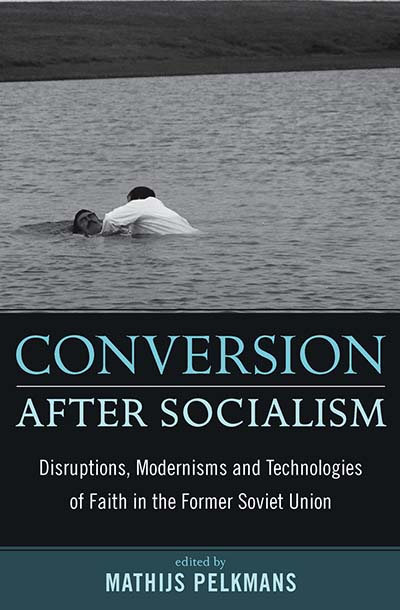
Conversion After Socialism
Disruptions, Modernisms and Technologies of Faith in the Former Soviet Union
Edited by Mathijs Pelkmans
216 pages, 2 tables, 4 images, bibliog., index
ISBN 978-1-84545-617-7 $135.00/£104.00 / Hb / Published (November 2009)
eISBN 978-1-84545-962-8 eBook
Reviews
“Material deprivation and social dislocation remain defining features of post-Soviet societies. This volume adds much-needed depth to previous analyses of coping strategies and networks of support by exploring the moral dimension of individual subjective experience…[and] makes an original and important contribution to our understanding of post-socialist and postcolonial societies and speaks to the renewed interest in religion within the discipline.” · JRAI
"... an unusually strong edited collection that will have an important impact on Post-Soviet studies but that will also find a high profile place for itself in the developing field of the anthropological study of Christianity … the first collection to focus on the spread of Protestantism, and particularly its Pentecostal and charismatic forms, in the Post-Soviet world." · Joel Robbins, University of California, San Diego
“This book is an excellent, well written contribution to the study of religious change and spiritual encounters in post-communist Eurasia. It offers a persuasive analysis of conversion rooted in the disruptive qualities of the new post-Soviet era. It also attempts to relate the phenomena to broader theoretical debates on the quest for modernity…[It] should be essential for students of conversion and religious change in post-communist settings. Although it is targeted at informed academic audiences, the book could also prove to be interesting reading for curious wider audiences with an intellectual interest in various facets of the transformation processes across the former Soviet Union and the wider post-communist space.” · Europe-Asia Studies
Description
The large and sudden influx of missionaries into the former Soviet Union after seventy years of militant secularism has been controversial, and the widespread occurrence of conversion has led to anxiety about social and national disintegration. Although these concerns have been vigorously discussed in national arenas, social scientists have remained remarkably silent about the subject. This volume’s focus on conversion offers a novel approach to the dislocations of the postsocialist experience. In eight well researched ethnographic accounts the authors analyze a range of missionary encounters as well as aspects of conversion and "anti-conversion" in different parts of the region, thus challenging the problematic idea that religious life after socialism involved a simple "revival" of repressed religious traditions. Instead, they unravel the unexpected twists and turns of religious dynamics, and the processes that have challenged popular ideas about religion and culture. The contributions show how conversion is rooted in the disruptive qualities of the new "capitalist experience" and document its unsettling effects on the individual and social level.
Mathijs Pelkmans is Lecturer in Anthropology at the London School of Economics. He holds a Ph.D. from the University of Amsterdam and worked as a research fellow at the Max Planck Institute for Social Anthropology from 2003 to 2006. Over the past ten years he has carried out extensive fieldwork in Georgia and Kyrgyzstan. He is the author of Defending the Border: Identity, Religion, and Modernity in the Republic of Georgia (2006) and has published on Muslim-Christian relations, territorial borders, political turmoil and postsocialist change.
Subject: Anthropology of ReligionAnthropology (General)
Area: Central/Eastern EuropeAsia-Pacific
Contents
Of Related Interest
Order and Disorder
Anthropological Perspectives
The Domain of Constant Excess
Plural Worship at the Munnesvaram Temples in Sri Lanka
Beyond Rationalism
Rethinking Magic, Witchcraft and Sorcery