Join our Email List




See Related
History JournalsEmail Newsletters
Sign up for our email newsletters to get customized updates on new Berghahn publications.
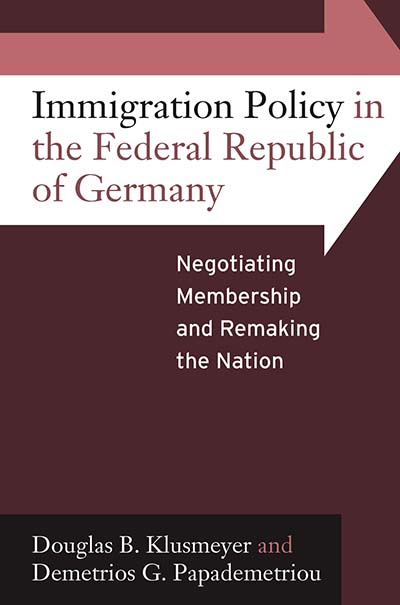
Immigration Policy in the Federal Republic of Germany
Negotiating Membership and Remaking the Nation
Douglas B. Klusmeyer and Demetrios G. Papademetriou
336 pages, 17 tables, bibliog., index
ISBN 978-1-84545-611-5 $145.00/£107.00 / Hb / Published (November 2009)
ISBN 978-0-85745-625-0 $34.95/£27.95 / Pb / Published (May 2013)
eISBN 978-1-84545-969-7 eBook
Reviews
“To produce a book as thorough and useful as this one represents a major achievement. Anyone wanting an introduction to immigration in the Federal Republic should start with Klusmeyer and Papademetriou.” · European History Quarterly
“By providing an up-to-date account, this book fills a need and should be of interest to scholars, policy researchers, and students… I recommend this book as a very helpful overview of a policy area that has changed rapidly.” · German Studies Review
“The authors are two of the most innovative and refreshing thinkers on migration and integration policy worldwide. What makes this book extraordinary is its nuanced evaluation of historical and contemporary migration policies, including all the ambivalence and contradictions that have accompanied these policy debates in Germany. The book also distills the positive paradigm of change that has recently emerged; it identifies new opportunities and unsolved challenges in German migration and integration policies. With this book, the authors have made a timely and very important contribution to understanding the root causes and key challenges to immigration reform in the Federal Republic of Germany.” · Rita Süssmuth, Chair of the EU High Level Group on “Social Integration of Ethnic Minorities and their full Participation in the Labor Market,” former Chair of Germany’s Independent Immigration Commission, and former President of the German Federal Parliament.
"...[T]he most authoritative and comprehensive study ever written on German immigration, citizenship and asylum policies. It offers a fresh view on well and less well known facts interpreted and put into perspective by two well known scholars of international migration policy." · Rainer Münz, Senior Fellow at the Hamburg Institute of International Economics
“This masterful, comprehensive, and incisive book lets us know how the largest and richest country in Europe has struggled to balance its commitment to its national character with the inevitability of migration-driven change. It is the definitive analysis of this vexing policy arena in Germany.” · John Mollenkopf, Director, Center for Urban Research & Distinguished Professor, Political Science and Sociology, CUNY
“This is a very timely and important book, and will provide immigration scholars on both sides of the Atlantic a clear understanding of developments related to immigration and integration policy in Germany. The authors’ pragmatic and critical approach addresses the years that Germany spent in denial of its status as a country of immigration and the impact this had on policy development. Germany is a key player in the European Union, and developments there will deeply impact developments related to immigration policy at the EU level.” · Terri E. Givens, Associate Professor, University of Texas at Austin
Description
German migration policy now stands at a major crossroad, caught between a fifty-year history of missed opportunities and serious new challenges. Focusing on these new challenges that German policy makers face, the authors, both internationally recognized in this field, use historical argument, theoretical analysis, and empirical evaluation to advance a more nuanced understanding of recent initiatives and the implications of these initiatives. Their approach combines both synthesis and original research in a presentation that is not only accessible to the general educated reader but also addresses the concerns of academic scholars and policy analysts. This important volume offers a comprehensive and critical examination of the history of German migration law and policy from the Federal Republic’s inception in 1949 to the present.
Douglas B. Klusmeyer teaches in the Department of Justice, Law and Society in the School of Public Affairs at American University, Washington, DC. He has both a PhD in modern European history and a JD in law from Stanford University. Previously, he was the codirector of the Carnegie Endowment’s Comparative Citizenship Project and an associate with the Endowment’s International Migration Policy Program. His publications focus on migration, citizenship, political ethics, and international politics.
Demetrios G. Papademetriou is President and Co-Founder of the Migration Policy Institute (MPI), a Washington-based think tank dedicated exclusively to the study of international migration. He is also President of Migration Policy Institute Europe, a nonprofit, independent research institute in Brussels that aims to promote a better understanding of migration trends and effects within Europe; and serves on MPI Europe’s Administrative Council. He is also the convener of the Transatlantic Council on Migration, which is composed of senior public figures, business leaders, and public intellectuals from Europe, the United States, and Canada. He also convenes and co-directs the Regional Migration Study Group, an MPI and Woodrow Wilson Center-convened initiative that in 2013 will propose new regional and collaborative approaches to migration, competitiveness, and human-capital development for the United States, Mexico and Central America.
Subject: History: 20th Century to PresentRefugee and Migration Studies
Area: Germany
Contents
Of Related Interest
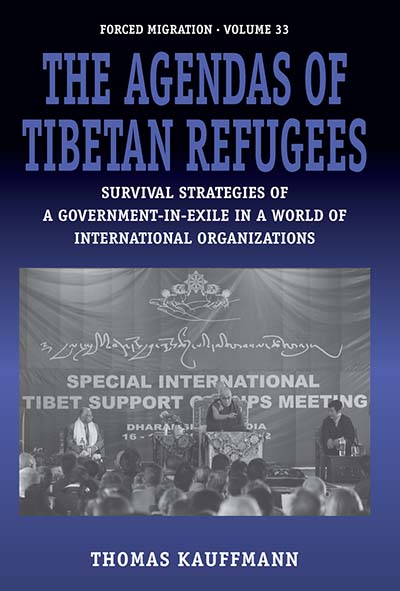
The Agendas of Tibetan Refugees
Survival Strategies of a Government-in-Exile in a World of International Organizations
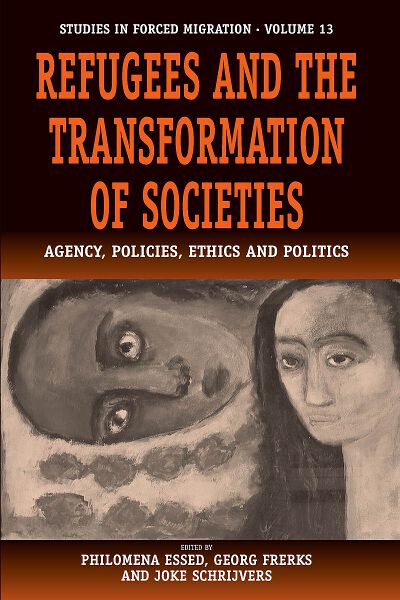
Refugees and the Transformation of Societies
Agency, Policies, Ethics and Politics

Turks in Europe
From Guest Worker to Transnational Citizen