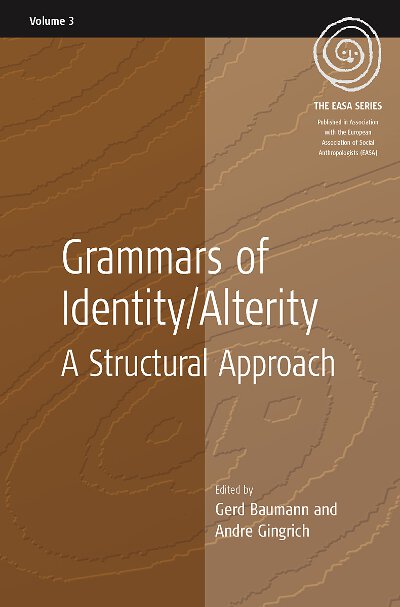
GRAMMARS OF IDENTITY / ALTERITY
A Structural Approach
Edited by Gerd Baumann and Andre Gingrich
| 240 pages, bibliog., index ISBN 978-1-84545-108-0 Pb $22.50/£13.50 Published ( 2005) ISBN 978-1-57181-698-6 Hb $39.95/£25.00 Published ( 2004) Buy now and get 15% off listed price |
All chapters available for download - see below.
“A short review cannot do justice to the richness of this, or to the problems posed by its analytical framework…This is a thought-provoking, problematic even troubling volume with many excellent chapters.” · The Journal of the Royal Anthropological Institute
"This book's strength is two-fold. First, as an edited volume it was delightfully cohesive, with each author considering the same set of basic questions, and utilizing the three grammars as a frame for examining identity in their various contexts...The second core strength for me is the fluid treatment of both structural and agentic aspects of identity...I found this a stimulating volume and think it has much to offer for readers interested in better understanding identity processes." · Anthropology and Education Quarterly
Issues of the construction of Self and Other, normally in the context of social exclusion of those perceived as different, have assumed a new urgency. This collection offers a fresh perspective on the ongoing debates on these questions in the social sciences and the humanities by focusing specifically on one theoretical proposition, namely, that the seemingly universal processes of identity formation and exclusion of the 'other' can be differentiated according to three modalities. All contributors directly engage with rigorous empirical testing and theoretical cross-examination of this proposition. Their results have direct implications not only for a more differentiated understanding of collective identities, but also for a better understanding of extreme collective violence and genocide.
Gerd Baumann is Reader in Social Anthropology at the Research Centre Religion & Society of the University of Amsterdam. Among his books are: National Integration and Local Integrity: The Miri of the Nuba Mountains in the Sudan (1986), Contesting Culture: Discourses of Identity in Multiethnic London (1996) and The Multicultural Riddle: Rethinking National, Ethnic and Religious Identities (1999).
Andre Gingrich is Professor for Social Anthropology at Vienna University and Member of the Austrian Academy of Sciences. His ethnographic field interests include the Muslim Middle East, but also Tibet and Austria. Having lectured and taught at SAR (Santa Fé), the University of Chicago, and other institutions in the US and Europe, his books include Anthropology by Comparison (2002, co-edited with R.G.Fox).
Related Link: European Association of Social-Anthropologists (EASA)
Series: Volume 3, EASA Series
Download chapters from this title
Table of Contents (Free download)
List_of_Figs (Free download)
Foreword (Free download)
Acknowledgements (Free download)
Conceptualising Identities
Anthropological Alternatives to Essentialising Difference and Moralizing about Othering
Andre Gingrich
From an anthropological perspective, debates on identity/alterity in the early twenty-first century face an increasingly clear dilemma. On the one hand, various notions of identity/alterity (or difference) inform vast segments and fields of the humanities and the social sciences. By consequence and at least partially as an adaptation and reaction to that situation, references to identity/ alterity (or difference) have proliferated in major anthropological works as well. In one way or another, these 'imports' from wider interdisciplinary fields inform a wide range of recent debates inside anthropology, primarily among junior scholars. On the other hand, a closer inspection of more established usages of these terms by senior anthropologists reveals sobering results. In a recent study, Boston-based Brazilian anthropologist Paulu Pinto (2002) examined a wide spectrum of such conventional usages by anthropologists and other social scientists. Although that spectrum includes works by authors such as Frederik Barth, Abner Cohen, and Pierre Bourdieu, Pinto concludes quite convincingly that in practice, the ensuing concepts of identity are few, and moreover, they do not relate well to debates outside anthropology, or for that matter sociology. Inside anthropology, such accumulated conceptual reflections and elaborations by senior scholars on 'identity/alterity' therefore are dispersed and somewhat isolated from wider debates and from their more recent 'import' into the field.
Price: $9
Download full chapter (PDF)
Grammars of Identity/Alterity
A Structural Approach
Gerd Baumann
This chapter will propose in more detail the three grammars of identity/alterity with which our volume is concerned.1 To do so as clearly as possible, it makes three moves. The first of these introduces each classificatory model on its own and then exemplifies the grammars as they are employed, often in competition with each other, in the realms of politics, religion, and aesthetics. Having affirmed that the grammars can be recognized in the most diverse social processes, the second and third moves ask two critical questions, one theoretical, the other primarily methodological. Theoretically, the three grammars must face what I have called 'the ternary challenge' as part of the age-old question whether classificatory structures are binary or ternary. I will propose that all three grammars are ternary, but each in its own way. This further increases the analytical potential of the grammars, but it also raises a methodological question. Since the grammars seem to work almost too well for comfort, the third move will face Karl Popper's (1972 [1935]) time-honoured question of falsification: if a proposition works well, then what are the criteria for it not working? The answer to this question will be sought in language and language use, or langue and parole to be precise, and it will address the question of violence. In particular, it will focus on genocidal violence, that is, killing the other at the cost of killing one's own former self. After this short guide through the argument, let me now return to where we are so far.
Price: $9
Download full chapter (PDF)
Othering the Scapegoat in Nepal
The Ritual of Ghantakarna
Michael Mühlich
This chapter will examine the role of scapegoats and the process of scapegoating in society. This role and process may be discerned in terms of the three grammars proposed in this volume, that is, orientalization, encompassment and the revitalization of segmentary social groups and interests. While these terms have their own history in anthropology, my usage will be interpretational, rather than strict in is application.1 I will primarily focus on a ritual in Nepal, namely the Ghantakarna ritual held at the peak of the monsoon season by Newars of the Kathmandu Valley. The term scapegoat needs, however, to be defined more exactly if we are to succeed in gaining a global view on a subject which may and should give rise to opposing views, touching as it does on hierarchy and its encompassment in one type of society and on marginalisation in others.
Price: $9
Download full chapter (PDF)
German Grammars of Identity/Alterity
A Diachronic View
Anne Friederike Müller
This chapter attempts to answer two questions. First, it sets out to test whether the three grammars of selfing and othering can be used to grasp changes over time in the constitution of collective identities. In this vein, I propose to combine the synchronic structuralist view of the grammars with a diachronic approach. Second, this chapter is concerned with an ethical and political assessment of these three structural models. What is it that makes some grammars more or less peaceful or aggressive than other grammars?
Price: $9
Download full chapter (PDF)
Alterity as Celebration, Alterity as Threat
A Comparison of Grammars between Brazil and Denmark
Inger Sjørslev
This contribution will explore mechanisms of cultural denigration and social
exclusion. To this purpose, I shall try out the grammars within two national
contexts, those of Brazil and Denmark. The main advantage of the grammars
appears to lie in enabling a better understanding of the processes that
create exclusion, intolerance, new forms of racism, and ultimately conflict
and violence.
My choice of Brazil and Denmark might indicate that I want to compare
incomparable units or even units that cannot be clearly defined: after all, who
believes in uniform national characters (Neiburg and Goldman 1997)? I propose,
however, that it is possible to identify certain cultural models,
metaphors and conceptions of collective selfing that characterize dominant
ideas in the two countries respectively. I also think it is important to improve
our tools for understanding how identity politics and cultural politics work
in relation to ideas about rights and citizenship, and what consequences such
ideas may have in terms of inclusion or exclusion and unequal treatment. The
aim in comparing the two countries is thus to sharpen our analytic tools to
understand some of the concrete actions and practices we find in each.
Price: $9
Download full chapter (PDF)
Completing or Competing?
Contexts of Hmong Selfing/Othering in Laos
Christian Postert
In contemporary highland Laos, Hmong identity is a contested topic. Various observers attest to the presence of a marked consciousness of a Hmong self being different from all other ethnic groups. The idea is that the Hmong denial of foreign rule, their uncompromising desire for liberty, and a certain martial spirit drove and still drive them time and again into violent conflicts with the hegemonic powers in their respective regions of settlement. Such instances occurred between 1855 and 1872 in China, in 1911 in colonial French- Indochina, again between 1918 and 1921 in China and colonial French-Indochina, and in 1960 and 1967/68 in Northern Thailand (Tapp 1989: 18, 35-37, 78, 98, 140). In Laos, Hmong identity construction is still deeply affected by the aftermath of the Vietnam War. The majority of the Laotian Hmong fought for the American side, and only a minority fought for the Socialist Pathet Lao. This placed all of them in the limelight of suspicion by the later Socialist government. Although today most Hmong villagers tend to comply with the demands of the Laotian nation-state, guerrilla activities carried out in present-day Laos are still perceived to be mainly Hmong-backed. In a situation of great power differentials, all Hmong villagers experience a heightened pressure of integration into a transethnic national polity. What does this mean for the feasibility of discourses about Hmong identity in Laos?
Price: $9
Download full chapter (PDF)
'Out of the Race'
The Poiesis of Genocide in Mass Media Discourses in Côte d'Ivoire
Karel Arnaut
On 26 October 2000, Laurent Gbagbo, leader of the Socialist Party FPI claimed victory over General Robert Guéï in the Ivorian presidential elections. 1 One day later, some fifty-seven corpses, mostly of young men, were discovered in a mass-grave in the suburb Yopougon of the capital Abidjan. Many hundreds of civilians, protesters, militants of different political parties, and security forces were killed in street violence over the following days. It was, however, the mass-grave that caught international attention. The United Nations established a Commission of Enquiry that identified the perpetrators as members of the security forces and their henchmen as civilians, some of them militants of the victorious Socialist Party FPI (United Nations 2001: 17). Most prominent among the executioners, the report said, were state policemen (gendarmes) who wanted to take vengeance for the killing of one of their commanding officers. The policemen had attributed this murder, as well as other aggressions in Abidjan, to militant members of the Republican Party RDR (Rassemblement des Républicains) who had been massively contesting the presidential elections because their leader, Alassane Ouattara, had been excluded from standing as a candidate.
Price: $9
Download full chapter (PDF)
Dehumanization as a Double-Edged Sword
From Boot-Camp Animals to Killing Machines
Jojada Verrips
If you ladies leave my island, if you survive recruit training, you will be a weapon, you will be a minister of death, praying for war. And proud. Until that day you are pukes, you are scumbags, you are the lowest term of life on earth. You are not even human. You people are nothing but a lot of little pieces of amphibian shit. (Senior Drill Instructor Gunnery Sgt. Hartman in Full Metal Jacket)In introducing the grammars of identity/alterity based on orientalization, segmentation and encompassment, Baumann has raised the question of which circumstances would have to arise for the three grammars to cease to work. He proposed this would happen if they were made to 'implode' by 'a corruption of language' which would 'reduce the complexity of each grammar to the blatancy of an unmitigated binarism: "us good, they bad"'. 'It is when language makes the grammars implode,' so he argues, 'that unmitigated binarism helps violence explode'. I want to expand on this argument by showing that such an implosion might be accompanied at the same time by at least a temporary humiliation and dehumanization — for instance, through the use of a similar kind of invective language — of exactly those men or women who are to fight or destroy the others represented as 'bad', 'disgusting' and therefore 'destroyable'. In other words, I want to make clear that negative ways of classifying and labeling people may not only lead to radical exclusion, elimination or extermination, but may also lead to radical inclusion in particular social groups. Invective and dehumanizing language seems to be a double- edged sword. Dehumanization not only leads to the most violent exclusion of the other, but it is also a means toward the most violent inclusion of selves into an overpowering 'us'.
Price: $9
Download full chapter (PDF)
Between Structure and Agency
From the langue of Hindutva Identity Construction to the parole of Lived Experience
Christian Karner
A synchronic bias and the reductionist treatment of cultural meaning as epiphenomenal to structure may be the most commonly identified flaws in the structuralist paradigm (see Champagne 1990; Craib 1992; Douglas 1976; Wilden 1972). In this chapter I take two further limitations of the Lévi- Straussian framework, which are particularly relevant to the study of identity formation or negotiation, as my conceptual starting points: firstly, the assumption that an entire discourse may be reducible to a single grammar of identity reflected in terms such as 'cultural principle of order' (Descola 1992) or 'structural equation' or 'logic' (Kunin 1995, 1998). Secondly, I will challenge the common structuralist overemphasis on the deterministic power of 'system' (or langue in the Saussurian terminology) through a complementary analysis of individual social actors' reception, decoding or — as it will turn out — selective and contextual appropriation of a discourse constructing a particular Hindu 'self' and its various 'others'. In doing so, I will complement other contributions to this book that similarly draw attention to ideological struggles over classificatory grids. Agency, resistance, and (individual) parole are thus reintroduced into the discussion of self/other relations and their underlying cognitive patterns.
Price: $9
Download full chapter (PDF)
Encompassment and its Discontents
The Rmeet and the Lowland Lao
Guido Sprenger
This chapter explores certain features of Baumann's three grammars of alterity/ identity and relates them to their consequences in social practice. The argument expands in two ways: first, certain features are derived from the structure of each grammar which are not explicitly mentioned by Baumann. The validity of the grammars as theoretical models is tested by linking these features to ethnographic data from Northern Laos. The central question to be asked, both of the models as theoretical abstractions and of the data to be analysed, is: how much and what kind of dialogue is made possible by each grammar?
Price: $9
Download full chapter (PDF)
Debating Grammars
Arguments and Prospects
Gerd Baumann and Andre Gingrich
The cross-examination of the three grammars has exemplified an analytic approach pragmatically based on a 'weak' rather than an essentialised conception of identity/alterity. Identity and alterity were seen as mutually constitutive. The project, conducted in a dialogical manner, has traced four steps of enquiry. The first step proceeded from a critique of essentialist and moralist ideas of identity and othering to a differentiation of the three grammars. As these grammars are articulated in social interactions, they inevitably involve dimensions of hegemony, hierarchy and power, and thus the second step has analysed these in ethnographic studies and comparisons. When hierarchy and power are expressed by physical force, one comes up against the limitations imposed on the use of the grammars. Violence, so it was argued in the third step, not only limits the use of the grammars, but its inherent delegitimization of grammatical otherings in turn furthers the rule of anti-grammatical otherings. Our last angle of enquiry, the fourth step, has attempted to widen the debate by revisiting the problem of structure versus agency and by questioning the relationship between grammatical and antigrammatical otherings. In taking these four steps, we have suggested answers to some questions and tried to reformulate others.
Price: $9
Download full chapter (PDF)
Contributors (Free download)
Index_Name (Free download)
Index_Subject (Free download)