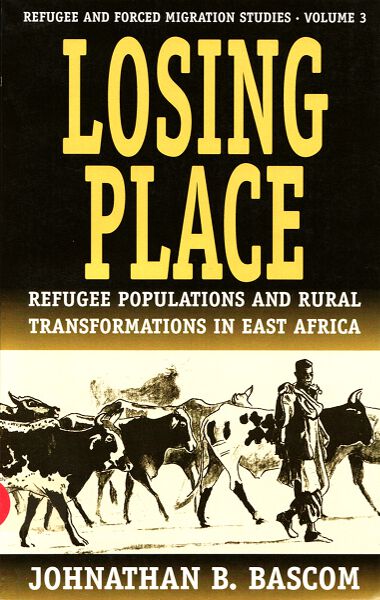
LOSING PLACE
Refugee Populations and Rural Transformations in East Africa
By Jonathan B. Bascom
| 224 pages, 9 maps, 5 tables, 7 graphs, 7 ills, glossary, bibliog., index ISBN 978-1-57181-830-0 Pb $22.50/£15.00 Published ( 2001) ISBN 978-1-57181-083-0 Hb $90.00/£50.00 Published ( 2001) Buy now and get 15% off listed price |
All chapters available for download - see below.
"Very useful, both for its analysis and for its historical detail." · International Migration Review
"A very good piece of work ... a major contribution to understanding the impact of new economic environments upon the economic and social survival of refugees ..." · Elizabeth Colson, University of California, Berkeley
"[Bascom's] work is of the highest quality, representing an exemplary geographical approach to a phenomenon and its associated problems." · W.T.S. Gould, Graduate School of Population Studies, University of Liverpool
"Dr. Bascom is an outstanding scholar whose research is on the cutting edge of integrating population, economic, regional, cultural, agricultural, and political geographies." · William B.Wood, Director, Office of the Geographer and Global Issues
Refugee flight, settlement, and repatriation are not static, self-contained, or singular events. Instead, they are three stages of an ongoing process made and mirrored in the lives of real people. For that reason, there is an evident need for historical and longitudinal studies of refugee populations that rise above description and trace the process of social transformation during the "full circle" of flight resettlement, and return home. This book probes the economic forces and social processes responsible for shaping the everyday existence for refugees as they move through exile.Jonathan Bascom is Associate Professor in the Department of Geography at East Carolina University.
Series: Volume 3, Forced Migration
Download chapters from this title
Table of Contents (Free download)
List_of_Maps_Figures_and_Tables (Free download)
Preface (Free download)
Abbreviations (Free download)
Acknowledgments (Free download)
Credits (Free download)
Introduction (Free download)
Refugees and Rural Transformation
Introducion
To where are refugees forced to flee in East Africa? The vast majority resettle in areas adjacent to their homeland along borders of neighboring countries (see Map 2.1). The geography of these mass movements is important in many different respects, but especially so for the participants themselves. They must establish a new livelihood in the country to which they move. Successes and failures hinge on the social and economic formations that exist in the host country, which may be substantially different from their homeland. Many refugees, for example, have left kin-driven "production systems" or "lifeways" and then resettled in an economy where their sources of livelihood are conditioned by a global system of production that is far more competitive and capitalistic.1 The spatial pattern of development remains highly uneven throughout East Africa where the commodification of the peasant economy may vary widely within a given country as well as on either side of a border between nations.
The economic landscape that refugees encounter includes peaks of development and valleys of underdevelopment. For these reasons the everyday existence of refugees in East Africa can be understood best by conceptualizing the prevailing character of the social and economic landscape across which they are forced to move.
This chapter surveys the historical process of rural transformation in East Africa with an emphasis on its spatial distribution vis-á-vis the predominant zones of refugee concentration. Establishing a sense of the "bigger" picture may lie beyond the immediate "refugee horizon," but it is fundamental. Analyses fall short if they overlook the larger process of rural transformation and its impact upon refugee migration and resettlement. Hence, the goal of this chapter is to build an historical map of the changing rural landscape, paying special attention to the regions that host large refugee influxes. Because colonialism established the main contours of the contemporary political economy, that era is the logical point in time at which to begin.
Price: $9
Download full chapter (PDF)
Migration and Agrarian Change on Border Lands
Introducion
The border region of eastern Sudan has been home to the longest refugee concentration in East Africa. The Eritrean exodus began on 5 March 1967. Men, women, and children began arriving in Kassala, a Sudanese town bordering Ethiopia's northern province. By June, the number of refugees grew to 25,503, prompting the United Nations to begin providing protection and assistance.1 By 1990, more than half a million people had sought refuge in Sudan (one in every seven Eritreans). Despite the Eritrean war's end in May 1991 and national independence two years thereafter, 320,000 Eritreans remain in eastern Sudan as of late 1998.
This chapter introduces readers to the Eritrean refugee population, their preflight socioeconomic context, and the changing nature of the Sudanese economy into which they moved. It begins with causes for forced migration. In addition to highlighting the variable conditions under which different portions of the population left Eritrea, this section of the chapter explores the prevailing social and economic relationships in the principal region of origination. Familiarity with their preflight environment enhances our understanding of the changes that refugees have experienced in Sudan. The later portion of the chapter focuses on rural transformation in Sudan, a process that deeply and increasingly defines the everyday existence of refugees during asylum.
Price: $9
Download full chapter (PDF)
Integration and the Cultivation of a Hard Life
Introducion
In the late 1930s, a group of Sudanese immigrated across the Atbara River and founded a new settlement fifty kilometers from the Ethiopian border.1 The village name, Wad el Hileau or "Son of the Sweet," was chosen either to honor the place from which they came (Es Sufi) or the "sweet" environment afforded by the waters of the nearby Setit River. This rural village would become home to the largest concentration of unassisted refugees in eastern Sudan. Its sixty-year story provides an ideal window through which to see interwoven dynamics between refugees and rural transformation. This chapter has several parts. The first half focuses on Wad el Hileau's attractiveness as a site for incoming refugees to settle and for wealthy Sudanese to appropriate large chunks of land (and cheap labor) for rainfed schemes. The latter half of the chapter is concerned with state support for the expansion of rainfed schemes and the commodification of refugee labor. It gives special attention to wage labor and concomitant opportunities for reaping substantial profits.
Price: $9
Download full chapter (PDF)
Resettlement and Positions of Poverty
Introducion
Changing class relationships among refugees are some of the rural transformation's effect on refugee populations. Using Wad el Hileau as an illustration, this chapter explores the existence of social stratification among rural refugees. The analysis exposes the underlying mechanisms of immiseration and accumulation that create and perpetuate social differentiation. Such mechanisms are influential and powerful. They play a large role in determining the strategies that unassisted refugees adopt to secure household sufficiency. They dictate the proportion of households in different locations within the agrarian class structure, and they have begun to fragment the refugee household as a self-contained unit of production.
The evidence presented in this chapter provides a broader explanation for why poverty is so endemic among refugees. The first section introduces the positions that refugees at Wad el Hileau occupy in the social relationships of agricultural production and market exchange. The next sections examine five mechanisms that create and mediate social differentiation. The last section highlights environmental factors that are likely to accentuate the process of class differentiation even further in the future.
Price: $9
Download full chapter (PDF)
Exile and the Perils of Pastoralism
Introducion
An unprecedented number of pastoralists have moved into the eastern region of Sudan having fled the protracted conflict in Eritrea. Most of them attempted to bring their livestock across the border. Their arrival, coupled with the massive expansion of mechanized agriculture in the same region, has accelerated conflict over land resources, particularly along the border. This chapter identifies pressures that are bringing refugee herds to the point of extinction, thereby jeopardizing pastoralism as a way of life for these refugees. We will start by highlighting the logic of production among pastoralists before they left Eritrea.
Price: $9
Download full chapter (PDF)
Asylum and the Making of Home Terrain
Introducion
This chapter moves down in scale to the "terrain" within refugee homes. It focuses on changes in the constitution of refugee households and the life experiences of exiles, many of which are amplified or accelerated by the process of rural transformation at the resettlement site. In so doing, this chapter is largely concerned with age and gender relationships. Refugee women and children are often over-looked, despite the fact that they constitute 80 percent of the world's uprooted people. Our understanding is weakest for those who reside outside official camps or settlements.1 Unassisted women and children, however, are the focus of the analysis to follow. Forty such individuals living in Wad el Hileau provide the primary data for this chapter. (The sub-sample was comprised of fifteen married women, five single women and five single men between eighteen and twenty-five years of age, and fifteen children between the ages of ten and seventeen.)2 These refugee women and children supplied important narrative statements as well as more discrete kinds of data related to sources of income, financial expenditures, time allocation and travel patterns.3 Their experiences, core relationships and narrative explanations are keys to a clearer understanding of the dynamics within refugee households.
Price: $9
Download full chapter (PDF)
Repatriation and the Search for Home
Introducion
The 1990s have been proclaimed "the decade of repatriation." While legal, financial and logistical impediments to repatriation are important, too often the perspective of refugees themselves, is overlooked. This chapter examines refugees' motivation and logic for repatriation, recognizing that the decision usually involves a combination of motivations, intentions, perceptions, conditions, and expectations. The experiences of exiled Eritreans living in Wad el Hileau provides the basis for analysis. In doing so, the central focus of this book, the relationship between refugees and rural transformation, resurfaces. Not only does it play a prominent role in determining the prospects for repatriation, but it affects the process by which refugees reach a decision and influences the prospects of success upon reintegration in the homeland.
Price: $9
Download full chapter (PDF)
Concluding Reflections
Introducion
For us, the poor, there is no action, / But only to wait and to witness.
T. S. Eliot, Murder in the Cathedral
By the time the fool has learned the game, the players have dispersed.
African Proverb
We now turn to the implications of the analysis presented in the preceding chapters. This concluding chapter has three sections. The first one summarizes the findings presented in this study. The second portion suggests the implications of those findings for future studies of refugees. And the third section suggests their applications for refugee policy.
Price: $9
Download full chapter (PDF)
Bibliog (Free download)
Census_of_Wad_el_Hileau (Free download)
Glossary (Free download)